


I've got a question for anyone investing in Zero Trust: What happens after you grant access?
Not who authenticated. Not whether the device passed a check. Not whether policy allowed the connection. Those are important questions, and we should absolutely keep asking them. I'm asking a different one. Once a trusted user, device, or AI agent is inside an approved session, how do you know that trust is still deserved?
Because that's where a lot of modern attacks live. Not outside the front door, trying to smash their way in. Inside legitimate access paths, using credentials, applications, and services the business already trusts.
Access is a decision. Trust is a moving target.
Continuous evaluation is already a Zero Trust principle. The challenge is putting it into practice by connecting access decisions with evidence of attacker behavior throughout the session. Netskope does something essential. It helps organizations make and enforce context-aware access decisions across web, SaaS, cloud, and private applications. That control matters.
But a correct access decision at 9:00 a.m. doesn't guarantee legitimate behavior at 9:05.
A session can be authorized and still be abused. An identity can authenticate successfully and still be compromised. An approved application can carry command-and-control activity. A connection can be encrypted and still be part of an attack.
None of that means Zero Trust failed. It means we sometimes ask access controls to answer a question they weren't designed to answer. Access policy tells us whether a connection should be allowed. It doesn't, by itself, tell us whether everything happening through that connection continues to make sense.
That second question is behavioral. And behavior changes.
The attacker sees one environment. Why doesn't the SOC?
Picture a remote employee with legitimate access to a SaaS application and an internal service. An attacker compromises the employee's identity. They log in through an approved path, explore available systems, use an unfamiliar service, and begin moving toward more valuable resources.
Each step may look ordinary when viewed alone. A successful login. An HTTPS connection. A cloud API request. A new destination.
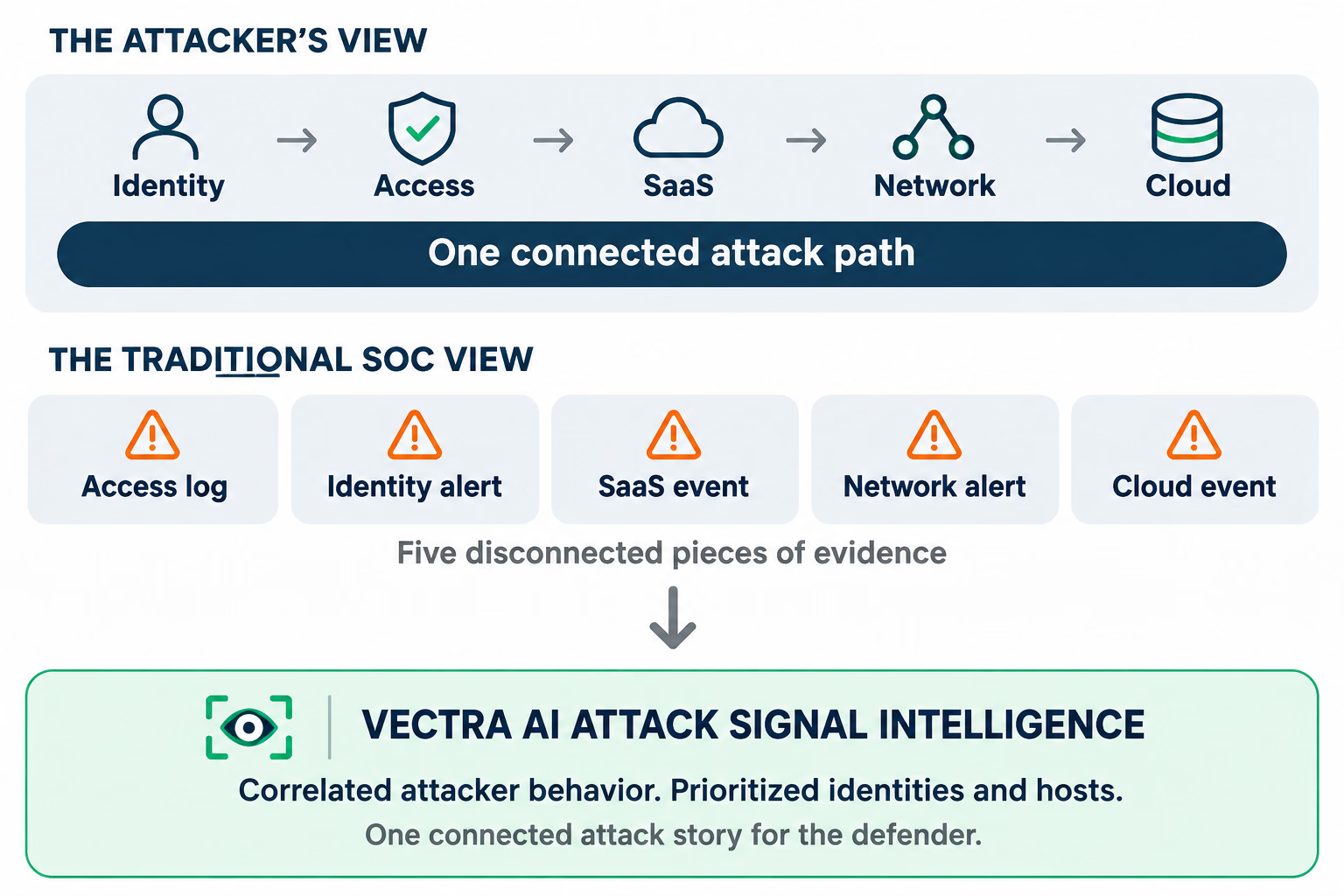
Now think about the analyst. Secure access has one piece of the story. Identity has another. Network detection has another. SaaS and cloud tools have the rest. The analyst becomes the integration layer, manually reconstructing what happened while the attacker keeps moving.
I call that getting attacker soundbites when what we need is the attack story. I'm less interested in alert counts than in how quickly defenders can answer three questions: Is this real? Does it matter? What do we do next?
What Netskope and Vectra AI change together
This is why the Netskope and Vectra AI integration matters to me. It's not about putting two logos next to each other or adding another feed to a SOC dashboard. It's about connecting the access decision to what attackers actually do after access is granted.
Netskope brings the secure access context and control. Vectra AI brings AI-native behavioral detection and Attack Signal Intelligence to identify suspicious activity, connect related behaviors, and prioritize the identities and hosts that warrant investigation.
With Netskope Cloud TAP, policy-selected web traffic traversing Netskope infrastructure can be copied into customer-managed cloud object storage. Netskope Stitcher retrieves and replays that traffic to a dedicated Vectra virtual sensor. The sensor processes it and sends enriched metadata to the Vectra platform for analysis. The integration can also associate observed remote-user activity with the corresponding Netskope user identity.
Why does that matter? Because Vectra AI's behavioral analytics can look for attacker signals in that traffic without requiring payload decryption. That includes the kinds of suspicious patterns attackers try to conceal inside otherwise routine, encrypted communications. That observation can then be assessed alongside behavior from other connected network, identity, cloud, and SaaS sources.
There is also a path back.
Through the Netskope Cloud Threat Exchange integration, selected indicators of compromise (IoCs), such as IP addresses and domains derived from Vectra AI detections, can be shared with Netskope, where configured policies can use them for enforcement.
Observe. Understand. Prioritize. Act. That's the workflow. The technology should make it easier, not make analysts learn another alphabet soup of consoles.
What continuous threat detection means for the defender
Start with the compromised remote user. The question isn't simply whether Netskope allowed the session. It should have, based on the information available at that moment. The question is whether subsequent behavior starts looking like reconnaissance, command and control, credential abuse, lateral movement, or other signs of attack progression.
And consider the SOC team's day. If analysts have to stitch access logs, network evidence, identity events, and cloud alerts together by hand, they're spending scarce time assembling context instead of making decisions. Correlated, prioritized attacker behavior gives them a place to start and a clearer reason to act.
This isn't a claim that one integration magically sees every packet or stops every attack. Cloud TAP coverage depends on the traffic Netskope captures and the deployment choices customers make. Nor is behavioral detection a replacement for secure access, endpoint protection, or policy enforcement. These controls do different jobs. The point is to make those jobs reinforce one another.
Make Zero Trust continuous
Here's my takeaway: A Zero Trust architecture has to support continuous evaluation long after a session is approved.
People, devices, workloads, service accounts, and AI agents all operate through trusted connections. Some will be compromised or misused. Attackers will keep making malicious activity resemble business as usual.
We can't solve that by denying every connection. We also can't solve it by trusting every connection forever.
We have to secure access and use continuous monitoring to assess the behavior that follows. Netskope helps determine who or what gets access to which applications and data. Vectra AI helps defenders recognize when activity after access starts telling an attacker story, then decide what deserves attention.
That's the opportunity I see in Netskope and Vectra AI together: less blind trust, fewer disconnected soundbites, faster clarity for the people defending the business.
Because getting through the door shouldn't give an attacker the benefit of the doubt for the rest of the day.
Secure access. Continuous attack defense. That's how Zero Trust becomes more than an access decision.