The EDR market reached $5.10 billion in 2025, with 66% of organizations now deploying AI-powered solutions for autonomous threat response (Mordor Intelligence, 2025).
72% of successful ransomware attacks in 2025 involve endpoint compromise, making endpoint protection essential for preventing breaches that average $4.45 million (Ponemon Institute, 2024).
Organizations using EDR report 82% faster threat detection and an 85% reduction in false positives compared to traditional rule-based approaches (Vectra AI, 2025).
Endpoint detection and response (EDR) is a cybersecurity technology that continuously monitors endpoint devices to detect, investigate, and respond to advanced threats through behavioral analytics and automated containment capabilities. Unlike traditional antivirus software that relies on signature-based detection, EDR analyzes patterns of behavior across endpoints to identify sophisticated attacks including fileless malware, zero-day exploits, and living-off-the-land techniques that evade conventional security controls.
As ransomware attacks surge 36% year-over-year and the average data breach now costs organizations $4.45 million, the traditional approach of relying solely on prevention-based security tools has reached its breaking point (IBM, 2024). EDR addresses this gap by providing continuous visibility into endpoint activities, enabling security teams to detect threats that bypass perimeter defenses and respond before damage occurs.
This guide explains how EDR works, what differentiates it from antivirus, XDR, MDR, NDR, and SIEM, and how to evaluate and implement EDR solutions effectively. Whether you are a CISO building a business case for EDR, a SOC analyst comparing platforms, or a security architect designing detection coverage, this page covers the technical, operational, and strategic dimensions of endpoint detection and response.
Why organizations need EDR
Prevention-based security alone cannot stop modern attacks. Antivirus and endpoint protection platforms block known malware using signature databases, but they fail against zero-day exploits, fileless attacks, polymorphic malware, and living-off-the-land techniques that use legitimate system tools. EDR assumes that some threats will evade prevention and provides the detection, investigation, and response capabilities needed to contain them before they cause damage.
The attack surface has expanded dramatically. Remote and hybrid work patterns mean endpoints now connect from networks organizations do not control. BYOD policies multiply the number and diversity of devices requiring protection. Cloud workloads create new endpoint categories that traditional security tools were not designed to monitor. Web-based delivery vectors, includingSEO poisoning campaigns that redirect users to malicious download pages through manipulated search results, further expand the exposure surface that endpoint agents must cover. Every unprotected endpoint represents a potential entry point for attackers.
Attacker dwell time remains dangerously high. Without continuous endpoint monitoring,security hackers and ransomware operators can remain inside networks for weeks or months, establishing persistence, escalating privileges, and exfiltrating data before detection.
Regulatory requirements now mandate EDR deployment across critical sectors. Executive Order 14028 requires federal civilian agencies to implement EDR capabilities, with $1.5 billion allocated for federal EDR programs in fiscal year 2025. State mandates affect over 40,000 organizations across healthcare, financial services, and critical infrastructure. Organizations subject to these mandates must ensure continuous monitoring, centralized logging with 90-day retention, and integration with threat detection programs.
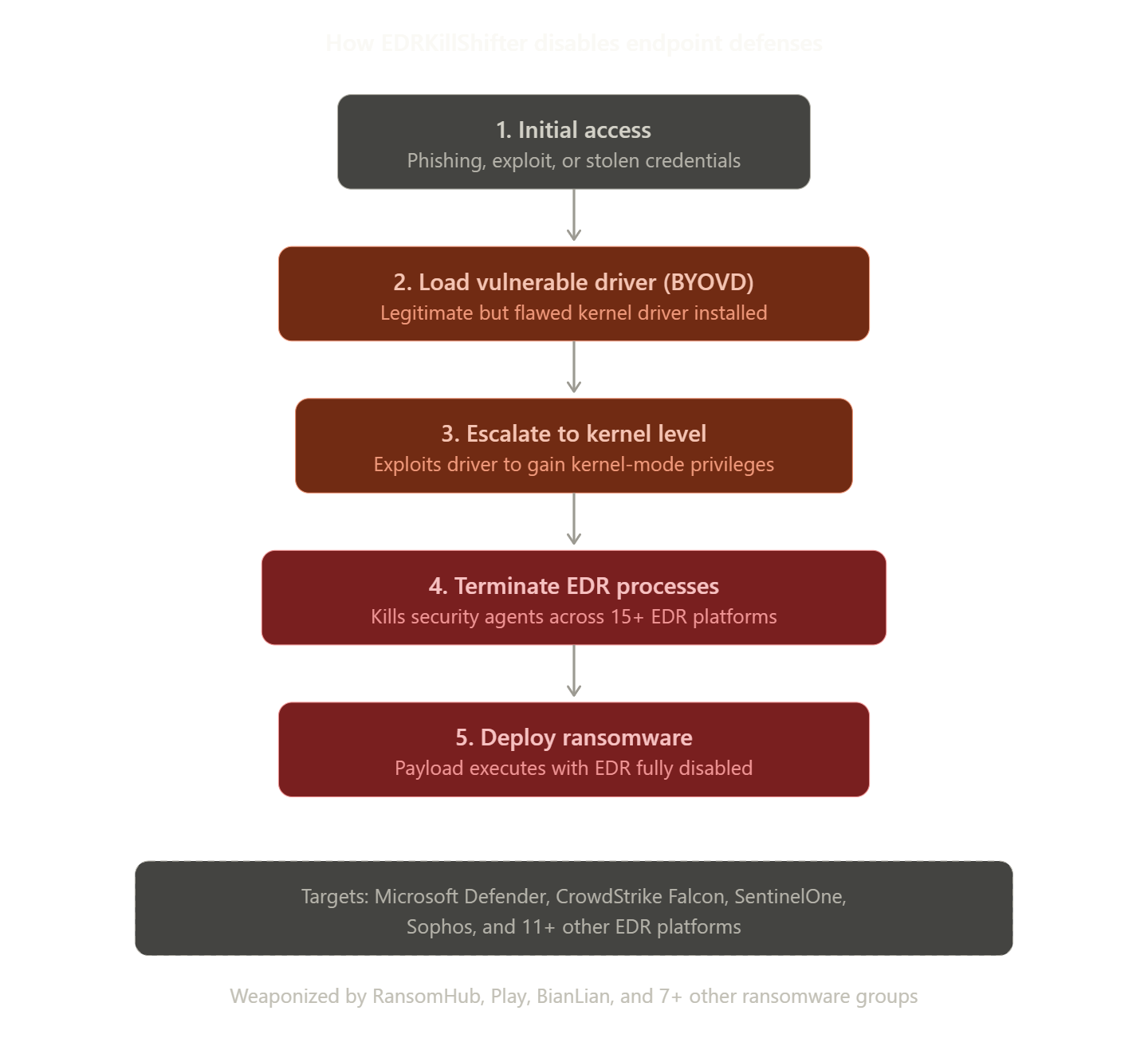
Sophisticated evasion techniques continue to escalate. Tools like EDRKillShifter, weaponized by over 10 major ransomware groups, use Bring Your Own Vulnerable Driver (BYOVD) techniques to terminate EDR processes before launching ransomware payloads. AI-powered behavioral mimicry generates malware that perfectly imitates legitimate application behavior, achieving 45% evasion rates against traditional EDR. These escalating tactics make behavioral detection and continuous monitoring not optional enhancements but fundamental requirements.
EDRKillShifter attack chain
How EDR works
EDR operates through a multi-stage workflow that begins with lightweight agents deployed across all endpoints in an organization’s environment. These agents continuously collect telemetry data about system activities, including process creation, file system changes, network connections, registry modifications, and user behaviors. This raw data streams to either a cloud-based or on-premises analytics platform where machine learning models and behavioral analysis engines process billions of events to identify potential threats.
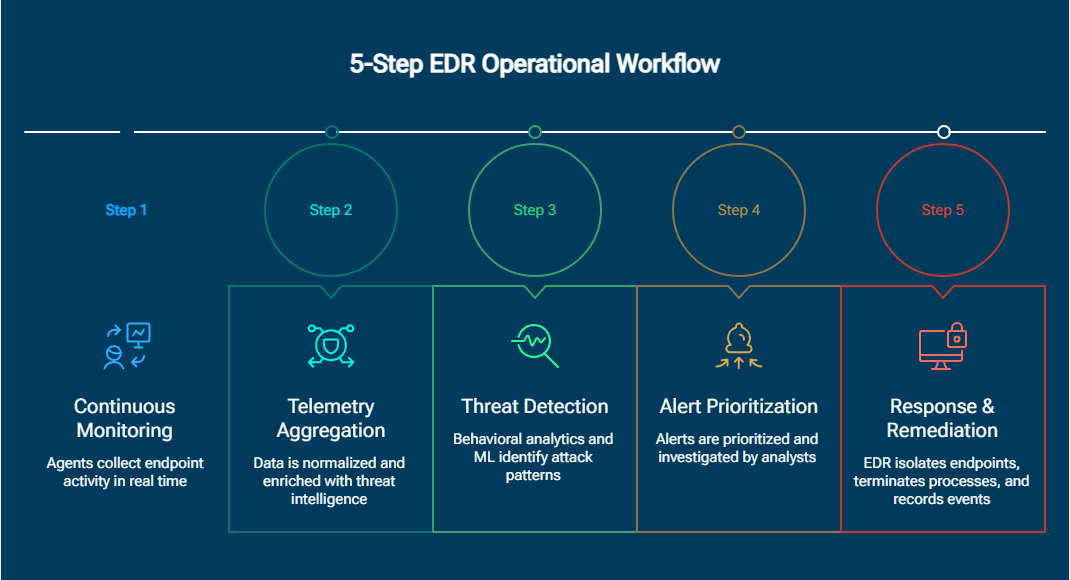
The EDR workflow process
The EDR workflow follows a five-stage operational model that balances automated detection with human investigation. Understanding each stage clarifies why EDR delivers fundamentally different outcomes than traditional security tools.
The EDR workflow process
Step 1 — Continuous monitoring and data collection
Software agents installed on each endpoint continuously log relevant activity: process execution, file modifications, network connections, registry changes, authentication events, and user behaviors. Devices with agents installed are called managed devices. This telemetry streams in real time to the EDR platform.
Step 2 — Telemetry aggregation and enrichment
Data ingested from each device is sent to the EDR solution, which can be cloud-based or on-premises. Event logs, authentication attempts, application usage, and other information are normalized and enriched with threat intelligence context.
Step 3 — Analysis and threat detection
The EDR solution applies behavioral analytics, machine learning, and correlation engines to identify indicators of attack (IOAs) that would otherwise be invisible. Unlike signature-based detection, behavioral analysis identifies attack patterns regardless of whether the specific malware or technique has been seen before.
Step 4 — Alert prioritization and investigation
EDR surfaces suspected threats and sends actionable alerts to the security team, prioritizing by severity, asset criticality, and correlation with threat intelligence. Analysts investigate using forensic timelines and contextual data to validate whether the alert represents a genuine threat.
Step 5 — Response, containment, and remediation
Depending on the trigger, the EDR system may automatically isolate an endpoint, terminate a malicious process, or quarantine a file. EDR technology keeps a forensic record of past events so security analysts can reconstruct attack chains and prevent recurrence.
EDR detection methodologies
EDR combines multiple detection techniques to identify threats that evade traditional security controls. While signature-based detection remains useful for known threats, modern EDR primarily relies on behavioral analytics to uncover suspicious activity.
These systems establish baselines of normal behavior for each endpoint and continuously monitor for deviations that may indicate malicious intent. Common behavioral signals include:
Unusual process relationships
Abnormal network traffic patterns
Suspicious file access or execution sequences
Machine learning enhances these capabilities by identifying patterns that are difficult for human analysts to detect. Advanced models analyze large volumes of malware samples and attack behaviors to recognize new variants and zero-day threats based on similarities to known techniques. Some platforms also incorporate natural language capabilities, allowing analysts to query threat data using conversational language and making threat hunting more accessible.
A key evolution in EDR is the shift from Indicators of Compromise (IOCs) to Indicators of Attack (IOAs). Instead of focusing only on known malicious artifacts, IOAs detect attacker behavior and intent, enabling detection even when tools or infrastructure change.
IOCs: Detect known artifacts (e.g., file hashes, IP addresses)
IOAs: Detect malicious behavior regardless of the tool used
For example, credential dumping can be identified whether an attacker uses Mimikatz, a PowerShell script, or a custom tool. By focusing on behavior rather than signatures alone, EDR provides stronger protection against both known and unknown threats.
Response and remediation capabilities
EDR response capabilities go beyond alerting, enabling immediate containment and remediation of active threats. When suspicious activity is detected, EDR can automatically isolate compromised endpoints from the network to prevent lateral movement while preserving forensic evidence for investigation. This isolation can be granular, blocking specific protocols or destinations without disrupting critical business operations.
Key response actions include:
Endpoint isolation: Contain compromised devices while maintaining visibility
Process termination: Stop malicious processes before damage occurs
File quarantine: Remove or contain suspicious files to prevent execution
These capabilities are especially critical in ransomware scenarios. EDR can detect malicious behavior early and terminate the process before encryption begins. Some advanced solutions also provide rollback capabilities, restoring affected files from shadow copies or backup mechanisms as a last line of defense.
EDR platforms also integrate with Security Orchestration, Automation, and Response (SOAR) systems to enable coordinated, automated workflows across the security stack. This allows organizations to respond to incidents quickly and consistently without relying on manual intervention.
Typical automated response workflows include:
Disabling compromised user accounts in Active Directory
Revoking VPN or remote access
Initiating forensic evidence collection
Creating incident tickets for tracking and response
By automating these actions, organizations can significantly reduce response times and improve overall incident handling efficiency.
Threat detection in practice
EDR demonstrates its value in real-world attacks where speed, trust, and stealth define attacker success. Whether dealing with ransomware, supply chain compromises, or insider threats, modern detection depends on identifying abnormal behavior rather than relying on known signatures alone. These threats often bypass traditional controls by using legitimate tools, trusted software, or authorized access.
Across these scenarios, EDR focuses on a consistent set of behavioral signals:
Abnormal process execution and relationships
Misuse of legitimate tools (e.g., PowerShell, admin utilities)
Unusual data access or transfer patterns
Deviations from normal user or application behavior
Ransomware highlights the importance of speed. Modern variants can encrypt entire environments in under an hour, but EDR can detect early indicators such as mass file modifications, shadow copy deletion, and suspicious encryption activity. This enables automated containment within milliseconds, often stopping the attack before encryption begins.
Supply chain attacks introduce a different challenge: Attackers operate through trusted software. Incidents like SolarWinds and Kaseya showed how legitimate applications can be weaponized at scale. EDR detects these threats by identifying when trusted applications behave abnormally, such as executing unexpected commands or accessing sensitive data outside normal patterns.
Insider threats rely on valid access, making them difficult to detect with traditional controls. EDR addresses this through behavioral baselining, identifying when users deviate from typical activity, such as accessing unusually large volumes of data or using administrative tools outside their normal role.
The table below summarizes how EDR detects and responds to these threat types based on behavior rather than trust.
Threat type
How the attack works
Key detection signals
EDR response outcome
Ransomware
Rapid file encryption across systems
Mass file changes, shadow copy deletion, encryption-related activity
Endpoint isolated, process terminated before encryption
Supply chain
Compromised trusted software used as an entry point
Legitimate apps executing unusual actions, abnormal data access patterns
Unusual data access volume, abnormal admin activity, data exfiltration patterns
Suspicious behavior flagged based on user baseline
AI and behavioral analytics in EDR
Artificial intelligence has transformed EDR from a reactive monitoring tool into a predictive security platform. Autonomous SOC operations now handle 85% of Tier 1 alerts without human intervention, using machine learning models trained on millions of security incidents to automatically triage, investigate, and respond to threats with accuracy rates exceeding human analysts.
Behavioral detection and MITRE ATT&CK alignment
The integration with the MITRE ATT&CK framework provides a standardized taxonomy for understanding and responding to threats. EDR solutions map detected behaviors to specific ATT&CK techniques across thecyber kill chain from initialreconnaissance through privilege escalation and data exfiltration, enabling security teams to understand an attacker's tactics, techniques, and procedures (TTPs) and predict their next moves. This framework integration also facilitates threat intelligence sharing between organizations and enables purple team exercises where defenders test their detection capabilities against known attack patterns.
Predictive threat modeling capabilities use machine learning to anticipate attack patterns before they materialize. By analyzing global threat intelligence, organizational vulnerabilities, and historical attack data, AI-powered EDR can predict which assets are most likely to be targeted and proactively strengthen defenses. For example, if a new ransomware variant begins targeting healthcare organizations on the East Coast, the system can automatically adjust detection rules and increase monitoring for similar organizations before attacks begin.
Managing false positives with AI
The challenge of false positives remains one of the most significant operational hurdles in EDR deployment, with 45% of all EDR alerts requiring manual validation according to 2024 industry data. This high false positive rate creates alert fatigue that can consume 30–50% of SOC analyst time, potentially causing genuine threats to be overlooked. Addressing this challenge requires a combination of proper tuning, baseline establishment, and intelligent automation.
Modern EDR platforms achieve a 97.3% detection accuracy with hybrid CNN-RNN models while reducing false positive rates to 0.8%, down from 45% with traditional rule-based approaches. Effective baseline establishment during the initial deployment phase, running in detect-only mode for at least 30 days, allows the system to learn normal behavior patterns for each environment. Alert prioritization algorithms consider the severity of detected behavior, the criticality of affected assets, the user’s role, and correlation with threat intelligence to focus attention on genuine threats.
Automation and orchestration capabilities further reduce the burden. Machine learning models learn from analyst feedback, automatically tuning detection rules based on which alerts are confirmed as false positives. SOAR integration enables automated enrichment and validation workflows that can verify alerts before they reach human analysts.
EDR and traditional antivirus take fundamentally different approaches to endpoint security. Antivirus operates on a prevention-first model, using signature databases to identify and block known malware before it can execute. This approach works well for commodity malware but fails against zero-day exploits, fileless attacks, polymorphic malware, and living-off-the-land techniques. EDR takes a detection-and-response approach, assuming some threats will evade prevention and providing the visibility and tools needed to identify and contain them.
The response capabilities further differentiate these technologies. When antivirus detects malware, it typically quarantines or deletes the file and logs the event. EDR provides comprehensive incident response capabilities including network isolation, process termination, and system remediation. EDR maintains detailed forensic records of all endpoint activities, enabling security teams to reconstruct attack chains, understand the full scope of compromise, and prevent similar attacks in the future.
Real-time monitoring represents another crucial distinction. While antivirus performs scheduled or on-access scans, EDR maintains persistent visibility into endpoint activities. This continuous monitoring enables detection of living-off-the-land attacks that abuse legitimate tools, insider threats, and advanced persistent threats that operate slowly to avoid detection. According to industry data, organizations using EDR detect threats 82% faster than those relying on antivirus alone, with mean time to detection dropping from days to hours or minutes.
The following table summarizes the key differences between EDR and traditional antivirus across the capabilities that matter most for security operations.
Full process timeline, attack chain reconstruction
Investigation support
Minimal
Deep forensic analysis, threat hunting, timeline reconstruction
False positive handling
Block or allow
Risk-scored prioritization with behavioral context
How does EDR compare to XDR?
Extended Detection and Response (XDR) expands detection capabilities beyond endpoints to encompass networks, cloud workloads, email, and identity systems. While EDR provides deep visibility into endpoint activities, XDR correlates telemetry across multiple security domains to detect sophisticated attacks that span different vectors. This unified approach addresses a critical limitation of EDR: the inability to see threats that do not directly touch endpoints.
The scope of visibility differentiates the two significantly. EDR focuses exclusively on endpoint telemetry, process execution, file system changes, and local network connections. XDR ingests and correlates data from endpoints, network traffic, cloud APIs, email gateways, and identity providers, creating a holistic view of the attack surface. This broader visibility enables detection of complex attack chains, such as phishing emails that lead to credential theft, followed by cloud account compromise and data exfiltration, a sequence that pure EDR might miss critical components of.
The migration path from EDR to XDR is accelerating, with market analysis indicating the XDR market has exceeded $4 billion in 2025. Major EDR vendors are expanding their platforms to include XDR capabilities, recognizing that endpoint-only visibility is insufficient for detecting modern attacks. Organizations implementing XDR report 40% reduction in operational overhead through consolidated workflows, unified investigations, and automated cross-domain responses.
How does EDR compare to MDR?
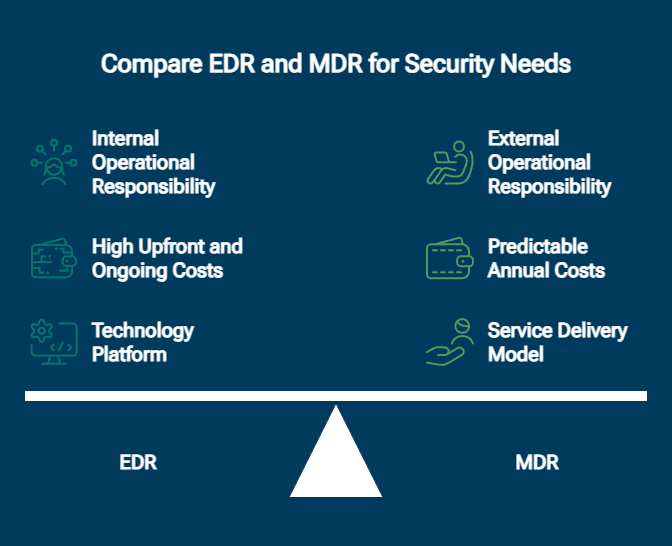
Managed Detection and Response (MDR) is a service delivery model rather than a technology. While EDR is a technology platform that organizations deploy and operate themselves, MDR combines technology with human expertise, delivering security outcomes rather than just tools. The fundamental distinction lies in operational responsibility: with EDR, organizations must hire, train, and retain security analysts to operate the platform; with MDR, the provider handles monitoring, investigation, and response.
Cost considerations differ significantly. EDR requires upfront licensing costs plus ongoing investments in staffing, training, and complementary security tools. Industry estimates suggest a 24/7 SOC requires a minimum of five full-time analysts plus management, totaling over $800,000 annually in personnel costs alone. MDR services typically cost $50,000–$250,000 annually depending on organization size, providing access to senior security experts and advanced tools that would be cost-prohibitive to maintain internally.
Many organizations use EDR as the underlying technology within an MDR service. The EDR platform provides the endpoint telemetry and detection capabilities, while the MDR provider’s analysts handle monitoring, investigation, and response. This approach is particularly valuable for organizations that lack the resources or expertise to operate a full SOC.
How does EDR compare to NDR?
Network Detection and Response (NDR) monitors network traffic flows and behavioral patterns to detect threats that move across the network, including between endpoints, cloud services, and unmanaged devices. While EDR provides deep visibility into what happens on individual managed endpoints, NDR sees how activity moves across the environment, detecting lateral movement, command-and-control communications, and data exfiltration at the network level.
The coverage model is fundamentally different. EDR requires agents installed on each device, which means unmanaged devices, IoT/OT systems, and BYOD endpoints often remain invisible. NDR monitors all traffic traversing the network regardless of whether devices have agents, providing visibility into the estimated 50% or more of enterprise devices that are unmanaged. This makes NDR essential for environments with significant IoT/OT footprints or where agent deployment is constrained.
EDR and NDR are strongest when integrated. EDR identifies what is happening on the endpoint; NDR identifies how threats move between endpoints and across the broader network. When an attacker uses legitimate credentials to move laterally between systems, traditional EDR might see only normal user activity on each individual endpoint. NDR detects the anomalous movement pattern across the network, revealing the attack’s scope and progression. Organizations that integrate EDR with NDR report 90% reduction in mean time to respond and 40% fewer security incidents reaching critical severity.
How does EDR compare to SIEM?
Security Information and Event Management (SIEM) and EDR serve complementary but distinct roles in the security architecture. SIEM platforms aggregate and correlate logs from across the IT environment, providing centralized visibility into security events from firewalls, servers, applications, and security tools. EDR focuses specifically on endpoint telemetry, providing deep visibility into endpoint behaviors that SIEM’s log-based approach might miss.
Detection capabilities vary based on data availability. SIEM excels at detecting attacks that generate log anomalies across multiple systems, such as brute force attacks, failed authentication events, or data exfiltration generating unusual network traffic patterns. EDR specializes in detecting endpoint-specific threats like fileless malware, process injection, and credential dumping that might not generate traditional log events. The most effective approach combines both technologies, with EDR feeding detailed endpoint telemetry into SIEM for correlation with other security events.
Integration between EDR and SIEM has become a critical success factor, with organizations reporting 90% faster incident response when these systems work together. EDR provides the detailed endpoint forensics needed to investigate alerts generated by SIEM correlation rules, while SIEM provides the broader context needed to understand the full scope of an attack.
The following table compares EDR against related security technologies across the dimensions that most impact detection and response outcomes. Understanding these differences helps organizations design a security architecture where each technology covers its intended domain without gaps or overlap.
Technology
What it is
Primary coverage
Key strength
Key limitation
EDR
Endpoint detection tool
Managed endpoints
Deep endpoint visibility and forensics
Cannot see network, cloud, or unmanaged devices
XDR
Extended detection platform
Endpoints + network + cloud + email + identity
Cross-domain correlation, unified investigation
Requires skilled operators; complex to implement
MDR
Managed detection service
Varies by provider (often endpoint + network)
24/7 human expertise, no internal SOC required
Less customization than in-house operations
NDR
Network detection tool
All network traffic (managed + unmanaged)
Sees lateral movement, unmanaged devices, east-west traffic
No visibility into endpoint-level process activity
SIEM
Log management platform
All systems generating logs
Centralized correlation, compliance reporting
Log-dependent; misses endpoint behaviors not logged
What should you look for in an EDR solution?
With the EDR market exceeding $5 billion and hundreds of vendors competing, selecting the right solution requires evaluating capabilities across detection depth, response speed, coverage scope, and operational fit. The difference between effective and ineffective EDR often comes down to six key evaluation criteria.
Endpoint visibility: Real-time visibility across all endpoints allows you to view adversary activities even as they attempt to breach your environment. Evaluate whether the solution monitors processes, file changes, registry modifications, network connections, and user behaviors comprehensively.
Threat database and intelligence: Effective EDR requires massive amounts of telemetry collected from endpoints and enriched with context so it can be mined for signs of attack with a variety of analytic techniques. Assess the breadth and freshness of threat intelligence feeds.
Behavioral protection: Relying solely on signature-based methods or indicators of compromise (IOCs) leads to the “silent failure” that allows data breaches to occur. Effective endpoint detection and response requires behavioral approaches that search for indicators of attack (IOAs) before a compromise can occur.
Threat intelligence integration: An EDR solution that integrates threat intelligence can provide context, including attribution details on the adversary and other information about the attack. Evaluate whether the provider conducts original threat research.
Response speed and automation: EDR that enables fast and accurate response to incidents can stop an attack before it becomes a breach. Assess mean time to contain (MTTC), automated playbook capabilities, and whether the solution supports both automated and manual response.
Cloud-native architecture: A cloud-based solution ensures zero impact on endpoints while making capabilities such as search, analysis, and investigation done accurately and in real time. Evaluate deployment model, agent performance impact, and scalability.
The following checklist provides a structured framework for evaluating EDR solutions against the criteria that most directly determine detection and response effectiveness.
Forensic timeline, query language, threat hunting, natural language search
No search capability, limited historical data, no threat hunting
Deployment speed
Time to full deployment, cloud-native vs on-prem, pilot program support
>90 days to deploy, requires extensive professional services
EDR implementation and best practices
Successful EDR implementation requires careful planning, phased deployment, and ongoing optimization. Industry benchmarks indicate a 60-day implementation timeline for most organizations, though this varies based on endpoint count, environment complexity, and integration requirements. Organizations that follow structured implementation methodologies report 95% endpoint coverage within 90 days and 70% reduction in security incidents within the first year of deployment.
The planning phase establishes the foundation. Organizations must first define clear objectives and success metrics, whether focused on regulatory compliance, threat detection improvement, or incident response acceleration. Pairing EDR with a broader operational security (OPSEC) program ensures that endpoint coverage aligns with the organization's overall information protection posture, reducing the intelligence adversaries can gather before any attack begins
Pilot deployment strategies minimize risk while validating effectiveness. Best practices recommend starting with 5% of endpoints minimum, selecting a representative sample that includes different operating systems, user roles, and business functions. The pilot phase should run for at least 30 days in detect-only mode, allowing security teams to understand normal behavior patterns, identify potential false positives, and refine detection rules before enabling automated response capabilities.
Phased rollout following successful pilot testing ensures smooth deployment across the entire organization. Organizations typically expand deployment in waves of 20–25% of endpoints, monitoring system performance, detection accuracy, and user impact at each stage. Priority should be given to high-value assets such as domain controllers, file servers, and executive systems, followed by broader deployment to standard user endpoints.
The business case for EDR
The business case for EDR investment becomes compelling when considering both risk reduction and operational efficiency gains. With average data breach costs reaching $4.45 million in 2024, preventing even a single major incident can justify entire EDR programs. Organizations report average return on investment of 280% within the first two years, factoring in reduced breach probability, faster incident response, decreased downtime, and improved compliance posture (Ponemon Institute, 2024).
Direct cost savings from breach prevention represent the most significant ROI component. Industry data shows organizations with mature EDR deployments experience 95% fewer successful endpoint infections and 82% faster threat detection compared to those using traditional antivirus alone. Given that ransomware attacks average $1.85 million in total costs including ransom payments, recovery efforts, and business disruption, EDR’s ability to block 98% of ransomware attempts before encryption begins provides substantial financial protection.
Operational efficiency improvements deliver ongoing value beyond security outcomes. EDR automation reduces manual investigation time by 70%, allowing security teams to handle more incidents with existing resources. The mean time to respond drops from hours or days to minutes, minimizing the business impact of security incidents. Automated remediation eliminates the need for manual malware removal and system rebuilding, reducing IT support tickets by 40% according to organizations with mature EDR deployments.
Compliance and cyber insurance benefits provide additional financial justification. Organizations meeting regulatory EDR requirements avoid fines that can reach $1 million per violation under state mandates. Cyber insurance premiums decrease by an average of 15–25% for organizations with comprehensive EDR deployment, while some insurers now require EDR as a condition of coverage.
Vectra AI’s approach to endpoint security extends beyond traditional EDR through Attack Signal Intelligence™, which correlates endpoint behaviors with network traffic patterns and identity activities to detect threats that evade endpoint-focused tools. Rather than relying solely on endpoint agents that attackers increasingly target for disruption, the platform analyzes attack signals across multiple domains to identify malicious behavior regardless of where it originates or how it attempts to hide.
This unified detection approach addresses critical EDR limitations. Identity-based attacks, including account takeover through stolen credentials, represent a growing blind spot for endpoint-focused tools, as compromised accounts generate activity that looks legitimate on each individual device. Detecting lateral movement and data exfiltration across systems requires correlating that activity at the network level, where the full attack pattern becomes visible.
The integration of network detection and response with endpoint visibility enables detection of sophisticated threats that operate primarily in memory or use living-off-the-land techniques. By analyzing network traffic patterns generated by endpoint activities, the platform can identify command-and-control communications, data staging, and exfiltration attempts that endpoint-only solutions might miss. This comprehensive visibility proves particularly valuable against ransomware operations that disable EDR agents before launching their attacks, as network behavioral analysis continues even when endpoint visibility is compromised.
As the Gartner Magic Quadrant leader in Network Detection and Response with 35 patents in cybersecurity AI, Vectra AI delivers the cross-domain visibility that transforms EDR from an endpoint-only tool into a component of unified threat detection across the modern enterprise.
Sources and methodology
The statistics, benchmarks, and market data referenced throughout this guide are drawn from published industry reports and validated research. Key sources include:
IBM Cost of a Data Breach Report, 2024 — breach cost benchmarks and detection time statistics
Ponemon Institute, 2024 — endpoint compromise rates, ROI calculations, infection reduction metrics
Sophos Active Adversary Report, 2025 — ransomware timing patterns and attack frequency
Wire19 Industry Survey, 2025 — AI-driven EDR adoption rates across US organizations
Market data and growth projections represent the most recently available figures at the time of writing (March 2026). Where multiple sources report conflicting figures, we cite the most conservative estimate.
FAQs
What is endpoint detection and response?
Endpoint detection and response (EDR) is a cybersecurity technology that continuously monitors end-user devices, workstations, servers, laptops, and mobile devices, to detect, investigate, and respond to cyber threats in real time. EDR uses behavioral analytics and machine learning to identify threats that bypass traditional antivirus, including fileless malware, zero-day exploits, and credential-based attacks.
How is EDR different from antivirus?
Traditional antivirus relies on signature databases to identify and block known malware. EDR uses behavioral analytics to detect both known and unknown threats, provides continuous real-time monitoring rather than periodic scans, and includes comprehensive incident response capabilities including endpoint isolation, process termination, forensic investigation, and automated remediation.
How does EDR work?
EDR works by deploying lightweight software agents on endpoints that continuously collect telemetry about system activities. This data is analyzed in real time using behavioral analytics, machine learning, and threat intelligence to detect suspicious patterns. When threats are identified, EDR can automatically contain them through endpoint isolation, process termination, or file quarantine, while providing forensic data for investigation.
What is an example of an EDR?
Examples of EDR solutions include CrowdStrike Falcon Insight, Microsoft Defender for Endpoint, SentinelOne Singularity, Trellix EDR with Forensics, and Carbon Black. These platforms provide continuous endpoint monitoring, behavioral threat detection, automated response, and forensic investigation capabilities. Vectra AI extends EDR through Attack Signal Intelligence that correlates endpoint behaviors with network and identity signals.
Can EDR prevent ransomware attacks?
EDR is highly effective against ransomware, with properly configured deployments blocking 98% of ransomware attacks before encryption begins. EDR detects ransomware through behavioral indicators including mass file modifications, shadow copy deletion, suspicious process trees, and encryption-related API calls. Automated containment can isolate infected endpoints within milliseconds of detection.
How long does EDR implementation take?
Initial EDR deployment typically takes 72 hours to 10 days for standard environments. Pilot deployment with 5% of endpoints is recommended for at least 30 days in detect-only mode. Full enterprise deployment, including custom detection rules and security stack integration, may extend to 60–90 days. Organizations benefit from baseline protection from day one.
Is EDR required for regulatory compliance?
EDR is increasingly required by regulation. Executive Order 14028 mandates EDR for federal agencies. State regulations affect over 40,000 organizations across healthcare, financial services, and critical infrastructure. HIPAA, PCI DSS, and NIST CSF frameworks all include endpoint monitoring requirements that EDR directly satisfies. Cyber insurers increasingly require EDR as a coverage condition.
What is the difference between EDR and XDR?
EDR focuses exclusively on endpoint detection and response. XDR (extended detection and response) expands coverage to include network traffic, cloud workloads, email, and identity systems, correlating telemetry across domains to detect attacks that span multiple vectors. Many organizations are transitioning from EDR to XDR, with 80% of EDR deployments expected to transition by 2027.
How is EDR different from NDR?
EDR monitors what happens on individual managed endpoints through installed agents. NDR (network detection and response) monitors network traffic to detect threats moving between systems, including lateral movement, command-and-control communications, and activity involving unmanaged devices where EDR agents cannot be deployed. EDR and NDR are complementary, EDR provides endpoint depth while NDR provides network breadth.
What should I look for when selecting an EDR solution?
Evaluate six key criteria: endpoint visibility (real-time, all activity types), behavioral protection (IOA-based, not just signatures), threat intelligence integration (original research, global feeds), response speed (automated containment, playbooks), cloud-native architecture (minimal endpoint impact), and investigation tools (forensic timelines, natural language query, threat hunting).