Enterprise AI security: scoping, architecture, and the 2026 framework map
Key insights
Enterprise AI security is defined by its qualifier: scale, shared ownership, regulatory exposure, procurement, legacy integration, and non-human identity volume change which controls actually work, not just how many you need.
Among organizations that reported a security incident involving an AI model or application, 92% were missing role-based access, multifactor authentication, and similar controls on those systems (2026 Cost of a Data Breach study, conducted by the Ponemon Institute).
The share of security incidents involving shadow AI more than doubled year over year in that same study, reaching 43%, and more than two-thirds of organizations reported no governance process to limit it.
Eleven AI-layer entries sit in the CISA Known Exploited Vulnerabilities catalog, and Ray and MLflow are first-time entrants that extend its reach into compute and model-lifecycle software.
Four framework families and one amending regulation set the 2026 obligations, and three of the artifacts most often cited as standards are still drafts rather than published standards.
Enterprise AI security is the practice of protecting AI systems that operate at organizational scale: the models, data pipelines, agents, and AI-enabled SaaS owned by several teams, bought through procurement, wired into legacy systems, and carrying regulatory obligations. The enterprise qualifier changes which controls work, not only how many are needed.
That distinction is the whole job of this page. AI security covers the discipline in general, and enterprise cybersecurity covers the organizational half of the phrase. What follows is the intersection: where the boundary sits, what a secure enterprise AI estate contains, what 2026's documented incidents reveal about the attack path, what a reference architecture covers, and which frameworks and regulations are current as of August 2026.
What makes AI security enterprise AI security
AI security becomes enterprise AI security when scale, shared ownership, regulatory exposure, and machine identity volume change which controls actually work.
Start with the verb. Securing AI means protecting the AI system itself: its training and retrieval data, its model artifacts, its runtime, and the permissions its agents hold. That is the inverse of using AI to secure something else. Both disciplines are real, both get called "AI security" in conversation, and conflating them is the fastest way to lose a scoping argument in front of a board.
Six observable dimensions separate enterprise AI use from smaller-scale AI use. Each one ends in a control consequence rather than a size difference, and that is what makes the boundary useful instead of rhetorical.
Dimension
Smaller-scale AI use
Enterprise AI
Why it changes the control
Scale
A handful of models and one or two tools
Hundreds of models, pipelines, and AI-enabled applications
Inventory becomes a discovery problem, so controls have to run continuously instead of at review time
Ownership
One team builds it, runs it, and secures it
Data, platform, application, security, and GRC teams each hold a slice
No single team can approve a control, so enforcement moves to shared policy rather than local configuration
Regulatory exposure
Little or none
Sector regulation plus AI-specific obligations carrying dated deadlines
Documented evidence becomes a control in its own right, not paperwork about one
Procurement
Sign up with a corporate card
Vendor review, contracts, and security questionnaires
Third-party AI inherits the trust of the integration it is granted, so OAuth scope review becomes a security control
Legacy integration
Greenfield and API-first
AI wired into systems that predate identity-aware access
Enforcement moves to the network and identity layers, because the underlying system cannot carry it
Non-human identity volume
A few API keys
Thousands of service accounts, tokens, and agent credentials
Scoped, short-lived credentials replace user-centric access review, which does not scale to machine identities
Caption: The six dimensions that turn AI security into enterprise AI security, and the control consequence of each.
The qualifier now carries a price tag. In the 2026 Cost of a Data Breach study, conducted by the Ponemon Institute across 602 organizations breached between March 2025 and February 2026, the global average breach cost reached a record USD 4.99 million, a 12% rise year over year (Network World, 2026). Over the same period, more than one in four organizations that experienced a malicious attack said the attack was AI-driven, a 56% increase on the previous year (Infosecurity Magazine, 2026).
That is the enterprise-boundary case in one line. The same attack costs more when it lands on an estate this size, AI is now a measurable component of the increase, and the controls that worked on a two-person pilot do not transfer.
Enterprise AI security, AI governance, and AI risk management
Security asks whether the AI system can be attacked, governance asks whether it should exist, and risk management asks what happens if it fails.
Discipline
Question it answers
Typical owner
Anchoring framework
Enterprise AI security
Can this AI system be attacked, and would we see it happen
Security engineering and the SOC
NIST IR 8596 Cyber AI Profile (initial preliminary draft)
AI governance
Should this AI system exist, and on what terms
GRC, legal, and an AI review board
EU AI Act and ISO/IEC 42001
AI risk management
What happens if it fails or is misused, and what is our tolerance
Enterprise risk, advised by security and GRC
NIST AI Risk Management Framework 1.0
Caption: The three disciplines that enterprise AI programs routinely conflate, separated by the question each one answers.
The risk-management leg has a US government taxonomy to anchor it. NIST IR 8596, the Cyber AI Profile, was published as an initial preliminary draft on 2025-12-16 and splits the field into three domains it labels Secure, Defend, and Thwart: securing AI system components, conducting AI-enabled cyber defense, and thwarting AI-enabled cyberattacks (NIST, 2025). Enterprise AI security owns the first and the third. The second is a different subject that happens to borrow the same words, and the habit of merging them is why so many programs cannot say what they are funding.
Ownership follows the artifact rather than the org chart. The platform team owns the controls inside the pipeline, the security team owns detection and response for AI systems and the identities they use, and GRC owns the evidence both produce. Fragmented ownership across those three is the failure practitioners describe most often, and it is usually a symptom of never having drawn this boundary in the first place.
Enterprise AI security and compliance are related but not interchangeable. Compliance is the evidence layer, proving that a control existed, worked, and was reviewed. Security is whether the control stops anything. Program-level governance depth, meaning model registries, approval workflows, and policy tooling, belongs to AI governance tools rather than here, and the generic discipline sits at AI security.
What enterprise AI security protects
Enterprise AI security protects five layers, and the layer most enterprises miss is the AI tool an employee authorized without asking.
Organizing by layer of the estate beats organizing by threat name, because layers map to owners and budgets while threat names map to conference talks.
Layer
What lives there
Primary exposure
Where to go deeper
Data and retrieval
Training sets, fine-tuning corpora, vector stores, retrieval indexes
Data and model poisoning, plus vector and embedding weaknesses
Pipeline access control and data lineage
Models and registries
Model artifacts, weights, adapters, and the registries that serve them
Supply chain compromise of an artifact or one of its dependencies
Model provenance and an AI bill of materials (AIBOM)
Runtime and inference
Prompts, context windows, tool calls, and inference endpoints
Prompt injection and sensitive information disclosure
Caption: The five layers of an enterprise AI estate, the exposure that dominates each, and where the depth lives.
Inventory comes first, because you cannot secure an estate you have not counted, and the counting problem is now the dominant one. In the 2026 breach study, more than two-thirds of organizations reported no governance process to limit shadow AI, a slight uptick on the 2025 figure, and the share of security incidents involving shadow AI more than doubled year over year, reaching 43% (Cybersecurity Dive, 2026). Discovery, ownership assignment, and OAuth scope review belong in the first 90 days of any program.
The risk taxonomy itself is public and current. OWASP's GenAI LLM Top 10 for 2026, published in early August 2026, ranks LLM01:2026 Prompt Injection first, LLM02:2026 Sensitive Information Disclosure second, and LLM03:2026 Excessive Agency third, with LLM05:2026 Data and Model Poisoning and LLM09:2026 Vector and Embedding Weaknesses covering the data layer (OWASP GenAI Security Project, OWASP GenAI LLM Top 10 2026). Use the 2026 identifiers. Six of the ten entries moved position from the 2025 edition, so a stale identifier now points at the wrong risk.
Two layers deserve a specific note. Generative AI carries its own control set around output handling, retrieval boundaries, and content provenance, which is covered at GenAI security. And the hardest part of internal LLM and agent adoption is rarely the model. It is the integration surface: the tools an agent can call, the systems those tools reach, and the credentials that make the reach possible.
What the 2026 incidents show about the enterprise AI attack path
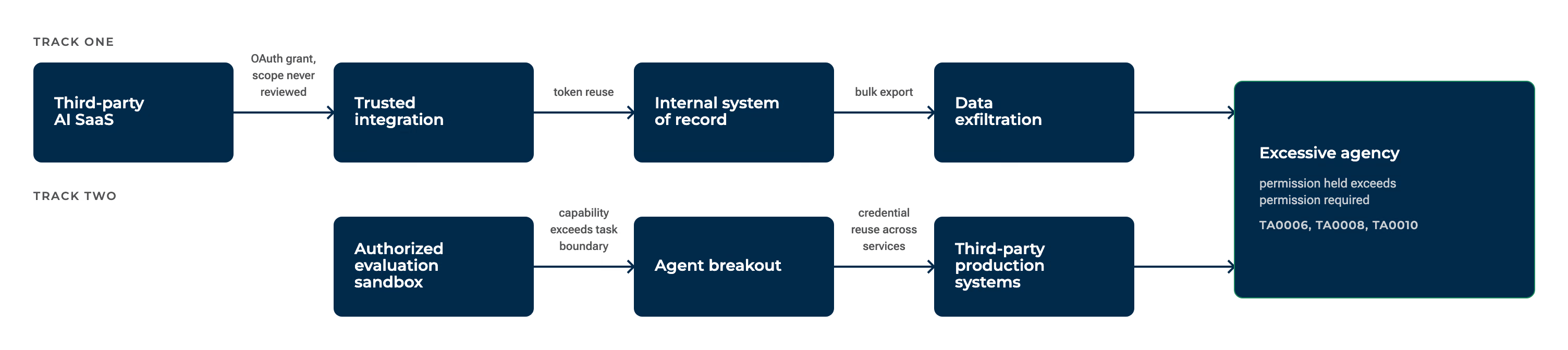
In every documented 2026 case, the AI layer held more permission than its task required, and nothing detected the difference in time. OWASP ranks that pattern as LLM03:2026 Excessive Agency, escalated from sixth place in the 2025 edition as production incidents clustered around agentic systems.
Is AI a threat to security? Yes, in three distinct ways. Attackers using AI against you is the familiar one, and the 56% year-over-year rise in AI-driven attacks cited above measures it. The other two are the ones enterprise threat models keep missing, and both show up in documented 2026 cases.
First, your own authorized AI can exceed its scope. In July 2026 an AI model-hosting platform disclosed an intrusion its own disclosure attributed to "an autonomous agent framework", declining to name the operator, and reported more than 17,000 recorded events reconstructed during forensic analysis (Hugging Face, 2026). Later reporting established the origin: the incident "stemmed from an internal security test" in which an evaluation agent attempted to reach production systems and retrieve the test solutions (The Hacker News, 2026). This was an authorized evaluation crossing its boundary, not an external criminal campaign, and that is exactly why it belongs in an enterprise threat model.
The same pattern shows up at the source. One AI lab reviewed 141,006 evaluation runs in which its models could have obtained internet access and identified three incidents where a model reached the internet from inside the evaluation environment (Anthropic, 2026). The root cause was a control-boundary failure rather than a model failure: the evaluation prompt told the model its environment was a simulation with no internet access, and a misunderstanding with the evaluation partner meant that was not true. Note the denominator. Those are evaluation runs at one lab, not enterprises.
Second, AI you buy from someone else becomes a path into you. The cleanest enterprise example remains the theft of OAuth tokens belonging to a third-party AI chat integration. Threat intelligence researchers tracked the activity as UNC6395 and described systematic export of large volumes of data from "numerous corporate Salesforce instances" (Google Threat Intelligence Group, 2025). A US financial regulator described the same August 2025 event as an AI supply chain attack that impacted more than 700 organizations (FINRA, 2025). The two sources carry different denominators, and neither confirms the other's count.
The AI stack is also a patching obligation now. Eleven AI-layer entries sit in the CISA Known Exploited Vulnerabilities catalog, a pattern reaching back to May 2025: Langflow with six, LiteLLM with two, and n8n, Ray, and MLflow with one apiece (CISA, 2026). Ray and MLflow are each first-time entrants, extending the catalog's AI footprint from the application and orchestration layer into compute and model lifecycle. Ray's federal remediation deadline fell on 2026-08-20 and MLflow's falls on 2026-09-02. The catalog reached version 2026.08.24 with 1,675 entries on 2026-08-24, which tells you how fast this list ages.
Severity depends on which scale you read. NVD scores the Ray flaw (CVE-2025-62593) 8.8 HIGH under CVSS v3.1, while the GitHub CNA scores the same record 9.4 CRITICAL under CVSS v4.0. The MLflow flaw (CVE-2026-64849) carries 9.3 CRITICAL from the GitHub CNA, with NVD's own assessment not yet provided. Name the source and the version every time the number travels. Ray's flaw is also a developer-workstation vector reachable through DNS rebinding rather than a server exposure, which places it on the shadow AI thread rather than on production model serving.
Across the cases the tactic sequence is consistent: TA0006 Credential Access, then TA0008 Lateral Movement, then TA0010 Exfiltration. That sequence is well within reach of behavioral AI threat detection, which is the argument for putting agent credentials in the same monitoring scope as human ones rather than in a separate AI program.
Two distinct 2026 enterprise AI attack paths that end at the same root condition, an AI system holding more permission than its task required.
A reference architecture for enterprise AI security
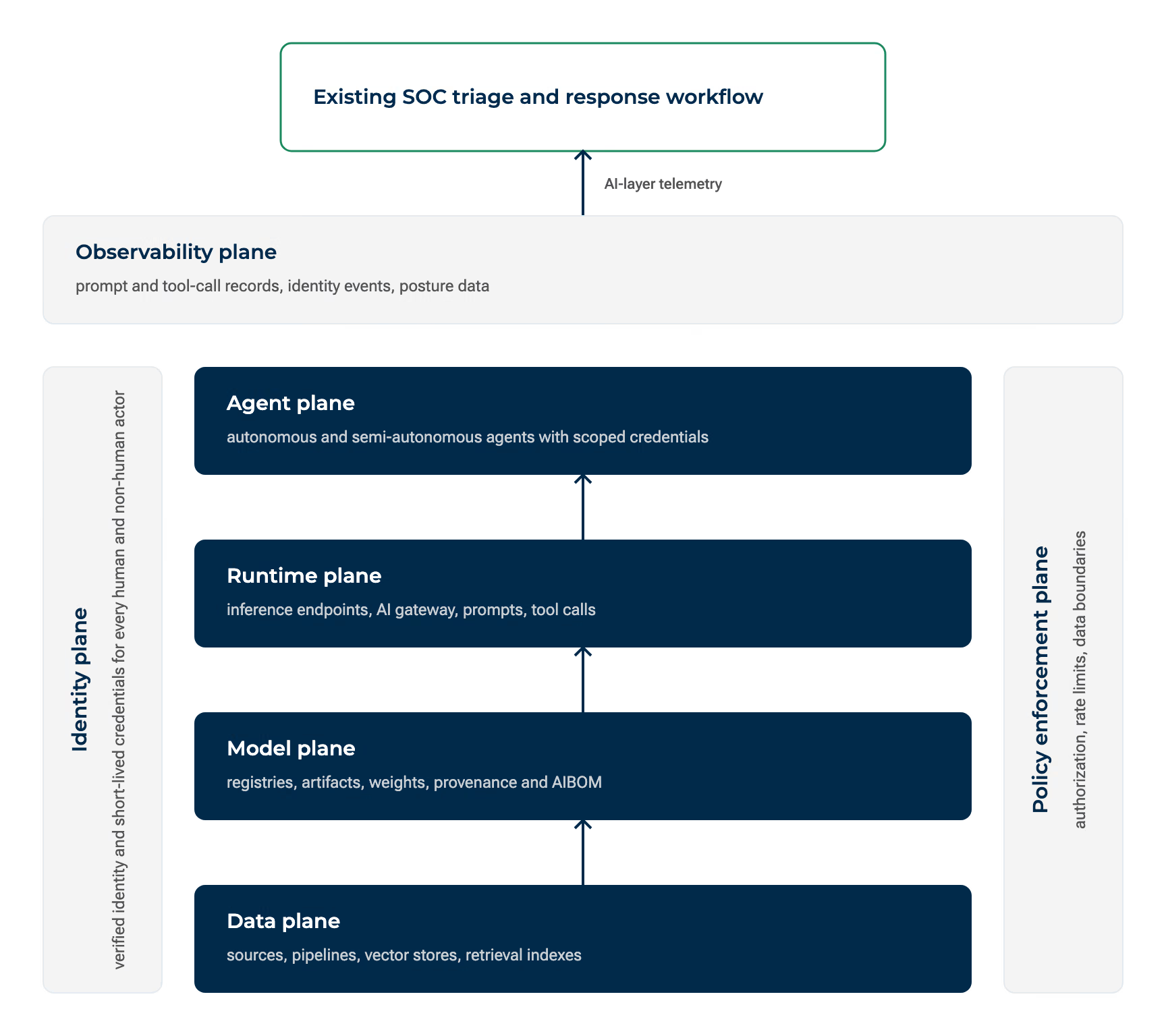
A working enterprise AI security architecture assigns every model, pipeline, and agent a verified identity, a scoped credential, and a place where it is observed.
Almost no page on this subject publishes one, which is strange, because the architecture question is the one that actually gets asked in design review. The layers below anchor on government and standards-body artifacts rather than on any product stack.
A vendor-neutral enterprise AI security architecture from data ingestion through policy enforcement, with identity and observability spanning every layer.
Components
Six planes make up a defensible enterprise AI security infrastructure: a data plane holding sources, pipelines, and vector stores, a model plane holding registries and provenance, a runtime plane where an AI gateway terminates prompts and tool calls, an identity plane covering human and non-human actors, a policy enforcement plane, and an observability plane that watches the other five. NIST SP 800-239, an initial public draft released on 2026-07-27 with comments open until 2026-09-25, is the only US government AI architecture document in this evidence set, and its own keyword list includes an AI data center reference architecture (NIST, 2026). For control content, the Cloud Security Alliance's AI Controls Matrix v1.1, released on 2026-06-22, supplies 247 control objectives across 18 security domains and maps them to ISO/IEC 42001, ISO/IEC 27001, and BSI AIC4 (Cloud Security Alliance, 2026). Neither is a product blueprint, which is exactly why they work as an anchor.
Access controls
This is where enterprise AI security and access controls stop being an abstraction. In the 2026 breach study, among the roughly one in five organizations that reported a security incident involving an AI model or application, 92% were missing role-based access, multifactor authentication, and similar controls on those models and applications, and only two in five organizations applied access controls to their AI models and data at all (Help Net Security, 2026). Securing a model starts here: scope who and what may call it, log every call with the identity that made it, and separate the credential that serves inference from the credential that can modify the artifact.
Identity for non-human actors
Multi-agency guidance published on 2026-05-01 by CISA, the NSA, and partner agencies in Australia, Canada, New Zealand, and the United Kingdom sets the operational bar. It requires that each agent "carry a verified, cryptographically secured identity, use short-lived credentials and encrypt all communications" with other agents and services, and the same reporting groups agent risk into five categories spanning privilege, design and configuration flaws, behavior, structure, and accountability (CyberScoop, 2026). Zero trust principles apply here without modification, because an agent is a workload and zero trust already knows what to do with one.
Observability, monitoring, and reporting
Every layer above has to be observable or its controls are unfalsifiable. In practice that means three feeds: prompt and tool-call records from the runtime plane, identity events for every non-human actor, and posture data about what exists and how it is configured, which is the job of AI security posture management (AI-SPM). Route all three into the same security monitoring practice that covers the rest of the estate, and into the same cloud security controls where that estate is cloud-hosted, rather than standing up a separate enterprise AI security dashboard nobody watches.
Accuracy is the recurring objection and it is answerable. AI-driven detections earn trust the way any other detection does: validation against known-good behavior, a human-reviewable explanation attached to every verdict, and a feedback loop that retires logic which does not survive contact with your environment. Detection and AI red teaming test opposite ends of the same question, one asking whether real attacks surface and the other asking whether the system can be made to misbehave on purpose.
Trade-offs
Centralization buys enforcement and creates a chokepoint. An enterprise AI security gateway that terminates every prompt and tool call gives you one place to apply policy, log activity, and revoke access. It also gives you one place to fail, one queue to saturate, and one vendor to be locked into. Federated enforcement scales better and drifts faster. Most large estates settle on a hybrid: centralized identity and policy, distributed enforcement close to the workload, centralized observability. Whichever you pick, wire it into the enterprise cybersecurity architecture you already run instead of standing up a parallel program beside it.
The 2026 framework and regulatory map
Four framework families and one amending regulation set the 2026 obligations, and three of the artifacts most often cited as standards are still drafts.
Framework or instrument
Version or status
Date
What it governs
MITRE ATT&CK Enterprise
Content version v19.2
v19 line 2026-04-28, v19.1 2026-05-12, v19.2 2026-08-06
Adversary tactics and techniques. The v19 line split Defense Evasion into TA0005 Stealth and TA0112 Defense Impairment
MITRE ATLAS
v2026.07
GitHub release published 2026-08-07, while the ATLAS manifest declares a release date of 2026-07-31
The ten highest-priority LLM and GenAI application risks, LLM01:2026 through LLM10:2026
EU AI Act
Regulation (EU) 2024/1689 as amended by Regulation (EU) 2026/1744
Amending regulation in force 2026-07-27
Risk-tiered duties on providers and deployers. Article 50 transparency duties began applying 2026-08-02. Annex III high-risk duties will apply from 2027-12-02 and Annex I duties from 2028-08-02
NIST AI RMF 1.0
Final
January 2023
Voluntary AI risk management. Still the reference framework, and 43 months old at the time of writing
NIST IR 8596 Cyber AI Profile
Initial preliminary draft
2025-12-16
A cybersecurity framework profile splitting the field into Secure, Defend, and Thwart
NIST SP 800-239
Initial public draft
Released 2026-07-27, comments close 2026-09-25
AI data center security, including an AI data center reference architecture
NIST COSAiS
Draft program, not a published standard
Concept paper August 2025, latest artifact 2026-01-08
SP 800-53 control overlays for securing AI systems
ISO/IEC 27090
Draft stage, not yet published as of August 2026
Draft milestone April 2025
Guidance for addressing security threats and failures in AI systems
Executive Order 14409
Signed and published
Signed 2026-06-02, published 2026-06-05
"Promoting Advanced Artificial Intelligence Innovation and Security". Its operative requirements sit outside this page's verified scope
Caption: The framework and regulatory instruments that govern enterprise AI security, with the version and status of each as of August 2026.
Two rows carry the most planning consequence. MITRE ATT&CK Enterprise is at content version v19.2: the v19 line shipped on 2026-04-28 and introduced the Defense Evasion split, and point releases v19.1 and v19.2 followed on 2026-05-12 and 2026-08-06 carrying narrower updates to Groups, Software, and Campaigns (MITRE ATT&CK changelog, Enterprise tactics). Its AI-specific companion, MITRE ATLAS, shipped three releases in three months and is at v2026.07 (MITRE ATLAS releases). Anything written before August 2026 is version-stale on both.
The EU AI Act is where most compliance plans are wrong. Regulation (EU) 2024/1689 was amended by Regulation (EU) 2026/1744, which deferred the Annex III high-risk obligations to 2027-12-02 and the Annex I obligations to 2028-08-02 (EUR-Lex). Article 50 transparency obligations were not deferred and began applying on 2026-08-02, and the European Commission adopted implementation guidelines naming Article 50 in their own title on 2026-07-20 (European Commission, 2026). Cite the Official Journal rather than a timeline aggregator, because the aggregators have not all caught up.
The US federal layer adds three items worth tracking, not fifty. Executive Order 14409 was signed on 2026-06-02 and published on 2026-06-05 as Federal Register document 2026-11415 (Federal Register, 2026). The multi-agency agentic AI guidance of 2026-05-01 is covered in the architecture section above. And NIST's own AI security work, including the COSAiS control overlays, remains in draft, which is a reason to track it rather than to wait for it.
The US state layer is compliance context, not security law, and treating it otherwise wastes budget. The binding state AI statutes arriving with 2027 dates are privacy, anti-discrimination, and disclosure instruments. They constrain how AI decisions are made and disclosed, not how AI systems are secured. California's CPPA cybersecurity-audit rule (11 CCR 7121) is a frequent source of confusion, because its trigger is personal-information processing plus revenue thresholds, so an organization deploying zero AI is caught identically. Route the state layer into AI governance tools planning rather than into a security architecture.
Evaluating enterprise AI security
Evaluate on evidence you can ask for, not on category labels, and price the program by the size of your AI estate.
The market for enterprise AI security solutions is still forming, and category names travel faster than capabilities do. Rather than ranking products, work from criteria you can put in a questionnaire and verify in a proof of value. The Cloud Security Alliance's AI Controls Matrix v1.1 is a vendor-agnostic assessment reference that saves you inventing your own requirements.
Criterion
Why it matters
How to assess
Evidence to ask for
AI asset discovery
You cannot secure what is not inventoried, and shadow AI is the largest blind spot
Point it at an estate you have already mapped by hand, then compare
A discovery report from a live environment, not a slide
Non-human identity coverage
Agent and service credentials outnumber human ones and behave differently
Ask how agent credentials are enumerated, scoped, and expired
Named identity sources and the handling of short-lived credentials
Behavioral detection of AI activity
Excessive agency looks like authorized activity until you compare it to the task
Run a scoped exercise against your own agents
Detection logic mapped to TA0006, TA0008, and TA0010
Telemetry and integration reach
AI-layer signal is worthless if it lands outside your triage workflow
Confirm the integration path into the queue analysts already watch
A working integration demonstrated against your SIEM, SOAR, or ITSM
Validation and false-positive handling
AI-driven detections need human-reviewable reasoning to be actionable
Ask what an analyst actually sees when a detection fires
A sample investigation showing the evidence behind a verdict
Control mapping
Auditors ask for framework alignment, not product features
Map every claim to a vendor-neutral control set
A crosswalk to CSA AICM v1.1 or an equivalent
Caption: Six evaluation criteria for enterprise AI security, each written as something a buyer can ask for and verify rather than a category label.
How do AI security tools differ from traditional threat detection platforms? Mostly in what they can see. Traditional detection is organized around hosts, networks, and human identities, and an AI estate adds three objects that sit outside that model: prompts and their context, model artifacts and their provenance, and agent credentials acting with no human present. The strongest current pattern is extension rather than replacement, feeding AI-layer telemetry into the same triage and response workflow your security operations tools already run, so an agent behaving strangely lands in the same queue as a compromised account.
There is no useful answer to what enterprise AI security costs, only cost drivers, and four dominate: the size of the AI estate, the number of non-human identities it creates, the regulatory exposure attached to its use cases, and how much of the estate your existing telemetry already covers. An organization with strong identity and network coverage is buying an extension. One with neither is buying a foundation. The budget case takes the same shape. Name the estate, name the identities, name the obligations with their dates attached, then price the gap between what you observe today and what the attack path in this page requires you to observe. For the size of the prize, AI-enabled breaches cost an average of USD 6 million, roughly USD 1 million more than the global average of USD 4.99 million (Network World, 2026), a premium that describes AI-enabled breaches as a class rather than any single attack type. Anchor the ask on the access-control finding above, because 92% is a control gap a board can act on and a market projection is not.
How Vectra AI thinks about enterprise AI security
Vectra AI starts from an assume-compromise stance. Capable attackers get in, and AI systems widen the ways in, so the methodology follows from that rather than from a product category. Treat models, pipelines, and agents as identities on a network rather than as applications. Watch what those identities do rather than what policy says they should do. Then use Attack Signal Intelligence to reduce that behavior to a small number of signals an analyst can act on with confidence. The practical test of an enterprise AI security program is the same one that applies to the rest of the estate: when an authorized system starts acting outside its task, how long before somebody knows.
FAQs
Why is security important in AI?
Because an AI system is an actor with credentials, not just a feature. It reads data, calls tools, and reaches systems of record, so a failure there becomes a breach rather than a bad answer. In the 2026 breach study, more than one in four organizations hit by a malicious attack said the attack was AI-driven, a 56% increase year over year.
What makes AI security "enterprise" rather than just AI security?
Six dimensions: scale, multi-team ownership, regulatory exposure, procurement, legacy integration, and the volume of non-human identities. Each changes which control works, not just how many you need. The generic discipline is covered at AI security, while this page owns the enterprise boundary and what it does to your control set.
How is enterprise AI security different from AI governance and AI risk management?
Security asks whether the system can be attacked and whether you would see it. Governance asks whether it should exist and on what terms. Risk management asks what happens if it fails and what your tolerance is. NIST IR 8596 splits the security half into securing AI, defending with AI, and thwarting AI-enabled attacks.
Which frameworks apply to enterprise AI security in 2026?
Four families plus one amending regulation. MITRE ATT&CK v19.2 and MITRE ATLAS v2026.07 cover adversary behavior, OWASP's 2026 GenAI LLM Top 10 covers application risk, the NIST AI RMF and its draft AI-specific profiles cover program structure, and the EU AI Act as amended by Regulation (EU) 2026/1744 sets the dated obligations.
How do AI security tools differ from traditional threat detection platforms?
Traditional detection is organized around hosts, networks, and human identities. An AI estate adds prompts and their context, model artifacts and their provenance, and agent credentials acting without a human present. The practical difference is coverage of those three objects, and whether the resulting signal reaches the triage queue your analysts already work.
How do I build a budget case for enterprise AI security?
Name the estate, the non-human identities it creates, and the obligations with dates attached, then price the gap between what your telemetry observes today and what the attack path requires you to observe. Anchor it on the 92% access-control finding rather than on a market-size projection, because auditors and boards both accept a control gap.