Detection engineering explained: a practitioner's guide to building, tuning, and measuring detections
Key insights
Detection engineering applies software engineering rigor — version control, peer review, testing, and metrics — to building and tuning the detections that surface malicious behavior.
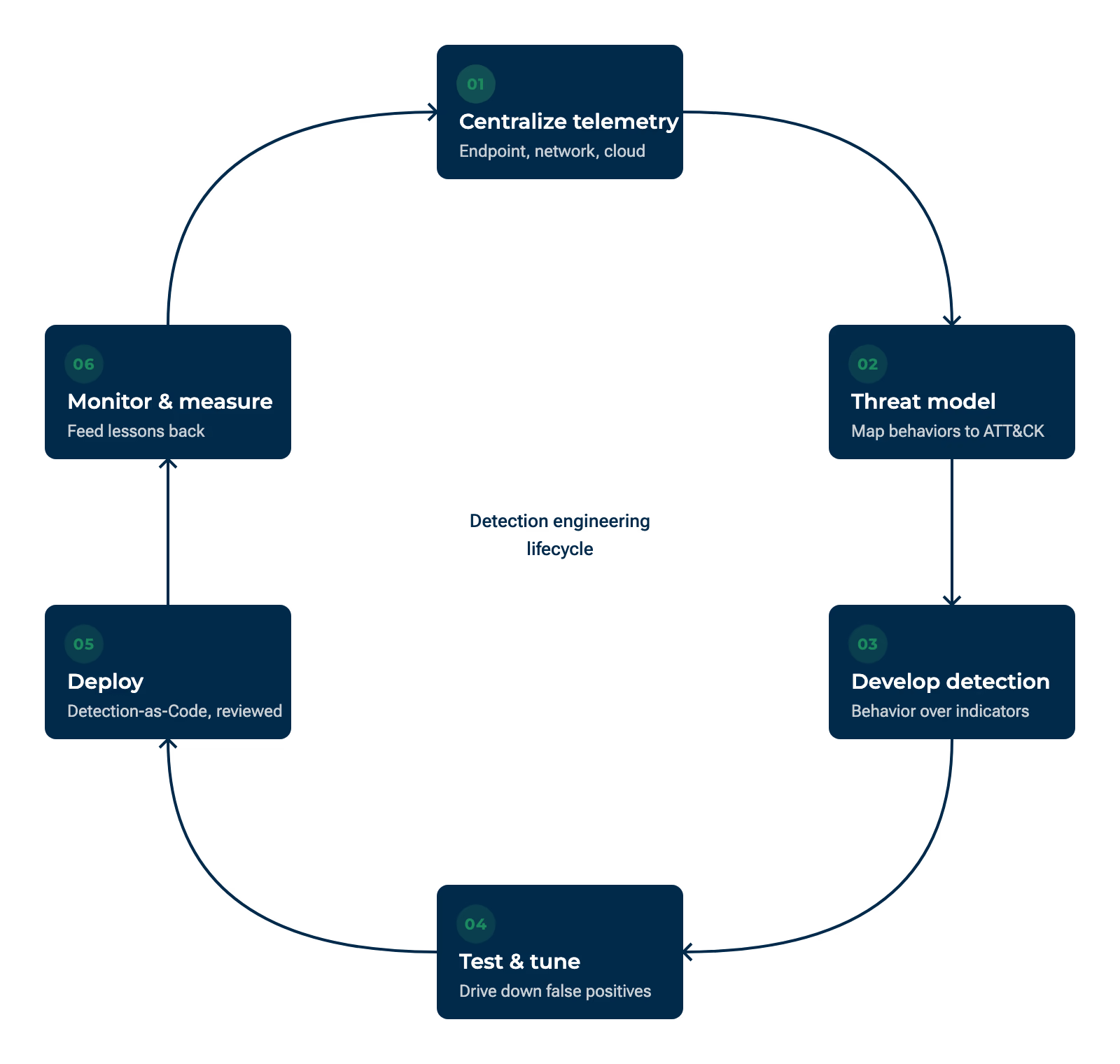
The lifecycle is a closed loop: centralize telemetry, threat-model with ATT&CK, develop, test and tune, deploy via Detection-as-Code, then monitor and feed lessons back.
Frameworks serve different jobs. The Alerting and Detection Strategy framework sets a per-detection quality bar, the hunting-to-detection bridge codifies hunts, and maturity models benchmark programs.
AI adoption is high but trust lags. In 2026, 83% of practitioners used AI tools, yet only 42% trusted AI for core work such as tuning (State of Detection Engineering, n=307).
You can start without an expensive platform. Sigma plus Python and an adversary-simulation tool is a credible no-SIEM starter stack for learners and resource-constrained teams.
Security teams rarely fail for lack of data. They fail because their detections do not fire, fire too often, or fire on the wrong things. False positives now rank as the number one detection challenge for 73% of organizations (2025), and that noise is exactly what this discipline sets out to fix. This guide explains what detection engineering is, walks the full lifecycle, compares the major frameworks, and shows a worked detection rule end to end. It is written for practitioners and grounded in open standards from MITRE ATT&CK and the Sigma detection format, with depth instead of marketing.
What is detection engineering?
Detection engineering is the systematic discipline of designing, building, testing, and tuning detections that identify malicious behavior across telemetry sources. It applies software engineering practices — version control, peer review, and continuous testing — to detection work, prioritizing high-fidelity signal over noise so analysts spend their time on real threats instead of chasing false positives.
That focus on signal matters because false positives and alert fatigue are the defining pain of modern security operations. Imprecise detections bury genuine threats under a flood of low-value alerts, and analysts learn to tune the noise out — sometimes along with the real attack. In 2025, 73% of organizations ranked false positives as their number one detection challenge, which is why a discipline built to raise fidelity has moved from nice-to-have to essential.
A few core terms anchor the rest of this guide. A detection is logic that identifies suspicious or malicious activity. A rule is one expression of that logic. Telemetry is the raw event data — process, network, identity, and cloud logs — that detections evaluate. A true positive is a correct alert on real malicious activity, while a false positive flags benign activity as malicious. The whole craft comes down to separating signal from noise. You will also see "threat detection engineering" used as a synonym for the same discipline, and it sits squarely within the broader goal of threat detection.
One thesis runs through modern practice: behavior beats signatures. AI is collapsing the time attackers need to weaponize a vulnerability, so detections that key on adversary behavior increasingly outperform brittle indicator chasing. Engineering detections around how attackers act — not just the artifacts they leave — is what keeps coverage durable as tools and indicators change.
Detection engineering vs threat hunting
Detection engineering systematizes the detection of known threats as durable, automated rules, while threat hunting proactively searches for unknown threats and feeds its findings back into detections. In short, hunting discovers; engineering operationalizes — the two form a loop where each strengthens the other.
How detection engineering works: the lifecycle
The detection engineering lifecycle turns telemetry into peer-reviewed, version-controlled detections that improve continuously through testing and feedback. It is a closed loop, not a straight line — observations from production flow back into earlier phases so coverage gets better over time instead of decaying after launch.
The lifecycle runs in six phases:
Centralize telemetry across endpoint, network, cloud, and identity.
Threat-model the behaviors to detect using MITRE ATT&CK.
Develop detection logic, favoring behaviors over brittle indicators.
Test and tune to drive down false positives.
Deploy through Detection-as-Code with version control and review.
Monitor, measure, and feed incident lessons back into detections.
The first phase comes before any rule writing: centralize telemetry. Endpoint, network, cloud, and identity sources each capture different attacker behaviors, and detections are only as good as the data underneath them. With telemetry in place, engineers move to threat modeling — choosing which behaviors to detect using the MITRE ATT&CK framework as the backbone, so coverage maps to techniques adversaries actually use rather than to whatever happened to cause the last incident.
Development comes next. The engineer writes logic against available telemetry and, wherever possible, keys on tactics and techniques rather than fragile indicators like a single file hash or IP address. Behavior-based logic survives small adversary changes that would break an indicator overnight. Testing and tuning then reduce false positives through thresholds, allowlists, and contextual filters — the difference between a detection analysts trust and one they mute.
Deployment happens through Detection-as-Code, and the final phase closes the loop: engineers monitor each detection's fidelity, measure its performance, and feed lessons from incident response back into the rule set. A detection that fired on a real intrusion teaches the team how to sharpen it; a noisy one tells them what to tune or retire.
Detection-as-Code (DaC)
Detection-as-Code treats detection rules like software: stored in version control, peer reviewed, and validated through a CI/CD pipeline before they reach production. The benefits mirror those of modern software development — auditability, rollback, collaboration, and consistent quality across a large rule set.
Adoption climbs the ladder unevenly, though. In 2026, 62% of teams used version control for detections and 58% used peer review, but only 42% reached full CI/CD integration (State of Detection Engineering survey, n=307). The blockers are practical rather than philosophical: 72% of teams cited time and resource constraints, and 61% pointed to an in-house skills gap. Detection-as-Code is widely understood as the right destination; getting all the way up the maturity curve is where most programs stall.
Detection engineering frameworks compared
Frameworks serve different jobs. The Alerting and Detection Strategy framework sets a per-detection quality bar, the hunting-to-detection bridge codifies hunts into durable rules, Detection-as-Code governs engineering practice, and maturity models benchmark whole programs. Picking the right one starts with knowing which problem you are solving.
The Alerting and Detection Strategy (ADS) framework treats each detection as a documented, peer-reviewed artifact. Rather than shipping a rule as a one-line query, ADS requires a goal, the categorization of the technique against MITRE ATT&CK, the detection logic, known blind spots, and validation steps. The result is a consistent quality bar that makes detections reviewable and maintainable instead of opaque.
The hunting-to-detection bridge codifies the output of threat hunting into durable detections. A structured hunt — prepare, execute, then act on what you learn — should not end with a one-time finding. The bridge takes a behavior a hunter uncovered and turns it into an automated, tested rule so the same technique is caught without manual effort next time.
Detection-as-Code is the engineering-practices framework already covered above: version control, peer review, and CI/CD applied to detection content. Where ADS governs the quality of a single detection, Detection-as-Code governs how the whole repository is built, reviewed, and shipped.
Making individual detections reviewable, mapped, and maintainable
Hunting-to-detection bridge
Codify hunt findings into durable, automated rules
Process model
Turning one-time hunt discoveries into lasting coverage
Detection-as-Code
Govern detection development like software
Engineering practice
Scaling a repository with version control, review, and CI/CD
Maturity models (matrix, DEBMM)
Benchmark a program and chart improvement
Maturity model
Assessing where a team stands and planning the next stage
These frameworks are complementary, not competing. A mature program might use ADS for individual detection quality, the hunting bridge to source new detections, Detection-as-Code to ship them, and a maturity model to measure the whole effort.
A worked detection rule example
A good detection starts from a behavior, expresses it as portable logic, then tunes out benign noise. To make that concrete, consider a behavior common in real intrusions: a user opens a document, and an Office application or Explorer spawns an encoded PowerShell command. This pattern maps to MITRE ATT&CK technique T1059.001 (Command and Scripting Interpreter: PowerShell), which falls under the Execution tactic.
The telemetry required is process-creation logging that captures the parent process, the child process, and the command line. The logic, expressed in Sigma, keys on a known Office or file-browser process launching powershell.exe with an encoded-command flag. The rule below is defensive detection logic only — it describes what to look for, not how to perform the technique.
title: Encoded PowerShell spawned by Office or Explorer
id: 7c9e6679-7425-40de-944b-e07fc1f90ae7# placeholder UUID, replace per repo conventionstatus: experimental
description: >
Detects powershell.exe launched with an encoded-command flag by a Microsoft
Office application or Explorer. This parent-child pattern commonly follows a
user opening a malicious document. Detection logic only — non-actionable.
references:
- https://attack.mitre.org/techniques/T1059/001/
author: detection-team@example.com # team alias; mask any real contact as <REDACTED>date: 2026/05/29tags:
- attack.execution
- attack.t1059.001logsource:
category: process_creation
product: windows
detection:
selection_parent:
ParentImage|endswith:
- '\winword.exe' - '\excel.exe' - '\powerpnt.exe' - '\outlook.exe' - '\explorer.exe' selection_child:
Image|endswith: '\powershell.exe' selection_flag:
CommandLine|contains:
- ' -enc ' - ' -encodedcommand ' condition: selection_parent and selection_child and selection_flag
falsepositives:
- Administrative scripts launched from Explorer by trusted operators
- Approved add-ins that invoke PowerShell with encoded parameters
level: high
Reading top to bottom: logsource scopes the rule to Windows process-creation events so it evaluates only relevant data. The detection block defines three selections — the suspicious parent, the PowerShell child, and the encoded-command flag — and the condition requires all three together. That combination is the point. Any one element alone is common and benign, but a document process spawning encoded PowerShell is the behavior worth alerting on. The falsepositives field documents expected benign matches so reviewers understand the blind spots.
Tuning is where a raw rule becomes operational. The table below shows how targeted filters cut false positives without weakening the core logic.
Tuning stage
False-positive volume
Change applied
Initial deployment
High
Rule live with no exceptions
Allowlist signed admin tools
Medium
Exclude approved signed binaries and add-ins
Add off-hours context
Low
Prioritize matches outside normal change windows
The engineer validates the tuned rule against safe samples produced through adversary simulation in a lab, then runs it against a benign baseline to confirm the noise is gone. The output is a documented, tested, technique-mapped detection any teammate can read and maintain.
Detecting and preventing threats: practices, tools, and AI
Strong detection engineering relies on portable formats, ATT&CK mapping, and adversary testing — and a few practices show up in every mature program:
Use platform-agnostic formats: Sigma for log-based detections, YARA for files and memory.
Keep detections in version control with peer review.
Map every detection to a MITRE ATT&CK technique.
Validate detections with adversary simulation, such as an open atomic-test library.
On tooling, the landscape is best understood as categories rather than products: rule languages (Sigma, YARA), repositories and CI/CD pipelines, adversary-simulation frameworks, and a delivery target. That target is often a SIEM, but it can equally be an extended detection and response platform, endpoint detection and response agents, or network detection and response sensors that consume network telemetry directly.
AI deserves an honest, balanced treatment. Adoption is high: in 2026, 83% of practitioners reported using AI tools in their detection work. Trust, however, lags well behind — only 42% trusted AI for core tasks such as tuning (State of Detection Engineering, n=307). The gap is rational. AI genuinely helps with rule translation across query languages, alert triage, and identifying coverage gaps, but a human still owns the judgment calls on fidelity and what ships to production. The same survey underscores why rule quality matters so much: 66% of false positives originate from vendor-provided rules in 2026 (up from roughly 64% the prior year), which is exactly the noise a disciplined practice exists to reduce. This is also where behavioral threat detection earns its place, catching attacker behavior that static, vendor-shipped signatures miss.
Detection engineering without a full SIEM
You do not need an expensive platform to start. A capable beginner stack pairs Sigma for writing portable rules, Python for processing and testing logs, and an open adversary-simulation library to generate safe test activity. Write a rule, run atomic tests in a home lab to confirm it fires, then check it against benign data to measure noise. This free or low-cost path lets learners and small teams build real detection-engineering skill before committing to a platform, and the Sigma rules they write port directly into a SIEM later.
Metrics, maturity, and careers
Measure a small set of metrics first, then mature deliberately. Tracking everything at once is a common trap; a focused starter set tells you whether detections are getting better. The measurement-to-action gap is real — in 2026, 59% of teams tracked their false-positive rate but only 14% prioritized reducing it (State of Detection Engineering, n=307). Measuring without acting is wasted effort.
Metric
What it tells you
How to start
False-positive rate
Whether detections are precise or noisy
Sample a week of alerts and label true vs false
ATT&CK coverage by technique
Which adversary behaviors you can detect
Map existing detections to techniques and find gaps
MTTD contribution
How much a detection speeds up identification
Compare detection timestamps to incident timelines
Alert-to-analyst ratio
Whether alert volume is sustainable
Divide weekly alerts by available analysts
Tie those metrics to a maturity stage so progress is visible, and cite versions when you reference a maturity model, since specifics evolve. Improvement is incremental: reduce the false-positive rate, then widen ATT&CK coverage, then shorten MTTD contribution.
As a career, detection engineering is one of the fastest-growing roles in security, and it sits at the heart of modern SOC operations. To break in, build SOC and telemetry fundamentals, learn ATT&CK and a query or scripting language, then write and tune rules in a home lab to build a portfolio. Certifications such as the GIAC Certified Detection Analyst (GCDA) and focused SANS detection-engineering training help formalize the skill set. The compensation reflects demand: the average detection engineer salary sits around $161,255, ranging from roughly $120,941 to $218,164 (May 2026). One honest caveat from the field — only 13% of practitioners reported high software-engineering proficiency in 2026, so engineers who genuinely combine security knowledge with coding discipline stand out.
Detection engineering, compliance, and modern approaches
Detection engineering increasingly maps to compliance frameworks and is being reshaped by agentic, behavior-based approaches. Aligning detections to a recognized framework turns engineering output into audit evidence, and modern platforms are changing how detections get built in the first place.
On compliance, detection work maps cleanly to the NIST Cybersecurity Framework's Detect function — including continuous monitoring (DE.CM) and adverse event analysis (DE.AE) in CSF 2.0 — and to CIS Controls 8 and 13. Map detections to MITRE ATT&CK using the current model. The April 2026 ATT&CK v19 release, building on v18, structures detection around Detection Strategies (DET), Analytics (AN), and Data Components (DC), and supersedes the deprecated Data Sources taxonomy. Data Components describe the telemetry available, Analytics describe the logic applied to it, and Detection Strategies tie analytics together against a technique — a far more precise basis for proving coverage than broad data categories.
Modern approaches are shifting the discipline in two ways. Operations are moving from alert-first to case-first, grouping related signals into a single investigable case instead of a stream of disconnected alerts. And agentic detection is emerging — systems that auto-identify coverage gaps and even draft candidate detections in shadow or test mode, under human review, before anything goes live. Cloud-native coverage remains the biggest gap, cited as the number one weakness by 43% of organizations in 2026, and it is exactly where behavior-based detection matters most. That urgency is compounded by AI compressing the time from disclosure to exploit — research cited by Dark Reading describes time-to-exploit collapsing from over 125 days toward roughly half a day, which makes behavior-based AI threat detection increasingly valuable against techniques no signature anticipates.
How Vectra AI thinks about detection engineering
Vectra AI builds behavior-based detections — Attack Signal Intelligence — across network, identity, and cloud, so small teams get high-fidelity signal instead of more noise. That reflects the same behavior-over-signature thesis this discipline is built on: engineered rules give precise coverage of known techniques, while behavioral analytics extend reach to the attacks no one has written a rule for yet.
Future trends and emerging considerations
Over the next 12 to 24 months, three shifts will reshape how detections are built and maintained, and each is already visible in current practice.
AI will move from assistant to author, under supervision. Adoption is already high at 83% in 2026, but the trust gap — only 42% trust AI for core tuning — means the near-term change is qualitative, not just quantitative (State of Detection Engineering, n=307). Expect agentic systems to draft candidate detections and flag coverage gaps in test mode, with human review staying firmly in the loop. Teams that build governance around AI-generated detections now will be ahead of those that bolt on the tooling without controls.
Coverage measurement will get more precise. The move to the Detection Strategies, Analytics, and Data Components model in MITRE ATT&CK v18 and v19 points toward telemetry-aware coverage claims that are easier to validate against the data a team actually collects. Reporting and tooling will increasingly align to this model.
Cloud and identity will dominate the roadmap. With cloud-native coverage cited as the number one gap by 43% of organizations in 2026, and AI compressing time-to-exploit toward hours, investment will flow to telemetry and behavior-based detections for those fast-changing surfaces rather than to extending endpoint-centric rules. Organizations planning ahead should prioritize cloud and identity telemetry, adversary-simulation capability, and the engineering discipline to manage detections at scale.
Conclusion
Detection engineering turns security detection from craft into discipline. By running the lifecycle as a closed loop — telemetry, threat modeling, development, testing, Detection-as-Code deployment, and monitoring — and grounding the work in frameworks like MITRE ATT&CK and portable formats like Sigma, teams build coverage that lasts instead of rules that decay. The practices that matter are borrowed from software engineering and increasingly accelerated by AI, though the data is clear that human judgment still owns the calls that count. Start small: centralize telemetry, write a behavior-based rule, tune it against a benign baseline, and measure a handful of metrics before scaling up.
The discipline will only grow more central as attack surfaces expand into cloud and identity and adversaries move faster than any team can write rules by hand. The strongest programs pair precise, engineered detections of known techniques with behavior-based analytics that extend coverage into the unknown. To go deeper on the behavioral side of the practice, explore how Vectra AI approaches threat detection across network, identity, and cloud.
FAQs
What is detection engineering?
Detection engineering is the systematic discipline of building, testing, and tuning detections that surface malicious behavior across telemetry sources, prioritizing high-fidelity signal over noise. It applies software engineering practices — version control, peer review, and continuous testing — to detection work, so each detection is documented, validated, mapped to a known adversary technique, and measured for fidelity rather than written once and forgotten. The discipline exists because false positives and alert fatigue overwhelm security teams; in 2025, 73% of organizations ranked false positives as their number one detection challenge. By treating detections as engineered, maintained assets, the practice raises the quality of what reaches analysts and reduces the noise that buries real threats. It sits within the broader goal of threat detection, and you will see "threat detection engineering" used as a synonym. Done well, detection engineering is the difference between a team that drowns in low-fidelity alerts and one that consistently catches genuine attacks early.
How is detection engineering different from threat hunting?
Detection engineering systematizes the detection of known threats as durable, automated rules, while threat hunting proactively searches for unknown threats and feeds its findings back into detections. The two form a feedback loop and a mature program needs both — hunting discovers new behaviors, and engineering turns them into coverage that fires automatically from then on.
What does the detection engineering lifecycle look like?
The lifecycle runs in six phases and forms a closed loop. First, centralize telemetry across endpoint, network, cloud, and identity, because detections are only as good as the underlying data. Second, threat-model the behaviors worth detecting using MITRE ATT&CK as the backbone. Third, develop the detection logic, favoring tactics and techniques over brittle indicators that break with small attacker changes. Fourth, test and tune to drive down false positives using thresholds, allowlists, and contextual filters. Fifth, deploy through Detection-as-Code with version control and peer review. Sixth, monitor, measure, and feed incident-response lessons back into the detections. The loop matters: a detection that fired on a real intrusion teaches the team how to sharpen it, while a noisy one signals what to tune or retire. Running these phases as a managed pipeline is what produces durable coverage instead of rules that decay after launch.
What tools and languages do detection engineers use?
Detection engineers work with platform-agnostic rule formats and the pipelines that ship them. Sigma is the common format for log-based detections because it is portable across query languages, while YARA covers files and memory. Around those formats sit version control and CI/CD pipelines for Detection-as-Code, plus adversary-simulation tools — such as an open atomic-test library — to validate that detections fire on the behaviors they target. Detections are delivered to a SIEM, an extended detection and response platform, or network detection and response sensors. Importantly, you can start without an expensive platform: Sigma plus Python and a free adversary-simulation library is enough to write, test, and tune real detections in a home lab, and those Sigma rules port directly into a SIEM when you scale up.
How do I become a detection engineer?
Start by building solid SOC and telemetry fundamentals — understand alerts, triage, incident response, and how logging works across endpoint, network, cloud, and identity. Next, learn the MITRE ATT&CK framework and at least one query or scripting language, since detections are logic applied to data. Then practice: write and tune detections in a home lab, validate them with adversary simulation, and build a portfolio that shows real rules and the tuning behind them. Certifications such as the GIAC Certified Detection Analyst (GCDA) and focused SANS detection-engineering training help formalize the skill set and signal competence to employers. The role is in demand and well compensated — the average salary sits around $161,255, ranging from roughly $120,941 to $218,164 (May 2026). One differentiator stands out: only 13% of practitioners reported high software-engineering proficiency in 2026, so candidates who genuinely combine security knowledge with coding discipline are especially valuable.
Can you do detection engineering without a SIEM?
Yes. A SIEM helps at scale, but it is not a prerequisite for learning or practicing the discipline. A capable starter stack pairs Sigma for writing portable detection rules, Python for processing and testing log data, and an open adversary-simulation library to generate safe test activity in a home lab. The workflow is the same as in a funded program in miniature: write a rule, run atomic tests to confirm it fires on the target behavior, then check it against benign data to measure and reduce false positives. This free or low-cost path is ideal for resource-constrained teams and individuals building skills, and because Sigma is platform-agnostic, the rules written this way port directly into a SIEM or other platform when the time comes to scale.
How do you measure detection engineering effectiveness?
Start with a small, focused set of metrics rather than trying to measure everything. Four make a strong starter set: false-positive rate (are detections precise or noisy), ATT&CK coverage by technique (which adversary behaviors you can detect), mean-time-to-detect contribution (how much a detection speeds up identification), and the alert-to-analyst ratio (whether alert volume is sustainable for the team). The critical discipline is to act on what you measure — in 2026, 59% of teams tracked their false-positive rate but only 14% prioritized reducing it, so measurement without action is a widespread and costly trap. Tie these metrics to a maturity stage so progress is visible over time, and improve incrementally: lower the false-positive rate first, then widen coverage, then shorten detection time.