Alert Fatigue in Cybersecurity: How to Reduce Alert Noise and Improve SOC Performance
Key insights
Alert fatigue is measurable. Track false positive rates, uninvestigated alert percentages, and mean triage time against industry benchmarks to quantify the problem before investing in solutions.
The cost is staggering. Manual alert triage costs an estimated $3.3 billion annually in the U.S. (Vectra AI 2023), and 42% of alerts go entirely uninvestigated (Microsoft/Omdia 2026).
Compliance risk is underappreciated. Alert fatigue delays breach detection beyond NIS2, GDPR, and CIRCIA reporting windows, creating regulatory penalties and personal liability for executives.
Phased reduction works. A 30-60-90 day roadmap — from rule tuning to AI-powered triage — delivers measurable improvement without requiring a full SOC rebuild.
Signal quality beats volume reduction. Declining alert counts alone do not solve fatigue. Organizations need behavioral detection and correlated signal across the SOC visibility triad.
Every security operations center (SOC) faces the same paradox: the tools designed to protect organizations are drowning analysts in noise. Organizations now receive an average of 2,992 security alerts daily, yet 63% go unaddressed (Vectra AI 2026). That gap between what gets flagged and what gets investigated is where breaches begin. According to the 2025 SANS Detection and Response Survey, 73% of security teams name false positives as their top detection challenge. Meanwhile, 76% of organizations cite alert fatigue as a primary SOC concern (Cybersecurity Insiders 2025). This guide covers what alert fatigue is, how to measure it, how it intersects with compliance, and a phased roadmap for solving it.
What is alert fatigue?
Alert fatigue is the desensitization that SOC operations analysts experience when they face an overwhelming, sustained volume of security alerts, causing them to miss, delay, or ignore genuine threats. It degrades threat detection quality and increases organizational risk.
The concept originated in healthcare, where clinical staff became desensitized to the constant sound of medical device alarms — a phenomenon known as alarm fatigue. Cybersecurity adopted the term as SIEM adoption and detection tool sprawl accelerated through the 2010s and 2020s. The psychological mechanism is identical across both domains: when the volume of notifications exceeds human processing capacity, people stop responding to all of them — including the ones that matter.
The scale of the problem is well documented. Organizations receive an average of 2,992 security alerts per day (Vectra AI 2026), down from 3,832 in 2025 and 4,484 in 2023. Yet declining volume has not solved the problem. Sixty-three percent of those alerts still go unaddressed, and 76% of organizations cite alert fatigue as a top SOC challenge (Cybersecurity Insiders 2025). Volume reduction alone is not the answer. Signal quality is.
Alert fatigue vs. alarm fatigue
Alarm fatigue originated in clinical settings — hospitals where constant beeping from patient monitors desensitized nursing staff to critical warnings. Alert fatigue is the cybersecurity adaptation of the same phenomenon, applied to security monitoring alerts in SOC environments. Both share the same core mechanism: overwhelming notification volume leads to desensitization and missed critical signals. This page covers the cybersecurity context exclusively.
Common signs of alert fatigue
Alert fatigue rarely happens overnight. It develops gradually as analysts are exposed to high volumes of repetitive, low-value alerts over extended periods. Organizations can often identify the problem by monitoring both operational metrics and analyst behavior.
Common signs of alert fatigue include:
A growing backlog of uninvestigated security alerts.
Increasing mean time to triage (MTTT) and mean time to respond (MTTR).
Analysts dismissing or ignoring low- and medium-severity alerts without investigation.
Rising false negative rates, where genuine threats are discovered only after an incident.
Higher analyst burnout, turnover, and reduced job satisfaction.
Repeated investigations caused by duplicate or poorly correlated alerts.
An increasing reliance on manual triage across multiple security tools and consoles.
If these trends continue over time, organizations should review detection rule quality, alert prioritization, and signal correlation to reduce noise before it affects security outcomes.
What causes alert fatigue?
Alert fatigue stems from false positives, tool sprawl, manual triage, growing alert volumes, and staffing shortages that compound across fragmented SOC environments. Research from the ACM Computing Surveys identifies four structural categories of causes, while IBM's taxonomy extends this to six. Below is a consolidated view based on the most current data.
Tool sprawl and console fragmentation. Organizations manage an average of 10.9 security consoles (Microsoft/Omdia 2026). Sixty-nine percent deploy 10 or more detection tools, and 39% use 20 or more (Vectra AI 2026). Each tool generates its own alert stream with its own console, severity scale, and format.
Poor detection rule quality. Unrefined thresholds, redundant rules, and static signatures from legacy intrusion detection and prevention systems that fail to adapt to environmental changes generate noise at the source. Without regular tuning, detection rules degrade over time.
Alert volume growth. Seventy-seven percent of organizations saw increased alert volume, and 46% experienced a spike of 25% or more in the past year (Cybersecurity Insiders 2025).
SIEM platforms aggregate alerts from hundreds of sources, often without adequate correlation or deduplication. Endpoint detection and response tools generate endpoint-level alerts that multiply with fleet size. Only about 59% of tools automatically feed data into SIEM (Microsoft/Omdia 2026), leaving analysts to manually correlate the rest. The result: a single incident can generate dozens of separate alerts across platforms, each requiring independent investigation.
The real-world impact of alert fatigue
Alert fatigue causes missed breaches, billions in triage costs, analyst burnout, and creates exploitable gaps in insider threat detection.
Table: Quantified consequences of alert fatigue across financial, operational, and human dimensions.
Case study: Target breach (2013). FireEye's detection system identified the malware, but analysts missed the alert among thousands of daily notifications. The resulting data breach exposed 40 million payment card records — a textbook example of how alert fatigue translates directly into breach impact.
Case study: Equifax breach (2017). Patch alerts for CVE-2017-5638 were lost in the triage backlog, ultimately exposing 147 million records. The failure was not in detection but in incident response — a critical alert buried under operational noise.
Alert fatigue and insider threat detection
Insider threats present a unique challenge. Behavioral anomaly alerts — the primary signal for insider risk — are inherently high-noise because legitimate user behavior often resembles early-stage insider activity. When analysts deprioritize these alerts due to fatigue, insider threats go undetected for longer. With an annual average insider risk cost of $17.4 million (Ponemon 2025), the stakes of ignoring behavioral anomaly alerts are significant.
Alert storming as an adversary tactic
Sophisticated adversaries deliberately generate high volumes of alerts to overwhelm SOC analysts and mask actual intrusion activities. This tactic falls under MITRE ATT&CK Defense Evasion (TA0005) — specifically Impair Defenses (T1562). Intezer's 2026 research found that enterprises missing approximately 1% of real threats from low-severity alerts lose around 50 genuine threats per year — a gap adversaries actively exploit.
How alert fatigue affects SOC performance
Alert fatigue affects more than analyst well-being, it directly reduces the effectiveness of security operations. As analysts spend more time investigating false positives and duplicate alerts, genuine threats take longer to identify, prioritize, and contain. This slows incident response, increases operational costs, and creates opportunities for attackers to remain undetected.
Common operational impacts include:
Longer Mean Time to Detect (MTTD): Critical threats remain unnoticed because analysts must work through large volumes of low-priority alerts.
Higher Mean Time to Respond (MTTR): Investigation and remediation are delayed as security teams spend more time triaging noise than responding to confirmed incidents.
Reduced detection accuracy: High alert volumes increase the likelihood that analysts dismiss or overlook legitimate threats.
Lower analyst productivity: Repetitive manual investigations reduce the time available for threat hunting, detection engineering, and proactive security improvements.
Increased operational costs: More analyst hours are spent reviewing low-value alerts, while fragmented security tools create duplicated investigation effort.
Monitoring KPIs such as MTTD, MTTR, false positive rate, alert-to-incident conversion rate, and uninvestigated alerts helps security leaders quantify the operational impact of alert fatigue and measure improvements over time.
How to measure alert fatigue
Measuring alert fatigue requires tracking false positive rates, uninvestigated alert percentages, mean triage time, and analyst attrition against industry benchmarks. Without quantifiable cybersecurity metrics, organizations cannot identify, track, or report on alert fatigue to justify budget and tooling changes.
The most effective approach starts with a baseline measurement before making any changes. As Fortinet's SOC metrics guide recommends, organizations should capture current-state metrics across at least one full operational cycle before implementing improvements.
Table: Diagnostic scorecard for measuring and tracking alert fatigue severity in SOC operations.
KPI
Formula / definition
Target
Industry benchmark
False positive rate
False positive alerts / Total alerts x 100
<30% overall
46% average (Microsoft/Omdia 2026)
Alerts per analyst per day
Total daily alerts / Number of active analysts
Org-specific; reduce quarter over quarter
2,992 average daily (Vectra AI 2026)
Uninvestigated alert rate
Uninvestigated alerts / Total alerts x 100
<20%
42% (Microsoft/Omdia 2026) to 63% (Vectra AI 2026)
Mean triage time
Total triage time / Number of alerts triaged
<15 min
56--70 min average (Cybersecurity Insiders 2025)
Analyst attrition rate
Analysts departing / Total analysts x 100 (annual)
<15% annual
70% of junior analysts leave within three years (SANS 2025)
Alert-to-incident conversion rate
Confirmed incidents / Total alerts x 100
Org-specific baseline
Low rate signals excessive noise
Signs of alert fatigue in your SOC include rising uninvestigated alert percentages, increasing mean triage time, declining alert-to-incident conversion rates, and growing analyst turnover. Track these metrics monthly and compare against both internal baselines and the industry benchmarks above.
How to reduce alert fatigue
Reducing alert fatigue requires a phased approach — from rule tuning and enrichment to AI-powered triage and behavioral detection.
The following 30-60-90 day roadmap provides a structured implementation path. Start by fixing noise at the source, then build enrichment and correlation, and finally deploy strategic automation.
Diagram: Phased implementation timeline for reducing alert fatigue.
Phase 1 — Quick wins (first 30 days)
Audit and disable redundant or low-value detection rules
Tune alert thresholds based on environmental baselines
Consolidate duplicate alerts across overlapping tools
Implement basic risk scoring using asset criticality
Phase 2 — Structural changes (30–60 days)
Deploy alert enrichment with contextual data (user, asset, network)
Establish risk-based prioritization factoring asset criticality, user privileges, and activity severity
Build analyst-to-detection feedback loops for continuous SIEM alert tuning
Reduce console sprawl through tool consolidation or SIEM optimization
Phase 3 — Strategic transformation (60–90 days)
Implement AI-powered triage for Tier 1 alert investigation via SOC automation
Deploy behavioral analytics to replace signature-heavy rules with behavior-based detection
Establish continuous measurement using the KPI framework from the previous section
Detection rule tuning best practices
Start by identifying the top 10 noisiest detection rules by alert volume. Measure the false positive rate per rule and disable or refine those above 50%. Implement exception lists for known-benign activity patterns. Schedule monthly tuning reviews rather than treating optimization as a one-time effort.
However, Gartner cautions that AI-enabled SOCs do not automatically reduce staffing needs — they reshape skill requirements. Alert triage automation frees analysts from repetitive work, but organizations still need experienced operators to investigate escalated signals and tune AI models.
Alert fatigue and compliance
Alert fatigue delays breach detection beyond NIS2, GDPR, and CIRCIA reporting windows, creating regulatory penalties and personal liability for executives. No top-ranking competitor page connects alert fatigue to regulatory incident reporting timelines, yet the link is direct: when triage backlogs delay detection, organizations exceed mandatory notification deadlines.
Delayed detection in critical infrastructure sectors impacts reporting timelines
Final rule expected May 2026; 16 critical infrastructure sectors
NIST CSF
Continuous (DE.AE, DE.CM, RS.AN functions)
Alert fatigue degrades anomaly detection, continuous monitoring, and analysis capabilities
Framework-based; impacts audit posture
Alert fatigue is also exploited under the MITRE ATT&CK framework — specifically Defense Evasion (TA0005) through Impair Defenses (T1562) and Masquerading (T1036). Mapping compliance requirements to alert fatigue metrics gives SOC leaders a direct line of argument for investment in security frameworks and detection improvements.
Modern approaches to alert fatigue
Modern approaches address alert fatigue through signal-first detection, correlated SOC visibility triad architecture, and agentic AI that investigates every alert autonomously.
The industry is converging on a clear direction. Agentic AI SOCs are the dominant solution paradigm in 2026 — CrowdStrike, Swimlane, Prophet Security, Gurucul, and Radiant Security all announced agentic platforms in early 2026. Swimlane's AI SOC reported 99% Tier 1 resolution and 51% MTTR reduction. The shift is from alert-centric to signal-centric detection, reducing volume through correlation rather than suppression.
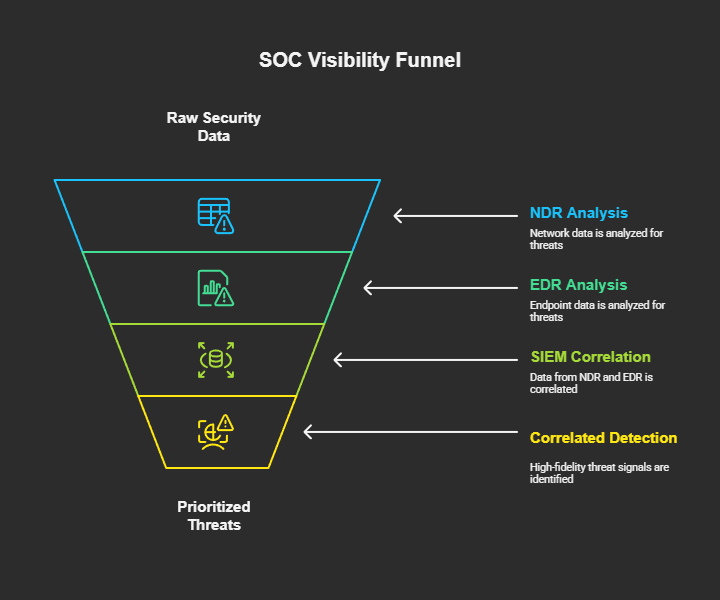
The SOC triad approach combines SIEM, EDR, and network detection and response to provide correlated visibility across log, endpoint, and network data. Rather than each tool generating independent alert streams, correlated detection stitches related signals across the full attack surface — transforming thousands of alerts into a handful of prioritized threat narratives based on attacker behaviors.
How Vectra AI thinks about alert fatigue
Vectra AI's assume-compromise philosophy treats alert fatigue as a signal quality problem, not a volume management problem. Attack Signal Intelligence uses behavioral detection models across network, cloud, identity, SaaS, and IoT/OT environments to surface real threats with high-fidelity signal — reducing alert noise by up to 99% (Globe Telecom) rather than simply filtering or suppressing alerts. The Vectra AI 2026 State of Threat Detection report details how signal clarity, delivered through a unified SOC platform, gives analysts the confidence to act on every detection.
FAQs
What is alert fatigue in cybersecurity?
Alert fatigue is the desensitization that SOC analysts experience when exposed to an overwhelming volume of security alerts. As alert volume exceeds human processing capacity, analysts begin to deprioritize, delay, or ignore alerts entirely — including genuine threats. Research shows 63% of security alerts go unaddressed (Vectra AI 2026) and 42% go uninvestigated (Microsoft/Omdia 2026). The problem is not new — it originated from healthcare alarm fatigue — but has intensified as organizations deploy more detection tools and face sophisticated, high-volume attack campaigns. Alert fatigue directly increases mean time to detect (MTTD), mean time to respond (MTTR), and breach risk.
What is the difference between alert fatigue and alarm fatigue?
Alarm fatigue originated in healthcare, where clinical staff become desensitized to the constant sound of medical device alarms in hospital settings. Alert fatigue is the cybersecurity adaptation of the same concept, applied to security monitoring alerts in SOC environments. Both share the same psychological mechanism — overwhelming notification volume leads to desensitization and missed critical signals. The key distinction is context: alarm fatigue refers to clinical alarms, while alert fatigue refers to cybersecurity alerts from SIEM, EDR, NDR, and other detection tools. This article covers the cybersecurity context exclusively.
How many security alerts does a SOC analyst receive per day?
Organizations receive an average of 2,992 security alerts daily (Vectra AI 2026), down from 3,832 in 2025 and 4,484 in 2023. Enterprises with 20,000 or more employees may receive more than 3,000 alerts per day. Despite the decline in average volumes, the problem persists — the uninvestigated rate remains critically high at 42--63% depending on the source. Volume reduction is a positive trend, but signal quality and triage capacity remain the critical bottlenecks.
What is the cost of alert fatigue?
Manual alert triage costs an estimated $3.3 billion annually in the U.S. (Vectra AI 2023). Organizations with highly fragmented SOCs spend 40% more on operational labor costs than those with consolidated tooling (Microsoft/Omdia 2026). The global average cost of a data breach reached $4.44 million (IBM 2025), and alert fatigue is a contributing factor to delayed breach detection. Indirect costs include analyst burnout, higher turnover, recruitment expenses, and the opportunity cost of experienced analysts spending time on false positives rather than threat hunting.
How does AI help with alert fatigue?
AI-powered triage platforms automate Tier 1 alert investigation, reducing manual workload by handling alert enrichment, correlation, and initial assessment. Organizations using AI extensively cut the breach lifecycle by 80 days and saved approximately $1.9 million on average (IBM 2025). Behavioral analytics models detect attacker behavior patterns rather than relying on static signatures, reducing the false positive rate at the source. However, Gartner cautions that AI-enabled SOCs reshape skill requirements rather than automatically reducing staffing needs. Analysts shift from repetitive triage to investigating escalated, high-fidelity signals.
What is cybersecurity burnout?
Cybersecurity burnout is the physical and emotional exhaustion that security professionals experience from sustained high-stress working conditions, often driven by alert fatigue. Between 63% (Tines 2023) and 76% (Sophos 2025) of SOC analysts report experiencing burnout. The 2025 SANS survey found that 70% of analysts with five years or less of experience leave their roles within three years. Burnout compounds alert fatigue — fatigued analysts make more errors, investigate fewer alerts, and are more likely to leave, creating a vicious cycle that further degrades SOC capacity.
What is alert tuning?
Alert tuning is the process of refining detection rules, thresholds, and alert configurations to reduce false positives and improve signal quality. Effective tuning starts by identifying the noisiest detection rules by alert volume, measuring the false positive rate per rule, and disabling or refining rules with rates above 50%. It also includes implementing exception lists for known-benign activity patterns and building analyst-to-detection feedback loops so that tuning is continuous rather than a one-time optimization. Monthly tuning reviews are a best practice. When combined with contextual enrichment and risk-based prioritization, alert tuning is one of the fastest ways to reduce alert fatigue without adding new tools.