Security orchestration explained: the coordination layer of modern security operations
Key insights
Security orchestration is the coordination control layer that connects disparate security tools, tasks, and teams into unified, repeatable workflows — it is the "O" in SOAR, not a synonym for it.
Automation runs one task, orchestration sequences many across tools, and SOAR is the platform that combines both with response and case management.
The orchestration and SOAR market sits at roughly USD 1.87B in 2025, trending toward USD 4.1–4.4B by 2030 at an estimated 15.8–18.8% CAGR — figures vary by analyst, so treat them as a dated range.
Orchestration directly supports NIS2 reporting clocks and NIST incident-response guidance through automated severity scoring, evidence collection, and report generation.
Most orchestration projects fail on integration complexity, rigid playbooks, and poor data quality — the fixes are starting small, building modular playbooks, and fixing the process before automating it.
Security teams run dozens of tools that rarely talk to each other. Analysts copy indicators between consoles, chase context across tabs, and lose minutes that attackers spend moving laterally. Security orchestration is the discipline that closes those gaps — connecting detection, enrichment, and response tools into coordinated workflows so the security operations center (SOC) acts as one system, not a pile of disconnected products. This guide defines the term precisely, separates it cleanly from automation and SOAR, and shows where it is heading as agentic AI reshapes the SOC.
What is security orchestration?
Security orchestration is the integration and coordination of security tools, tasks, and teams into unified, repeatable workflows. It acts as the control layer that connects detection, enrichment, and response systems so a single trigger can drive a coordinated sequence of actions across the SOC, rather than leaving analysts to stitch those steps together by hand.
The clearest way to picture it is an orchestra. Each security tool is an instrument: a SIEM listens for signals, an endpoint agent can isolate a host, an identity system can disable an account, and a ticketing platform records the work. Played alone, each is capable but uncoordinated. Orchestration is the conductor — it does not replace the instruments, it decides what plays, when, and in what order so the result is coherent instead of cacophonous.
The precise term matters because searchers who look up "security orchestration" are usually handed a definition of SOAR instead. The two are related but not identical. Orchestration is one capability: the connective tissue that coordinates tools and tasks. It is the "O" in SOAR (security orchestration, automation and response), the broader platform category that wraps orchestration together with security automation and response or case management. We situate orchestration inside SOAR here and link out to the dedicated explainer rather than duplicating it — see our deeper guide to SOAR for the full platform picture.
Keeping the distinction sharp pays off in practice. When leaders treat orchestration as a discrete, ownable concept, they can reason about it independently: which workflows to coordinate, which tools to connect, and where a human still needs to decide. That clarity is the foundation for everything that follows — how orchestration works mechanically, how it differs from automation, and how it maps to the compliance obligations that increasingly shape SOC priorities.
How security orchestration works (the control layer)
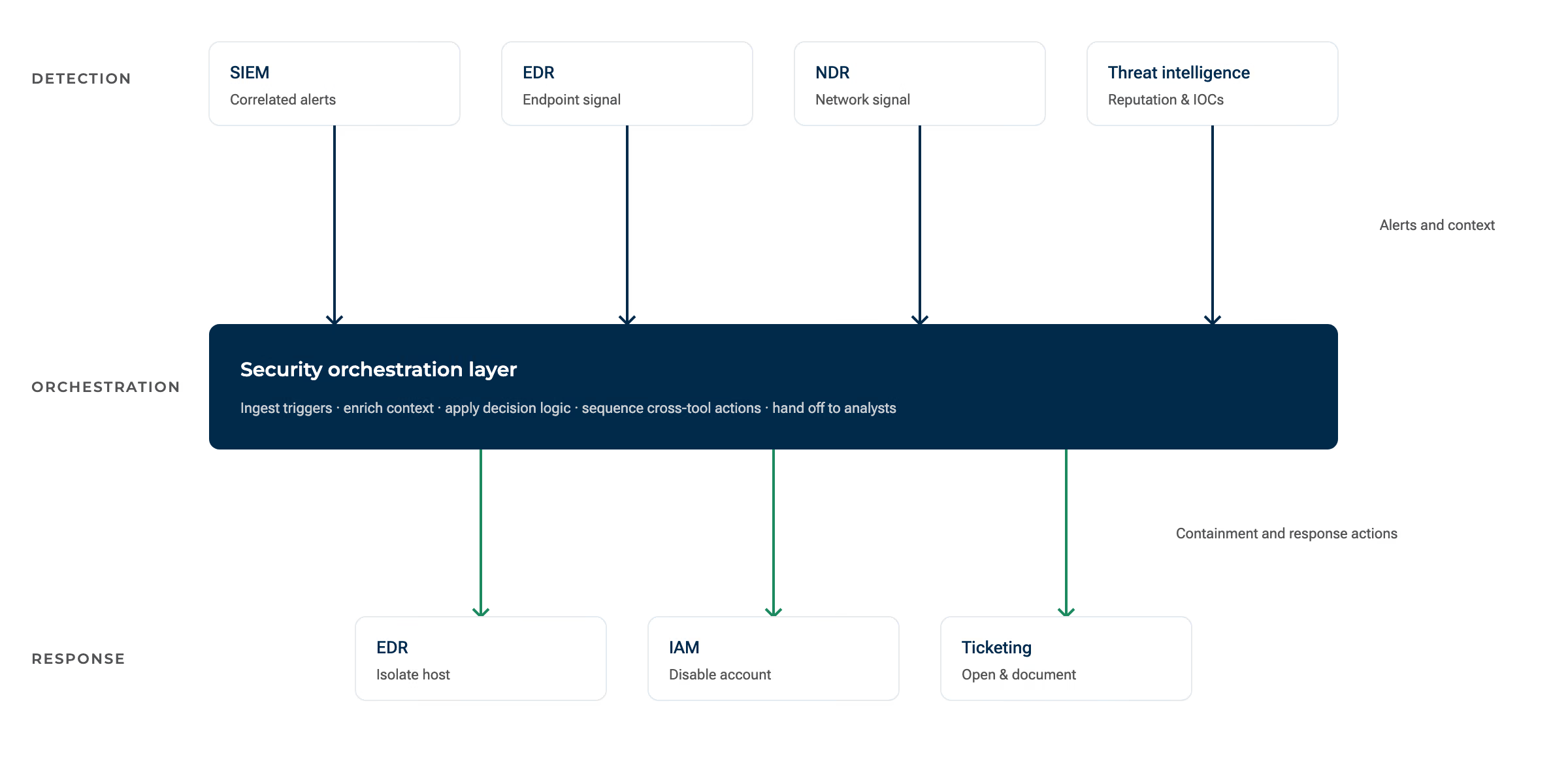
Orchestration connects tools through APIs and sequences their actions, turning isolated automated tasks into coordinated, context-aware workflows. Mechanically, it sits above the security stack as a control layer — receiving triggers, applying decision logic, calling each tool through its connector, passing data between steps, and handing off to a human when judgment is required.
The orchestration control layer sits above the SOC stack, ingesting alerts and context from detection and intelligence sources, then coordinating containment, response, and documentation actions across enforcement and workflow tools. Nodes and edges are labeled so the flow does not depend on color.
At the center is the orchestration layer. Around it sit the systems it coordinates: the SIEM and other detection sources, endpoint detection and response (EDR), network detection and response (NDR), identity and access management (IAM), threat intelligence feeds, and ticketing. Detection and intelligence systems push alerts and context inward; enforcement and workflow systems receive coordinated actions outward. The orchestration layer is what turns "an alert fired" into "the right sequence of actions ran across the right tools, in the right order."
The core functions of an orchestration tool are consistent across deployments:
Integrate tools through APIs and prebuilt connectors.
Ingest triggers from detection and intelligence sources.
Enrich events with context before any action runs.
Apply decision logic to route the workflow.
Sequence tasks across multiple tools in order.
Coordinate actions between detection, enforcement, and IAM.
Hand off to a human analyst at defined decision points.
Record every step for audit and reporting.
A useful distinction here is the playbook versus the runbook. A runbook is a procedure for a single system or task — the steps to quarantine one endpoint, for example. A playbook is the orchestrated workflow that spans multiple tools and teams for a given scenario, calling several runbooks in sequence (Wikipedia). Orchestration lives at the playbook level: it owns the "when, how, and in what order," while individual automated tasks own the "what."
That difference is easiest to see in an endpoint containment workflow. A single automated task might isolate one host. An orchestrated playbook does more: on a confirmed compromise it isolates the host through EDR, blocks the malicious IP at the firewall, disables the affected account through IAM, opens a ticket, and notifies the analyst — coordinated as one flow rather than five manual handoffs. The value is the coordination across tools, not the automation of any single step.
This is also where "enriched" orchestration earns its name. Before taking action, a well-designed workflow pulls in context: asset criticality, the affected user's role, related alerts, and threat-intelligence reputation. Acting on enriched context is what separates a workflow that contains a real threat from one that confidently isolates a CEO's laptop over a false positive. Context first, action second.
Orchestration vs automation vs SOAR
The cleanest mental model in modern security operations separates three terms that are constantly conflated. Automation is the "what": a single task executed without human action, such as detonating a suspicious URL in a sandbox. Orchestration is the "when, how, and in what order": connecting tasks, tools, and teams into a coordinated workflow. SOAR is the platform that unifies both and adds response and case management on top.
SOAR is the security platform category that combines orchestration, automation, and response with case management into a single system. It integrates disparate tools, runs playbooks across them, and gives analysts a shared workspace to manage incidents end to end. Orchestration is one pillar inside it — the coordination engine — which is why orchestration can exist as a capability without a full SOAR deployment, but SOAR cannot exist without orchestration (TechTarget).
Dimension
Automation
Orchestration
Response (SOAR)
What it does
Executes one defined task
Coordinates many tasks across tools and teams
Unifies orchestration and automation with case management
Scope
Single task or tool
Multi-tool, multi-team workflow
End-to-end incident lifecycle
Example
Detonate a URL in a sandbox
Isolate host, block IP, disable account in sequence
Manage the full phishing case from alert to closure
Human involvement
None for the task itself
Defined decision points and handoffs
Analyst-driven, with automation assisting
Table 1. Automation, orchestration, and response (SOAR) compared across what they do, their scope, a representative example, and the level of human involvement.
A common follow-on question is where SIEM and XDR fit. They are complements, not substitutes: a SIEM aggregates and correlates telemetry to surface alerts, XDR extends detection across domains, and orchestration coordinates the response to what they find. The mature pattern is to combine them rather than choose between them. For the full platform view of how orchestration, automation, and response come together, see our guide to security orchestration, automation and response (SOAR).
Types and deployment contexts
Orchestration adapts to its environment — cloud, network, policy, and AI-driven contexts each shape how it is deployed — and it increasingly arrives as code-first tooling rather than only GUI playbooks. The same control-layer principle applies across all of them, but the tools it coordinates and the decisions it routes differ by context.
Cloud security orchestration coordinates response across cloud-native services, workloads, and identities. Cloud-first deployment now dominates the broader market: cloud captured roughly 71% of the SOAR market in 2024, reflecting how much of modern security operations has moved off-premises (Mordor Intelligence, 2025). Tight integration with cloud security controls is what makes cloud orchestration effective.
Network security orchestration coordinates enforcement across firewalls, segmentation controls, and network detection so that a confirmed threat can be contained at the network layer. It connects detection to action across network security infrastructure.
Security policy orchestration focuses on consistently applying and updating security policies — access rules, segmentation, and configuration baselines — across many systems at once, reducing drift and manual reconfiguration.
AI security orchestration uses machine reasoning to decide investigative and response steps dynamically rather than following a fixed flow. It is the bridge to the agentic direction covered later in this guide.
A parallel shift is happening in how orchestration is delivered. Alongside traditional GUI playbook builders, code-first and open-source orchestration is gaining ground — workflow-as-code defined in version control, executed in isolated containers, and managed like any other engineering artifact. A March 2026 open-source launch brought Git-friendly, code-first workflow orchestration to security operations, signaling a 2026 trend toward developer-style tooling for resource-constrained and engineering-led teams (Help Net Security, 2026). Code-first and GUI approaches are not mutually exclusive; many teams use both depending on the workflow and who maintains it.
Security orchestration in practice
Phishing, endpoint containment, and alert triage are the canonical orchestration use cases, set against a market growing at an estimated 16–19% annually. These three workflows are where most teams start because they are frequent, predictable, and high-volume — the conditions under which coordination pays off fastest.
Phishing investigation and response. When a user reports a suspicious email, an orchestrated workflow auto-enriches the message, detonates URLs and attachments, renders a verdict, and remediates confirmed phishing across affected mailboxes. It is the canonical "start here" use case because phishing is frequent and pattern-predictable. One vendor case study reported roughly a 77% reduction in time to resolution and around a third of phishing cases handled with full automation; treat these as vendor-reported figures from a single deployment rather than universal benchmarks (Logpoint case study, vendor-reported).
Endpoint threat containment. On a confirmed compromise, orchestration coordinates EDR host isolation, a firewall IP block, and an IAM account disable in one workflow — the cross-tool coordination that single-tool automation cannot deliver.
Alert triage and severity scoring. On ingest, a scoring playbook reconciles asset criticality, affected users, and threat-intelligence context to prioritize alerts and, for major incidents, kick off statutory reporting. This is where orchestration connects day-to-day incident response to compliance obligations.
The driver behind all three is alert overload. Surveys consistently rank alert fatigue among the top SOC concerns — cited by roughly 76% of organizations in one 2025 study — and reported daily alert volumes range widely, from around 960 to well over 100,000 depending on organization size and counting methodology (Cybersecurity Insiders, 2025). The range matters more than any single number: the point is that volumes routinely exceed what human-only analysis can keep pace with, which is precisely the problem coordination addresses. Reducing alert fatigue is one of the clearest returns on a well-scoped orchestration program.
On market size, analysts disagree, so the honest answer is a dated range. The orchestration and SOAR market sat at roughly USD 1.87B in 2025 and is projected to reach USD 4.1–4.4B by 2030 at an estimated 15.8–18.8% CAGR, depending on the firm, scope, and base year (Mordor Intelligence, 2025; Grand View Research, 2025). These figures shift within six to twelve months and conflict across analysts — cite them with dates and never as a single authoritative number.
When evaluating the tools and platform landscape, look for breadth of integrations, the ability to build modular and reusable playbooks, human-decision checkpoints, and audit-ready logging — and weigh code-first against GUI-driven approaches based on who will maintain the workflows. Industry analysts frame this as a defined category with established evaluation criteria (Gartner SOAR glossary). For a broader operational view of how these capabilities fit a modern team, see our overview of security operations and the role of threat intelligence in enrichment. Independent, real-world accounts of orchestration transforming a SOC reinforce the same lesson: start narrow, prove value, then expand (SANS).
Why orchestration projects fail (and how to fix it)
Orchestration projects fail on integration complexity, rigid playbooks, and poor data — and the fixes are starting small, designing modular workflows, and thinking process-first. Vendor pages tend to skip this part. Naming the failure modes honestly is what separates a program that delivers from one that stalls after the first quarter.
Failure mode
Why it happens
How to fix it
Integration and API complexity
Connectors break as tools update; maintenance burden grows
Start with a few well-supported integrations; budget for ongoing connector upkeep
Rigid if/then playbooks
Brittle logic automates a broken process (garbage in, garbage out)
Fix the process first; build modular, reusable playbooks that call each other
Poor data quality
Workflows act on incomplete or low-fidelity input
Enrich with context before acting; validate inputs at each decision point
Expertise shortage
Small teams cannot build or maintain complex automation
Treat orchestration as a force multiplier; start with frequent, predictable incidents
Table 2. Common orchestration failure modes paired with their practical fixes.
The single most expensive mistake is automating a broken workflow. Orchestration amplifies whatever process it encodes, so if the underlying triage logic is flawed, automation scales the flaw. Fix the process first, then automate it — garbage in, garbage out applies with compounding interest once a playbook runs hundreds of times a day.
Design discipline addresses most of the rest. Begin with frequent, predictable incidents such as phishing and suspicious logins, where patterns are stable and the payoff is immediate. Build small, modular playbooks that call one another rather than monolithic flows that are impossible to maintain. Define triggers, decision points, and what "success" means before deploying anything. And always keep manual fallbacks for when automation fails — orchestration should degrade gracefully, not catastrophically.
The expertise gap deserves honest framing too. Europe's cybersecurity workforce shortfall has been cited at roughly 299,000 unfilled roles, which positions orchestration as a force multiplier for stretched teams rather than a replacement for skilled people. That figure should be read as an estimate from secondary reporting pending primary-source confirmation, but the directional point holds: orchestration helps small teams do more, which is also why disciplined incident response automation and broader security automation matter most where staff are scarce.
Security orchestration and compliance
Orchestration helps meet NIS2 reporting clocks and operationalizes NIST incident-response guidance through automated severity scoring, evidence collection, and report generation — a gap most competitor pages ignore. For regulated enterprises, this is often the clearest justification for the investment.
Framework
Requirement
How orchestration maps
Reference
EU NIS2 Directive
Incident reporting: 24h early warning, 72h notification, 1-month final report
Automated severity scoring, evidence collection, and report generation help meet statutory clocks
Table 3. How security orchestration maps to key regulatory frameworks and standards.
Under the EU NIS2 Directive, in-scope entities face a tiered reporting regime — a 24-hour early warning, a 72-hour notification, and a final report within one month — and orchestrated severity scoring, evidence collection, and report generation help teams hit those clocks reliably. The exact article numbering should be confirmed against the directive text before publication, but the reporting timelines themselves are well established.
On the standards side, NIST revised SP 800-61 to revision 3 in April 2025, explicitly acknowledging that modern data volumes exceed what human-only analysis can handle and encouraging automation and orchestration within the incident response workflow (NIST, 2025). This complements the broader compliance posture that the DETECT and RESPOND functions of NIST CSF 2.0 describe. Defensive frameworks make the mapping concrete: an orchestrated response to a brute-force attempt (T1110, MITRE ATT&CK) can move through detect, isolate, credential reset, and harden — the kind of structured eviction that MITRE D3FEND is designed to represent in machine-readable form.
Where security orchestration is heading
Orchestration is evolving toward agentic, reasoning-driven automation, but it remains the durable control layer beneath any AI agent or platform. The defining 2026 narrative is the shift from static-playbook SOAR to the agentic, or autonomous, SOC — and understanding it requires one careful distinction.
Automated and autonomous are not the same. Automated systems execute predefined steps: a playbook runs the same way every time. Autonomous systems reason about the situation and decide the steps dynamically, planning an investigation rather than replaying a script. The pragmatic middle ground that most serious practitioners endorse is human-on-the-loop, where AI agents act within bounded guardrails while humans supervise and can intervene — distinct from approving every individual action.
This shift is reshaping the category in two ways. First, analysts are re-classifying the space: standalone orchestration, automation, and case management are increasingly folding into broader security-operations platforms rather than standing alone as a discrete product box (Dark Reading). Second, agentic AI is being positioned as the new layer that plans and reasons on top of existing tooling, supported by AI-driven detection that surfaces what those agents act on. A healthy dose of realism applies: one widely cited 2026 survey found roughly 85% of enterprises piloting AI agents but only about 5% running them in production, a clear hype-versus-maturity gap (VentureBeat, 2026).
The durable view is straightforward. Whatever agent or platform sits on top, orchestration remains the integration and coordination control layer beneath it. Agents change how workflows are decided; they do not eliminate the need to coordinate tools, sequence actions, and document what happened. For teams without the staff to build this themselves, that capability increasingly arrives through a managed SOC model.
How Vectra AI thinks about security orchestration
At Vectra AI, we see orchestration's durable value as the integration and coordination control layer — the part that stays valuable no matter which agent or platform sits above it. The decisive factor is the quality of the signal feeding it. Orchestrated response is only as trustworthy as the input that triggers it, and automating on noisy input simply scales the noise. High-fidelity attack signal is what makes orchestrated, and eventually autonomous, response safe to act on: coordinate on clear signal, and orchestration becomes a force multiplier; coordinate on false positives, and it becomes an automated liability.
Conclusion
Security orchestration is the coordination control layer of modern security operations — the connective tissue that turns a collection of disconnected tools into a system that acts as one. Defined precisely, it is the "O" in SOAR: one capability that sequences tasks across tools and teams, distinct from single-task automation and from the broader SOAR platform that wraps it. The practical payoff shows up in canonical workflows like phishing response, endpoint containment, and alert triage, and in concrete compliance leverage against NIS2 reporting clocks and NIST guidance.
The path forward is clear-eyed. Start with frequent, predictable incidents, build modular playbooks, and fix the process before you automate it. As agentic AI reshapes how workflows are decided, orchestration does not disappear — it becomes the durable foundation beneath the agents. And the decisive variable throughout is signal quality: orchestrated response is only as good as what triggers it. To go deeper on the surrounding disciplines, explore our guides to SOC operations, security automation, and incident response automation.
FAQs
What is security orchestration?
Security orchestration is the integration and coordination of security tools, tasks, and teams into unified, repeatable workflows. It acts as the control layer that connects detection, enrichment, and response systems so a single trigger drives a coordinated sequence of actions across the SOC instead of manual, tool-by-tool handoffs. Orchestration is the "O" in SOAR — one capability within the broader platform category, not a synonym for it. In practice, it owns the "when, how, and in what order" of a security workflow: which tools act, in what sequence, and where a human analyst needs to decide. A common example is an endpoint containment playbook that isolates a host, blocks a malicious IP, and disables a compromised account as one coordinated flow rather than three separate manual steps. The goal is to make a SOC operate as a single coherent system rather than a collection of disconnected tools.
How is security orchestration different from automation?
Automation executes a single task without human action — detonating a URL in a sandbox, for example. Orchestration coordinates many such tasks across multiple tools and teams, deciding the sequence and routing decisions along the way. The simplest framing: automation is the "what," and orchestration is the "when, how, and in what order." A useful test is scope. If you are running one task on one tool, that is automation. If you are connecting several tasks across several tools into a workflow — and handing off to a human at defined points — that is orchestration. The two are complementary, not competing: orchestration coordinates the automated tasks that make up a workflow. See the comparison table in the disambiguation section above for a side-by-side view of automation, orchestration, and SOAR across scope, examples, and human involvement.
What is SOAR?
SOAR is the security platform category that combines orchestration, automation, and response with case management into a single system. It integrates disparate security tools, runs playbooks across them, and gives analysts a shared workspace to manage incidents from initial alert through to closure. Orchestration is one pillar inside SOAR — the coordination engine — alongside automation and response or case management. The relationship is hierarchical: orchestration can exist as a capability without a full SOAR deployment, but SOAR cannot exist without orchestration underneath it. Because SOAR is a broad topic in its own right, this guid
What is the difference between security orchestration and SOAR?
Orchestration is one capability; SOAR is the broader platform that contains it. Orchestration is the coordination layer that connects tools and sequences their actions — the "O" in the acronym. SOAR (security orchestration, automation and response) is the full platform that wraps orchestration together with automation and response or case management, giving analysts an end-to-end workspace for the incident lifecycle. Put differently, orchestration answers "how do these tools work together," while SOAR answers "how does the whole team manage incidents from detection to closure." You can practice orchestration without buying a SOAR platform — by connecting a handful of tools into coordinated workflows — but a SOAR platform always includes orchestration as a core pillar. Keeping the two distinct helps teams reason clearly about which workflows to coordinate first and whether a full platform is warranted.
Can security orchestration help with compliance reporting?
Yes. Orchestration directly supports regulatory reporting by automating the time-sensitive, evidence-heavy work that statutory clocks demand. Under the EU NIS2 Directive, in-scope entities must deliver a 24-hour early warning, a 72-hour notification, and a final report within one month — deadlines that are difficult to hit manually during an active incident. Orchestrated workflows help by scoring severity automatically, collecting and timestamping evidence as the incident unfolds, and generating draft reports populated with the required details. The same capability supports NIST guidance: SP 800-61 revision 3, published in April 2025, encourages automation and orchestration within the incident-response lifecycle precisely because data volumes now exceed human-only analysis. Orchestration also operationalizes the DETECT and RESPOND functions of NIST CSF 2.0 through coordinated, repeatable actions. See the compliance section above for a framework-by-framework crosswalk, and note that exact NIS2 article numbering should be confirmed against the directive text before relying on it.
What should I look for in a security orchestration platform?
Focus on five things. First, integration breadth — the platform is only as useful as the tools it can connect, so check for prebuilt connectors to your SIEM, EDR, identity, and ticketing systems. Second, modular playbook design — the ability to build small, reusable workflows that call each other, which keeps maintenance manageable as your library grows. Third, human-decision checkpoints — well-designed orchestration hands off to analysts at defined points rather than acting blindly. Fourth, audit-ready logging — every action recorded with timestamps, which matters for both troubleshooting and compliance reporting. Fifth, the delivery model — weigh code-first, version-controlled approaches against GUI playbook builders based on who will maintain the workflows; engineering-led teams may prefer workflow-as-code, while generalist teams often favor visual builders. Above all, evaluate the quality of the signal feeding the platform: orchestrating on noisy, low-fidelity input simply scales the noise, so high-fidelity detection is a prerequisite for trustworthy automation.
Will agentic AI replace security orchestration?
No — agentic AI changes how workflows are decided, but orchestration remains the durable control layer beneath it. The distinction is between automated and autonomous: automated systems run predefined steps, while autonomous agents reason about the situation and plan the steps dynamically. Even as agents take over the decision-making, something still has to integrate the tools, sequence the actions, and document what happened — and that is orchestration. The realistic near-term model is human-on-the-loop, where agents act within bounded guardrails and humans supervise and can intervene. Adoption data supports caution: one 2026 survey found roughly 85% of enterprises piloting AI agents but only around 5% in production, indicating a significant hype-versus-maturity gap. The durable takeaway is that orchestration is not being replaced; it is being repositioned as the foundation that agentic systems build on. Coordinate on high-fidelity signal and that foundation strengthens, regardless of how much reasoning moves to AI.