SOC as a Service delivers enterprise-grade security operations through a subscription model, eliminating the $1.5-2M annual cost of building internal SOC teams
Organizations with AI-augmented SOCaaS achieve 96% faster threat detection while saving an average of $1.8 million per breach
The Sophos-Secureworks $859 million acquisition signals market consolidation, creating more sophisticated managed security offerings
SMBs comprise the fastest-growing segment as 60% face closure within 6 months of successful attacks without proper security
Modern SOCaaS platforms integrate seamlessly with existing SIEM, EDR, and XDR tools while providing 24/7 monitoring and compliance reporting
4 million cybersecurity positions sit unfilled globally (ISC2, 2024). For most organizations, that gap makes building a continuous 24/7 analyst operation structurally impossible, which is the condition SOC as a Service was designed to address. This page explains what SOCaaS is, how it operates, how it differs from MDR and MSSP, and what determines whether it fits a given security environment.
What is SOC as a Service?
SOC as a Service (SOCaaS) is a cloud-based subscription model that provides 24/7 threat detection, monitoring, and incident response through a third-party managed security operations center, removing the need to build and staff an in-house SOC. Organizations subscribe to a defined set of security functions delivered by the provider's analyst team, detection technology, and threat intelligence.
Most mid-market organizations cannot sustain three analyst shifts, a detection engineering function, and a threat intelligence program simultaneously. SOCaaS bundles these into a subscription with detection coverage active within 30–90 days of onboarding. Unlike log-forwarding agreements, SOCaaS includes active containment, analysts who can isolate hosts, reset credentials, and block traffic during an attack, not just send alert emails.
How does SOC as a Service work?
SOCaaS runs through five sequential stages that operate continuously, not as a one-time setup. Each stage is active in parallel across the customer environment without requiring on-premises infrastructure.
Stage 1 — Asset discovery and tool integration: The provider connects to the customer environment through APIs, log forwarding, and network monitoring. SIEM platforms, EDR tools, identity systems, and cloud services are onboarded within the first 30–90 days.
Stage 2 — Continuous telemetry ingestion: Security events flow from endpoints, networks, cloud platforms, and identity systems into the provider's detection stack, creating a unified view across the attack surface.
Stage 4 — Analyst investigation: Tier 1 analysts perform initial triage. Confirmed threats escalate to Tier 2 or Tier 3 specialists for deeper investigation, threat hunting, and forensic analysis.
Stage 5 — Containment and reporting: Analysts isolate hosts, reset credentials, and block malicious traffic, then generate the documented evidence chain that compliance auditors and cyber insurers request after any incident.
What are the key components of SOCaaS?
A SOCaaS offering combines four components. The absence of any one creates gaps that rarely show up in a sales conversation and almost always show up during a breach.
A detection stack includes SIEM for log aggregation, EDR or NDR for endpoint and network visibility, cloud security integrations, threat intelligence feeds, and behavioral analytics. Providers that rely on signature-based detection alone miss the identity abuse and lateral movement that arrive through legitimate credentials and encrypted traffic, the techniques that most enterprise breaches now use to avoid alerting.
Defined security processes
Escalation procedures, runbooks, and response playbooks define how analysts act on detections and communicate with the customer's internal teams. Without documented process, a provider's detection quality is irrelevant, response depends on who picks up the phone and what they do next.
Service level agreement (SLA)
A contractual commitment defining response time targets (typically 15 minutes to 4 hours for critical incidents), threat coverage scope, reporting cadence, data handling requirements, and escalation paths. A vague SLA means the provider has not committed to measurable outcomes, and will not be accountable for them when it matters.
What are the benefits of SOC as a Service?
Industry estimates suggest that building an in-house SOC capable of 24/7 coverage can cost $1.5–2 million annually in staffing alone for a mid-sized enterprise, excluding technology, infrastructure, and training. SOCaaS shifts this from capital-intensive hiring to operational spend, with detection coverage typically active within 30–90 days of onboarding.
Cost reduction and ROI: Organizations typically achieve positive ROI within 6, 12 months through eliminated infrastructure investment, shared tooling across the provider's customer base, and reduced breach costs. IBM Cost of a Data Breach 2024 found that organizations with AI and automation in their security operations reduce breach costs by an average of $2.22 million compared to those without.
Faster detection and response: Dedicated analysts and continuously tuned detection models reduce mean time to detect and respond across every stage of the cyber kill chain, outcomes that correlate directly with breach severity and total containment cost.
Access to specialized expertise: SOCaaS providers handle thousands of incidents across industries, building pattern recognition across attack techniques — including ransomware campaigns and multi-stage attacks, credential abuse, and SEO-based threat delivery,that isolated internal teams cannot develop from lower incident volume. When one customer encounters a novel technique, every customer in the provider's fleet gets updated detection within hours.
Scalability: Provider infrastructure scales with organizational growth, cloud migration, or acquisition without requiring proportional headcount increases. The average cybersecurity position takes 21 weeks to fill. Waiting for hiring to keep pace with growth is not a detection strategy.
Continuous coverage: Follow-the-sun analyst shifts eliminate the detection gap during nights, weekends, and holidays, precisely when attackers with a 62-minute average breakout time (CrowdStrike Global Threat Report 2025) prefer to operate.
Compliance-grade documentation: Continuous logging, incident timelines, and audit-ready reports directly support requirements across HIPAA, PCI DSS, GDPR, NIS2, and CMMC without building internal evidence management infrastructure.
SOCaaS MDR and MSSP key differences
When an attacker is actively moving through your environment, the service type determines how quickly, and whether, containment happens. SOC as a Service, managed detection and response, and managed security service providers describe different operational models with different containment speeds, coverage scopes, and cost structures.
Organizations seeking full outsourcing without building an internal security program
Organizations with existing security programs needing specialized detection expertise
Organizations needing managed IT security infrastructure at scale
Typical monthly cost
$1K–$83K+ (scales by organization size)
$8K–$300K
$1K–$30K
Key differentiator
Comprehensive coverage including compliance and governance reporting
Specialized detection and response depth
IT infrastructure coverage breadth
SOCaaS vs MDR
SOCaaS and managed detection and response (MDR). The scope is what differs: SOCaaS includes compliance reporting, security program governance, and vulnerability coverage alongside detection and response. MDR narrows to threat detection and active containment — the right choice for organizations with established internal programs that need detection depth, not full operations outsourcing. Choosing MDR expecting full SOC coverage means rebuilding governance infrastructure internally alongside the outside detection service.
SOCaaS vs MSSP
MSSPs emerged from managed IT services. Their core business was keeping devices online and forwarding logs — not investigating behavioral anomalies or hunting for persistence. Many have expanded to include detection and response, but most still exclude vulnerability management and broader operational functions that SOCaaS bundles. The difference in analyst specialization and detection investment becomes visible when an active attack needs to be contained in under an hour.
Small business SOCaaS packages start at $1,000 per month. Enterprise deployments with custom SLAs and dedicated account teams reach $83,000 or more. The difference is analyst availability, SLA response time guarantees, and compliance reporting depth, not vendor margin.
IBM Cost of a Data Breach 2024 found that organizations with mature security AI and automation reduce breach costs by $2.22 million on average. For a mid-market organization spending $180,000 annually on SOCaaS, that figure recovers the full year's investment from a single avoided breach.
Who needs SOC as a Service?
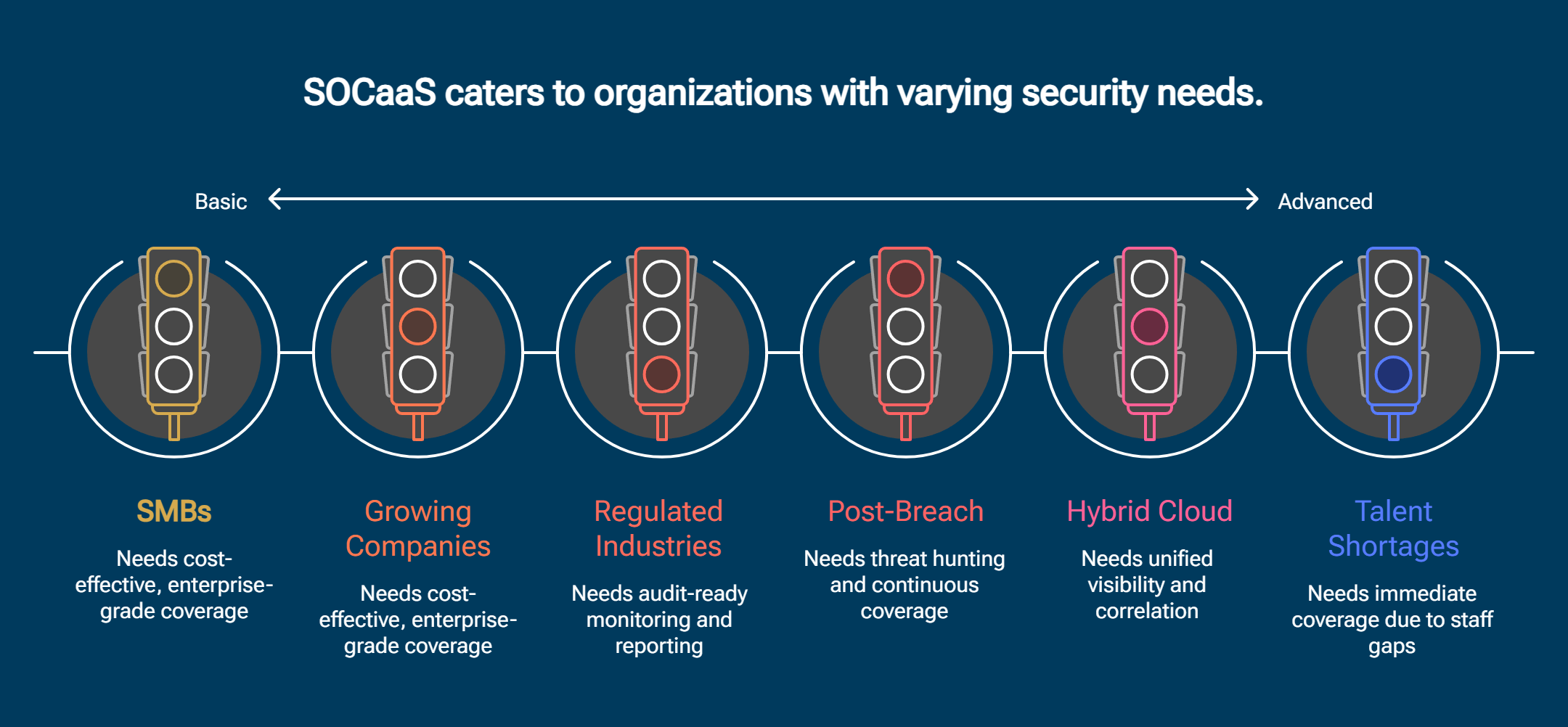
4 million cybersecurity positions sit unfilled globally (ISC2, 2024). Five scenarios identify when that gap, combined with operational complexity, makes SOCaaS the more defensible choice than continued in-house buildup.
Organizations with talent constraints
The ISC2 2024 workforce study counted 4 million unfilled cybersecurity positions globally. The average security role takes 21 weeks to fill. Building a three-shift analyst operation from scratch produces a team that needs additional months to develop the detection muscle memory that a provider's existing team has accumulated across thousands of incidents. SOCaaS provides that coverage within the onboarding window.
Hybrid and multi-cloud environments
Security teams monitoring activity across on-premises data centers, multiple cloud providers, SaaS platforms, IoT devices, and remote endpoints face one specific problem: no single point-solution covers all of these surfaces simultaneously. SOCaaS providers instrument the full environment and maintain the cross-domain correlation that spotting lateral movement requires.
Regulated industries
Healthcare, financial services, defense contractors, and government organizations facing HIPAA, PCI DSS, CMMC, NIS2, or DORA requirements need two things that internal teams struggle to produce at scale: continuous monitoring evidence and audit-ready incident documentation. SOCaaS generates both as a byproduct of normal operations.
SMBs and growth-stage companies
SMBs without a dedicated security operations function represent the fastest-growing SOCaaS adoption segment. Packages at $1,000–$10,000 monthly deliver detection and compliance reporting without requiring a full-time analyst to manage them — the only realistic option for organizations that cannot justify a six-figure annual security hire.
Organizations recovering from incidents
After a breach, the immediate threat is not the attacker's next move, it is the persistence they left behind before they were detected. SOCaaS providers deploy within days, actively hunt for footholds that pre-breach monitoring missed, and establish the continuous coverage the incident exposed as absent.
How to choose a SOCaaS provider
Feature lists and marketing claims are the wrong inputs for this decision. What matters is whether the provider can contain an active attack faster than the attacker can escalate. These five criteria produce an evaluation that security leaders can defend to boards and regulators.
Criterion
What to evaluate
Red flags
Detection coverage
MITRE ATT&CK technique coverage map, behavioral vs. signature-based detection ratio, coverage across network, identity, cloud, and endpoint
Signature-only detection with no behavioral AI; no published ATT&CK coverage map; endpoint-only visibility
Guaranteed MTTR by incident severity, escalation path documentation, SLA performance reporting cadence, financial penalties for SLA failure
No guaranteed response times; vague SLA language; no performance reporting; no financial accountability for SLA breach
SOCaaS and compliance
NIS2 took effect across EU member states in October 2024. CMMC 2.0 is phasing in for U.S. defense contractors through 2025 and 2026. SEC Regulation S-P requires large broker-dealers to disclose material cybersecurity incidents within 30 days. Each of these frameworks shares one requirement that point-in-time audits cannot satisfy: continuous monitoring evidence that controls are operating, not just documented.
SOCaaS addresses four specific dimensions of that obligation.
Continuous monitoring evidence
HIPAA's administrative safeguards (45 CFR 164.312) require ongoing activity monitoring. PCI DSS Requirement 10 mandates log management and monitoring across cardholder data environments. SOCaaS generates the 24/7 monitoring record these requirements demand, without the internal infrastructure cost of building and maintaining it.
Incident response documentation
Every incident generates a detection timeline, analyst action log, containment record, and resolution summary. That evidence chain is what cyber insurers require for claims, what regulators inspect during breach investigations, and what internal auditors use to assess control effectiveness. Producing it manually after the fact is slower and less reliable than receiving it as standard output from the SOCaaS platform.
Regulatory framework alignment
Leading SOCaaS platforms map detection capabilities to the NIST Cybersecurity Framework, ISO 27001, and MITRE ATT&CK. NIS2, DORA, and CMMC 2.0 are accelerating SOCaaS adoption specifically because they require demonstrable security operations capability, not policy binders and annual attestations.
Breach notification timelines
GDPR's 72-hour notification window and the SEC's 30-day Regulation S-P disclosure requirement are only achievable when detection and containment are fast. SOCaaS platforms with behavioral detection capabilities reduce time from initial compromise to containment, converting a process problem into a technology outcome.
How Vectra AI approaches SOC as a Service
Most managed security providers reconstruct attacks from logs — correlating events after the fact, then alerting on what already happened. Vectra AI delivers managed extended detection and response by observing how attackers behave in motion across network, identity, cloud, and SaaS before that behavior generates a conventional alert.
AI-driven attack signal intelligence
Vectra AI's behavioral AI models analyze how attackers progress through the cyber kill chain, reconnaissance, lateral movement, privilege escalation, command-and-control, and surface only the signals that indicate real attack progression, not statistical deviation. Organizations using Vectra AI have reduced mean time to detect and respond by more than 50% and cut low-fidelity alert volume by more than 99%.
Network and identity visibility
Vectra AI continuously monitors east-west network traffic and identity behavior across hybrid environments, including unmanaged devices that cannot run endpoint detection and response agents. Coverage spans on-premises data centers, multi-cloud, identity systems, SaaS platforms, IoT/OT, and AI infrastructure as one unified attack surface. Attackers who log in with valid credentials and move laterally between workloads remain visible, the gap that endpoint-only managed services cannot close.
Measurable outcomes
Globe Telecom reduced incident response time from 16 hours to 3.5 hours and cut alert noise by 99%, enabling analysts to focus on 6 real incidents instead of hundreds of thousands of low-fidelity alerts. A global manufacturing company isolated ransomware-infected hosts across Brazil and India within 30 minutes of detection, preventing OT disruption and production downtime. A global healthcare organization detected stolen credentials, cloud reconnaissance, and AWS persistence within days of deployment, activity that had not surfaced in their SIEM.
Ransomware breakout time now averages 62 minutes (CrowdStrike, 2025). The average data breach costs $4.88 million (IBM, 2024). The average cybersecurity position takes 21 weeks to fill. For organizations without continuous detection coverage, none of those numbers is improving.
The case for managed security operations is not theoretical. The question is whether your current detection posture can absorb the next 62 minutes. Security leaders can pressure-test that against four specific conditions in their environment:
Do we have 24/7 detection and response coverage — including nights, weekends, and holidays, when sophisticated attackers prefer to operate?
Can our current team detect lateral movement and identity-based attacks in real time, or only after compromise is confirmed?
Do we have audit-ready documentation of security control effectiveness for our applicable regulatory frameworks?
What is our realistic mean time to detect and respond to a credential-based attack, and does that number satisfy our risk tolerance?
Conclusion
The convergence of escalating cyber threats, critical security talent shortages, and technological advancement has positioned SOC as a Service as an essential component of modern cybersecurity strategy. With the market projected to reach $28.5 billion by 2029 and major acquisitions like Sophos-Secureworks validating the model's maturity, organizations across all industries and sizes are recognizing that managed security operations deliver superior outcomes compared to traditional approaches.
The evidence is compelling: organizations leveraging SOCaaS achieve 96% faster threat detection, save 50-70% compared to in-house SOC costs, and gain access to expertise and technologies that would otherwise remain out of reach. As autonomous SOC platforms emerge and AI capabilities mature, the gap between managed and internal security operations will only widen, making the decision to adopt SOCaaS less about whether and more about when and how.
Ready to explore how modern SOC as a Service can transform your security operations? Discover how Vectra AI's Attack Signal Intelligence™ approach delivers high-fidelity threat detection while reducing the noise that overwhelms traditional SOC operations.
FAQs
What is the difference between SOC as a Service and a traditional SOC?
A traditional SOC is an internal team the organization builds, staffs, and operates. SOCaaS delivers the same functions, monitoring, detection, triage, response, and reporting, through a third-party provider on a subscription basis. The structural difference is capital: internal SOCs require $1.5–2 million annually in analyst staffing before technology costs; SOCaaS converts that into predictable monthly spending with coverage active within 90 days. The tradeoff is control, in-house teams integrate more deeply with business context, SOCaaS trades that depth for speed and scale.
What is the difference between SOCaaS and MDR?
SOCaaS bundles monitoring, detection, response, compliance reporting, and security program governance into one subscription. MDR focuses on threat detection and active response. The primary distinction is scope: organizations outsourcing their entire security operations function choose SOCaaS; organizations with internal security programs that need specialized detection depth choose MDR. Choosing MDR expecting full SOC coverage means rebuilding governance infrastructure internally alongside the outside detection service.
How long does SOCaaS implementation take?
Most deployments complete initial onboarding within 30–90 days, beginning with coverage of critical assets and expanding as the provider fine-tunes detection rules and integrates additional data sources. Parallel operation with existing tools is standard during the transition period, maintaining detection continuity while the new service is calibrated.
What types of organizations use SOC as a Service?
SOCaaS adoption spans all size segments. The fastest growth is in SMBs under 500 employees and regulated industries, healthcare, financial services, and defense contractors, where compliance documentation requirements exceed what internal teams can produce. Enterprise deployments typically use co-managed models in which internal teams retain strategic oversight while the provider handles 24/7 monitoring and first-line response.
Can SOCaaS integrate with existing security tools?
Modern SOCaaS platforms connect to existing SIEM, EDR, XDR, and cloud security tools through APIs and log forwarding. The integration model augments rather than replaces existing investments. Providers conduct a discovery assessment during onboarding to map integration dependencies and identify coverage gaps, the gaps are usually what the existing tools were leaving open before the SOCaaS engagement began.
What is the typical ROI for SOC as a Service?
Organizations typically reach positive ROI within 6–12 months. IBM Cost of a Data Breach 2024 found that organizations with mature security AI and automation reduce breach costs by $2.22 million on average. For a mid-market organization spending $180,000 annually on SOCaaS, that figure exceeds the full year's investment from a single avoided breach. Direct cost avoidance, eliminated tool licenses, infrastructure, and analyst headcount, compounds on top of that.
Are there still traditional in-house SOCs?
Yes. Large enterprises, government agencies, and organizations in highly sensitive operational environments operate in-house SOCs, often augmenting them with managed services for specific capabilities, after-hours coverage, threat hunting, or specialized cloud detection. The more common model is co-managed: internal teams own strategy, escalation, and business context; the provider handles continuous monitoring and first-line response.
What are SOC 1, SOC 2, and SOC 3 reports?
SOC 1, 2, and 3 are audit reports published by the AICPA, they are not assessments of security operations center capability. SOC 2 reports evaluate a service organization's controls over security, availability, and confidentiality. They are relevant when vetting a SOCaaS provider as a vendor: a SOC 2 Type II report describes the provider's internal compliance posture, not how quickly they contain an active attack. Request both a SOC 2 Type II and a MITRE ATT&CK coverage map, the first establishes vendor trust, the second establishes detection capability.