Insider risk management explained: a 2026 program guide for security and GRC leaders
Key insights
Insider risk management addresses all risk from trusted access; the insider threat is only the malicious subset, and the negligent majority drives most cost. In 2026, 53% of incidents were non-malicious, accounting for $10.3 million of the $19.5 million average annualized cost (Help Net Security, 2026).
Governance comes before tooling. Stand up cross-functional ownership across security, HR, legal, and executive sponsorship, then build in phases against CISA's four-step model.
AI reshaped the threat model. Shadow AI is now a measured insider category, and AI agents act as privileged non-human insiders that legacy tools largely cannot monitor.
Maturity is measurable for free. Baseline a program with the CISA/CMU IRMPE self-assessment (19 NITTF elements) and track board-ready KPIs like mean time to detect and percentage of incidents pre-empted.
Modern insider risk management is behavior-first and identity-aware, covering human and non-human actors with privacy-by-design monitoring rather than data rules alone.
Insider risk management is the practice of identifying, assessing, and mitigating risks posed by people with legitimate access to an organization's systems and data — employees, contractors, partners, and increasingly non-human identities such as service accounts and AI agents. It is broader than the insider threat: all insider threats are insider risks, but most insider risk is negligent or accidental, not malicious.
That distinction matters because it changes how you build a program, who owns it, and where you spend. The economics are now hard to ignore. The 2026 Ponemon/DTEX research puts the average annualized cost of insider risk at $19.5 million, and a record-low 67 days to contain an incident still leaves a long window for damage (Help Net Security, 2026). At the same time, two new forces — employees pasting sensitive data into public AI tools, and autonomous AI agents acting with standing privilege — have opened blind spots that legacy data exfiltration controls and user and entity behavior analytics tools were never designed to see.
This guide explains what insider risk management is, how a program works, who runs it, how to measure its maturity, and why the AI era demands a rethink. It is written for CISOs, SOC leaders, security architects, and GRC teams who need to stand up or mature a program — and prove its value to a board.
What is insider risk management?
Insider risk management (IRM) is the discipline of identifying, assessing, and mitigating the risk that trusted people and identities will harm an organization — whether by accident, negligence, or intent. It spans employees, contractors, partners, and, increasingly, non-human identities (NHIs) such as service accounts and AI agents that hold standing access.
The single biggest source of confusion in this space is the difference between insider risk and the insider threat. The relationship is one of scope: an insider threat is a deliberate, malicious act by someone with trusted access — theft, sabotage, or espionage. Insider risk is the larger universe that contains it, and that universe is dominated by ordinary mistakes. A useful analogy: insider threat is arson, but insider risk is every way a building can catch fire, including a frayed cable nobody noticed. You manage the building for fire, not just for arsonists. For deep coverage of the malicious subset — detection methods, indicators, and program tactics — see Vectra AI's guide to the insider threat.
Why does this matter now? Because the cost has climbed and the attack surface has widened. The 2026 Ponemon/DTEX research puts the average annualized cost of insider risk at $19.5 million, up roughly 20% over two years (Help Net Security, 2026). And the same research names a category most programs cannot yet monitor: employees feeding internal documents, source code, and strategic plans into public AI platforms. We unpack the economics, the types of insiders, and the AI blind spot in the sections that follow.
How insider risk management works
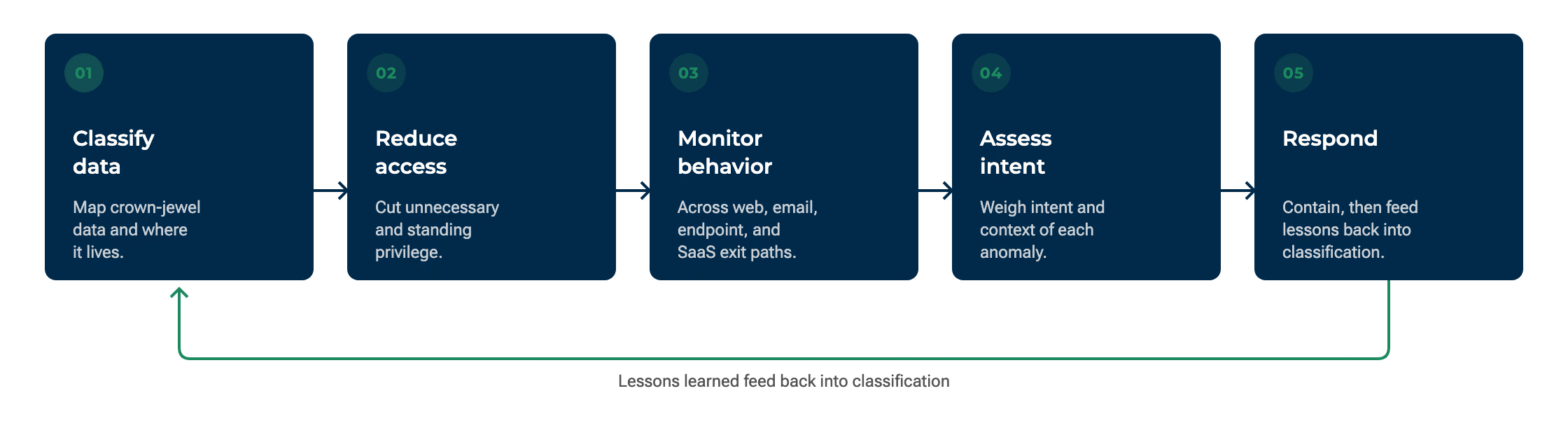
A working insider risk program is a lifecycle, not a tool. It connects people, process, and technology — and the order matters, because governance and data classification determine what the technology should even look for. Detection inputs span behavioral analytics, identity signals, and data-movement telemetry, not just static rules.
The lifecycle moves through five repeatable stages:
Classify crown-jewel data and where it lives.
Reduce unnecessary and standing access.
Monitor behavior across all exit paths.
Assess intent and context of anomalies.
Respond, contain, and feed lessons back.
The exit paths in stage three are where data actually leaves: the web, email, the endpoint, and SaaS applications. A program that watches only one path — say, email — misses the rest. Modern programs layer behavioral analytics over identity and data signals so that a single anomalous action (a privileged account suddenly exporting bulk records to cloud storage) surfaces as one prioritized signal rather than three disconnected alerts.
Speed is the payoff. The 2026 research recorded a record-low containment time of 67 days, down from 81 days in the prior-year (2025) edition (Help Net Security, 2026). That is progress, but a 67-day window is still long enough for a planted insider or a compromised account to do significant damage — which is why behavior-based detection across every path matters more than any single control.
A note on sequencing: governance precedes tooling. Buying a monitoring platform before you have classified your sensitive data, defined risk appetite, and agreed who responds is how programs generate noise instead of signal. The build-out section below maps that governance to a concrete model.
Figure 1 — The insider risk management lifecycle
Types of insiders
Most insider risk frameworks recognize three canonical categories, plus a fourth that is emerging fast. Understanding the mix is the fastest route to right-sizing controls, because the largest category is rarely the one teams instinctively fear.
Negligent (non-malicious): A trusted person causes harm through mistakes — misdirected email, weak handling of sensitive files, or unsanctioned tool use. This is the largest share by far.
Malicious: A deliberate insider acts to steal, sabotage, or conduct espionage. This is the classic insider threat, and the category that gets the headlines.
Compromised: A legitimate account is taken over by an external attacker, usually through credential theft. The insider here is the attacker wearing a trusted identity.
Non-human identity (emerging): Service accounts and AI agents hold standing privilege and can act autonomously. We cover this category in depth in the AI-era section below.
The 2026 economics make the case for prioritizing the negligent majority. According to the 2026 Ponemon/DTEX research, 53% of incidents were negligent or non-malicious, costing $10.3 million per year — the single largest share — while malicious incidents accounted for $4.7 million and credential theft for $4.5 million (Help Net Security, 2026). For context, the prior-year (2025) edition framed the split as roughly 55% negligent, 25% malicious, and 20% credential theft, against a lower $17.4 million total (DTEX, 2025). The headline shifts year to year, but the lesson is stable: negligence, not malice, is the dominant cost driver.
Type
Intent
Example
Primary control
Negligent
None — accidental
Pasting source code into a public AI tool
Awareness, data classification, AI-aware monitoring
Malicious
Deliberate harm
Stealing files before resigning to a competitor
Behavioral detection, least privilege, offboarding
Compromised
Attacker-driven
Stolen credentials used to export records
Identity threat detection, MFA, anomaly detection
Non-human identity
Autonomous or attacker-driven
AI agent or OAuth token exfiltrating data
Least-privilege scoping, audit logging, human override
Table 1 — Types of insiders, intent, example, and primary control.Scope: conceptual reference for the three canonical insider categories plus the emerging non-human category.
Insider risk management in practice
Real incidents make the categories concrete. The following anonymized 2025 cases — drawn from public reporting — show insider risk spanning negligent access, planted insiders, retained credentials, and machine identities. Each is presented defensively, to illustrate the control that would have helped.
Privileged support access abused. At a major crypto exchange in 2025, overseas customer-support agents were bribed and recruited by external criminals to abuse their legitimate support-tool access and exfiltrate data on roughly 70,000 customers. The attackers demanded a $20 million ransom (CNBC, 2025). The lesson: least-privilege access and behavioral monitoring of support tooling are essential, because a trusted role with broad access is a high-value target for recruitment.
Planted insider across SaaS. In a 2025 corporate-espionage dispute, an employee allegedly acted as a planted insider, accessing confidential files across multiple SaaS applications for months on behalf of a competitor (DataPatrol, 2025). The lesson: insider risk includes deliberately placed insiders, so onboarding due diligence and cross-SaaS anomaly detection both matter.
Retained access after offboarding. In a 2025 banking incident, a former staff member used retained access to reach records of roughly 689,000 customers, and the suspicious activity went unidentified for over a year (DataPatrol, 2025). The lesson: offboarding access revocation is a frontline insider-risk control, and retained credentials are a classic failure mode that prompt identity threat detection and response would surface.
A non-human identity as the insider. In a 2025 OAuth supply-chain campaign, a threat actor used compromised OAuth tokens belonging to an AI product — a machine identity — to authenticate to connected platforms and systematically exfiltrate data from more than 700 organizations, including several large enterprises and a major vendor (Mandiant / Google Cloud, 2025). The actor hunted embedded cloud keys and tokens inside the exported records. This is the canonical example of a trusted, non-human, privileged identity becoming the breach path — and why identity threat detection and response must extend to machine identities, not just people. The same dynamic underpins many a modern data breach.
Building an insider risk management program
This is where most programs succeed or stall. The differentiator is not the monitoring platform you buy; it is the governance you stand up first. The leading maturity research frames insider risk as a structural problem that requires cross-functional ownership before any tooling decision.
Who owns it: a cross-functional model
No single team can run insider risk alone, because the work spans technical detection, personnel matters, and legal exposure. The durable pattern is a cross-functional steering group with executive sponsorship, run day to day by security, with HR and legal as accountable partners. A RACI map keeps it honest.
Table 2 — RACI ownership for an insider risk management program.Scope: illustrative responsibility assignment across core program activities. R = responsible, A = accountable, C = consulted, I = informed.
Activity
Security
HR
Legal
Executive sponsor
Program charter and risk appetite
C
C
C
A
Data classification and access reduction
R
I
C
A
Behavioral monitoring and detection
R
I
C
I
Investigation of flagged behavior
R
C
C
I
Personnel action and intervention
C
A
C
I
Privacy and proportionality review
C
C
A
I
Board and regulator reporting
C
I
C
A
The named role on the security side is often an insider risk management analyst, who triages behavioral signals, runs investigations, and coordinates handoffs to HR and legal. Roles, charter, and authority should be written down before monitoring begins.
CISA's four-step model
Anchor the build in an authoritative framework rather than a vendor checklist. CISA's insider threat mitigation guidance defines a four-step model that scales from a startup to a federal agency:
Define the threat and program scope.
Detect and identify concerning behavior.
Assess the risk that behavior represents.
Manage the risk through proportionate response.
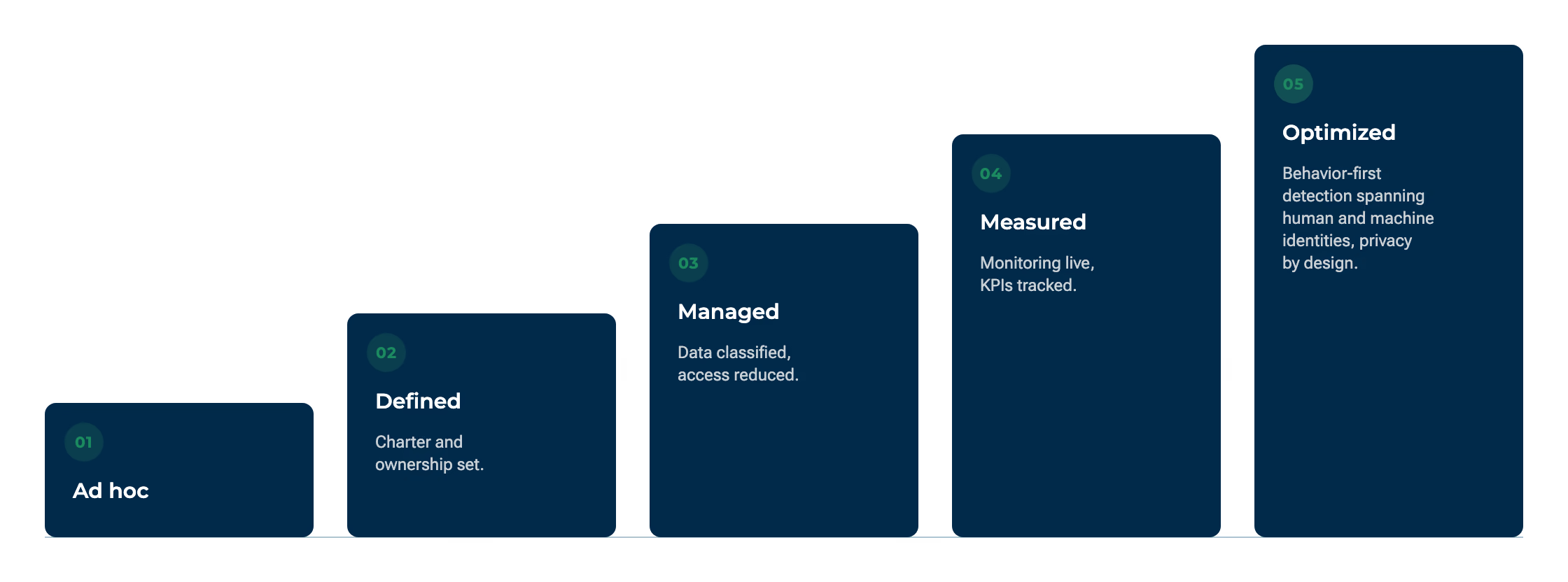
Map that model onto a phased build, where each phase raises one rung on the maturity ladder:
Charter the program and secure executive sponsorship.
Classify crown-jewel data and define risk appetite.
Reduce standing access and enforce zero trust least-privilege.
Instrument behavioral monitoring across exit paths.
Stand up an analysis-and-response hub inside SOC operations.
Add privacy-by-design controls and document authority and handoffs.
Build privacy in from day one rather than bolting it on; the compliance section explains why proportionality is non-negotiable in regulated regions. For the malicious-actor playbook specifically, an insider threat program layers tactical detection on top of this governance foundation.
The investment case is real. Average insider-risk spend rose from 8.2% of the cyber budget in 2023 to 16.5% in 2024, and 65% of organizations with an established program said it pre-empted a breach (DTEX, 2025).
Boards fund what they can measure. Two free, credible instruments turn insider risk from a gut feeling into a tracked program: a five-level maturity model and a no-cost self-assessment.
The maturity model runs from ad hoc to optimized, mirroring the ladder above. Most organizations begin at ad hoc or defined and target managed-to-measured within a few budget cycles. To baseline objectively, use the free CISA/CMU Insider Risk Mitigation Program Evaluation (IRMPE), which covers the 19 elements of the National Insider Threat Task Force (NITTF) framework across program management, personnel and training, and data collection and analysis. The NITTF maturity framework provides the underlying scoring backbone (ODNI/NITTF, 2024).
Risky behaviors intervened before harm ÷ total flagged
Trend up
Investigation log
Crown-jewel data classified
Classified sensitive assets ÷ total sensitive assets
Greater than 90%
Data classification inventory
Maturity score
IRMPE/NITTF self-assessment result
Rise one level per cycle
IRMPE assessment
Table 3 — Board-ready insider risk KPIs.Scope: example metrics for measuring an insider risk program; targets are illustrative and should be tuned to your risk appetite.
The financial argument for faster containment is direct: in the prior-year (2025) edition, incidents that ran beyond 91 days cost $18.7 million on average versus $10.6 million for those contained within 31 days (DTEX, 2025). Treat any single-source return-on-investment figures — such as multimillion-dollar savings or specific ROI multiples attributed to high maturity — as illustrative rather than headline, pending primary corroboration.
AI-era insider risk: shadow AI and agentic AI
This is the fastest-moving frontier of insider risk, and the area where legacy tooling is weakest. Two distinct shifts — one human, one non-human — have redefined the threat model in 2026.
The first is shadow AI: the unsanctioned use of public AI tools that quietly moves data outside enterprise controls. Employees paste source code, legal materials, architecture diagrams, and strategic plans into public LLMs, often through personal accounts on corporate devices that bypass enterprise data controls. The 2026 Verizon DBIR analyzed 858,440 DLP events involving AI tools, found that source code was the most common data type pushed into unsanctioned AI, and ranked shadow AI as the third most common non-malicious insider DLP action — a roughly fourfold year-over-year jump in share (Verizon, 2026). This is classic negligent-insider behavior at machine scale. (An earlier 2024 figure that roughly 11% of pasted data was confidential is now superseded as the headline by this behavioral data, though it remains useful context.) Vectra AI's overview of shadow AI goes deeper on the governance response.
The second shift is the rise of AI agents and machine identities as privileged insiders. An AI agent that processes data, makes decisions, and initiates autonomous actions is, functionally, an insider with standing access. US federal guidance has caught up to this framing: a joint guide led by CISA, NSA, and the FBI now treats AI agents inside operational technology as privileged internal actors requiring least privilege, human override, audit logging, and blast-radius isolation (CISA, 2025). The discipline of agentic AI security applies insider-style controls to these non-human actors, and connects to the broader practice of AI security.
The tooling blind spot ties both shifts together. Legacy DLP and UEBA largely cannot see non-corporate-account GenAI use, nor the non-human identities that agents create and inherit locally inside applications, invisible to central identity management. On the scale of those identities, treat the numbers as directional: 2025-2026 vendor research spans roughly 45:1 to 500:1 machine-to-human identity ratios depending on the environment. The defensible synthesis is that machine identities now vastly outnumber humans and are growing fast — not a single headline figure.
AI-agent insider controls — a quick checklist. Apply these to every autonomous agent and machine identity:
Least-privilege scoping per agent, not blanket service-account access.
Human override for consequential or irreversible actions.
Audit logging of every autonomous action the agent takes.
Blast-radius isolation and segmentation to contain a compromised agent.
Insider risk management and compliance
Insider risk management does not exist in a regulatory vacuum. Mapping a program to recognized frameworks gives auditors evidence and gives the board confidence — and for multinational organizations, the EU layer adds obligations that US-centric guides routinely skip.
On the US side, the program maps cleanly to CISA's four-step model and the IRMPE's 19 NITTF elements, with a NIST Cybersecurity Framework (CSF) crosswalk and NIST SP 800-53 controls covering asset identification, access pathways, and control effectiveness. Insider-relevant techniques in MITRE ATT&CK help teams reason about how trusted access is abused — useful because insiders already hold valid credentials.
Table 4 — Insider risk framework and technique crosswalk.Scope: how common frameworks and MITRE ATT&CK techniques map to insider risk management activities.
The EU layer creates real tension. NIS2 Article 21 mandates HR security, access-control policies, and asset management; it makes managers personally liable and sets staged incident reporting at 24 hours, 72 hours, and one month, with penalties up to €10 million or 2% of global turnover for essential entities (iGDPR, 2024-25). At the same time, GDPR Article 32 requires that any employee monitoring respect data minimization and proportionality. The result: in the EU, you must monitor enough to satisfy NIS2 without overreaching under GDPR, which is exactly why privacy-by-design belongs in the program charter. For a fuller treatment, see Vectra AI's resources on regulatory compliance and GDPR compliance.
One geographic caution on statistics: insider-actor share varies sharply by region — EMEA 29%, North America 5%, and APAC 1% in the 2025 DBIR (Verizon, 2025). Avoid quoting a single global insider percentage; cite the regional figures instead.
Modern approaches to insider risk management
The market is converging on a clear direction of travel. Modern insider risk management is behavior-first and identity-aware: it correlates signals across network, identity, and SaaS rather than relying on data-movement rules alone, and it explicitly covers non-human identities. Privacy-by-design monitoring and integration over a sprawl of point tools are now table stakes — particularly because insider incidents are widely reported as harder to detect than external ones (a directional, vendor-derived finding to treat as context, not a hard metric).
The most common buyer question is how insider risk management differs from adjacent categories. The short version: data loss prevention (DLP) watches data movement, user behavior analytics watches behavioral anomalies, an insider threat program targets malicious actors, and insider risk management is the governance umbrella that spans all of them. An insider risk management solution is therefore less a single product than a program that may draw on several capabilities.
Table 5 — Insider risk management vs DLP vs UEBA vs insider threat program.Scope: conceptual comparison of four related but distinct approaches to managing insider activity.
Dimension
Insider risk management
DLP
UEBA
Insider threat program
Scope
All trusted access (human and non-human)
Data movement
Behavioral anomalies
Malicious actors
Intent focus
All intents — negligent to malicious
Intent-agnostic
Anomaly-driven
Malicious intent
Posture
Detect and govern
Prevent and block
Detect
Detect and respond
Primary signal
Behavior + identity + data
Data content and flow
Behavior baselines
Behavior + investigation
For organizations selecting an approach, the practical advice is to lead with governance, prioritize behavior-first threat detection that spans identities, and insist on coverage of machine identities and non-corporate-account AI use — the two blind spots legacy tooling misses.
How Vectra AI thinks about insider risk
Vectra AI starts from an assume-compromise posture: smart adversaries — and negligent users — will find a way to misuse trusted access, so the question is how fast you can see it. That means treating every identity (human, service account, and AI agent) as a potential path, and surfacing the behavioral signal of misuse across network, identity, and cloud surfaces rather than relying on data rules alone. Attack Signal Intelligence is built to separate that real signal from the noise, so small teams can act on what matters.
Future trends and emerging considerations
The cybersecurity landscape continues to evolve rapidly, with insider risk at the forefront of emerging challenges. Over the next 12 to 24 months, organizations should prepare for several developments that will reshape how programs are built, measured, and regulated.
Shadow AI becomes a governed category, not a footnote. The 2026 Verizon DBIR's analysis of 858,440 AI-related DLP events moved shadow AI from anecdote to a measured top-tier insider action (Verizon, 2026). Expect AI-aware DLP and GenAI-usage governance to become standard program components, and expect the next report cycle to refine — and likely raise — these figures. Organizations that cannot yet see non-corporate-account AI use on managed devices should treat that gap as a near-term investment priority.
Non-human identity governance moves to the center. As machine identities and AI agents proliferate at ratios reported anywhere from roughly 45:1 to 500:1, the governance challenge shifts from people to the identities that act on their behalf. The defensible expectation is consolidation around non-human identity inventory, scoping, and lifecycle management — extending the same least-privilege discipline that zero trust architecture brought to human accounts. US federal guidance treating AI agents as privileged insiders (CISA, 2025) signals where private-sector expectations are heading.
Regulatory pressure intensifies, especially in the EU. NIS2 implementing regulations are still maturing across member states through 2025 and 2026, with manager liability and staged 24-hour, 72-hour, and one-month reporting raising the stakes for essential entities (iGDPR, 2024-25). Multinational programs should invest now in privacy-by-design monitoring that satisfies NIS2 obligations without breaching GDPR proportionality — a balance that will only get harder to strike retroactively.
For security and GRC leaders, the preparation checklist is consistent: inventory and govern non-human identities alongside humans, deploy monitoring that sees GenAI use, apply least-privilege and human-override controls to every AI agent, and extend insider-risk coverage to SaaS OAuth grants. Given the volatility of AI-insider data, plan to revisit program assumptions roughly every six months as new report cycles land.
Conclusion
Insider risk management has moved from a niche concern to a board-level discipline, driven by a $19.5 million average annual cost and a threat model that now spans careless employees, malicious actors, compromised accounts, and autonomous AI agents. The throughline of this guide is simple: insider risk is far broader than the insider threat, the negligent majority drives most of the cost, and governance must come before tooling.
The organizations that pull ahead will do three things. They will stand up cross-functional ownership and anchor it in CISA's four-step model. They will measure maturity with the free IRMPE self-assessment and report board-ready KPIs. And they will close the AI-era blind spots — shadow AI and non-human identities — that legacy tools cannot see. Behavior-first, identity-aware detection across network, identity, and cloud is what turns a policy document into a program that actually reduces risk.
To go deeper on the malicious subset, the behavioral analytics that power modern detection, or how an assume-compromise approach surfaces insider misuse, explore Vectra AI's related topic guides below.
FAQs
What is the difference between insider risk and insider threat?
All insider threats are insider risks, but most insider risk is negligent or accidental rather than malicious. Insider threat refers specifically to deliberate, malicious actions by someone with trusted access — theft, sabotage, or espionage. Insider risk is the broader umbrella that also includes the careless click, the misdirected file, and the compromised account. The distinction is operational, not academic: it determines how you build a program and where you spend. Because the negligent majority drives most cost — 53% of incidents and $10.3 million of the $19.5 million average annualized cost in 2026 (Help Net Security, 2026) — a program tuned only for malicious actors will miss the bulk of its risk. The practical takeaway is to manage for the full spectrum of trusted-access risk while reserving dedicated tactical detection for the malicious subset covered on Vectra AI's insider threat page.
What are the three types of insiders?
The three canonical types are negligent, malicious, and compromised insiders. Negligent insiders cause harm through mistakes such as misdirected email or unsanctioned tool use, and they represent the largest share of incidents. Malicious insiders deliberately steal, sabotage, or conduct espionage. Compromised insiders are legitimate accounts taken over by an external attacker, usually through credential theft, so the real actor is an outsider wearing a trusted identity. A fourth category is emerging fast: non-human identities such as service accounts and AI agents that hold standing privilege and can act autonomously. Each type calls for different controls — awareness and data classification for the negligent, behavioral detection and tight offboarding for the malicious, identity threat detection for the compromised, and least-privilege scoping with audit logging for non-human identities. Matching control to category is the fastest way to right-size a program.
Who is responsible for insider risk management?
Insider risk management is a cross-functional responsibility, not a single team's job. The durable model is a steering group with executive sponsorship, run day to day by security, with HR and legal as accountable partners. Security owns detection, monitoring, and investigation. HR is accountable for personnel actions and interventions, because insider matters touch employment law and employee relations. Legal owns privacy and proportionality review, which is critical in regulated regions where monitoring collides with data-protection rules. The executive sponsor owns the charter, risk appetite, and board reporting. On the security side, a named insider risk management analyst typically triages behavioral signals and coordinates handoffs. Writing down this RACI before monitoring begins prevents the two most common failure modes: a program that overreaches on employee privacy, or one that generates signals nobody is authorized to act on.
How is AI changing insider risk?
AI is reshaping insider risk in two distinct ways. First, shadow AI turns ordinary employees into negligent insiders at scale: people paste source code, legal materials, and strategic plans into public AI tools, often through personal accounts on corporate devices. The 2026 Verizon DBIR analyzed 858,440 AI-related DLP events and ranked shadow AI as the third most common non-malicious insider action, with source code the leading exfiltrated data type (Verizon, 2026). Second, AI agents and machine identities now act as privileged non-human insiders, holding standing access and initiating autonomous actions. US federal guidance now treats AI agents as privileged internal actors requiring least privilege, human override, and audit logging (CISA, 2025). Both shifts create blind spots that legacy DLP and UEBA largely cannot see, which is why AI agent security and AI-aware monitoring are now core to insider risk management.
How do you measure an insider risk program?
Start by baselining maturity with the free CISA/CMU IRMPE self-assessment, which covers the 19 NITTF elements across program management, personnel and training, and data collection and analysis (CISA IRMPE). That gives you an objective starting score on a five-level maturity model running from ad hoc to optimized. Then track a small set of board-ready KPIs: mean time to detect, mean time to contain, the percentage of risky behaviors intervened before harm, and the percentage of crown-jewel data classified. Tie the metrics to cost where you can — in the 2025 edition, incidents running beyond 91 days cost $18.7 million versus $10.6 million for those contained within 31 days (DTEX, 2025). Treat single-source ROI multiples as illustrative rather than headline. The goal is a measurement path the board can follow from one budget cycle to the next.
What is the difference between DLP and insider risk management?
Data loss prevention (DLP) focuses on data movement: it inspects content and enforces rules to block or flag sensitive data leaving defined channels. Insider risk management is broader. It combines behavioral, identity, and data signals to assess the intent and context of an action across all actors — human and non-human — rather than matching data against static rules. DLP might block an attachment; insider risk management asks whether a privileged account suddenly exporting bulk records at an unusual hour represents negligence, malice, or a compromised credential, and routes the answer to the right responder. In practice, DLP is one capability an insider risk program may use, alongside UEBA and identity monitoring. The reason the distinction matters: a rules-only DLP posture misses the negligent majority and the non-human identities that now drive a growing share of insider risk.
What is the average cost of insider risk?
The 2026 Ponemon/DTEX research puts the average annualized cost of insider risk at $19.5 million, up roughly 20% over two years from the prior-year (2025) edition's $17.4 million (Help Net Security, 2026). Negligence is the largest single share, accounting for $10.3 million of that total across 53% of incidents, with malicious incidents at $4.7 million and credential theft at $4.5 million. Containment time improved to a record-low 67 days, down from 81 days the prior year. These figures come from research spanning hundreds of organizations that each experienced at least one material insider event, so they reflect organizations already managing real incidents rather than a general population. Treat the annual headline as a moving target — it has risen steadily — and use it to frame the business case rather than as a precise prediction for any single organization.