Credential theft explained: techniques, detection, and enterprise defense
Key insights
Credential theft is the top breach vector. Stolen credentials initiated 22% of all breaches in 2025 (Verizon DBIR), with account compromise surging 389% year-over-year.
The infostealer supply chain is industrialized. Attackers harvested 1.8 billion credentials in the first half of 2025 alone, an 800% increase, while 16 billion credentials surfaced in a record-breaking dark web compilation.
Traditional MFA is no longer sufficient. The ShinyHunters SSO campaign (January 2026) bypassed push-based MFA in real time. Only phishing-resistant MFA (FIDO2/passkeys) provides strong protection.
Credential-based breaches cost $4.8 million on average and take approximately 292 days to identify and contain, making early detection critical.
Defense requires unified observability. Effective credential theft protection combines behavioral analytics, identity threat detection and response (ITDR), zero trust architecture, and continuous credential monitoring across network, identity, and cloud.
Credential theft is accelerating faster than most security teams can respond. According to the Verizon DBIR 2025, stolen credentials initiated 22% of all confirmed breaches — the highest of any single attack vector — while the Unit 42 2026 incident response report found that identity weaknesses played a material role in 90% of investigations. This guide breaks down the credential theft lifecycle from initial acquisition through exploitation, maps the full MITRE ATT&CK technique taxonomy, and delivers the detection and prevention strategies enterprises need to defend against credential-based attacks in 2026 and beyond.
What is credential theft?
Credential theft is the unauthorized acquisition of authentication material — usernames, passwords, tokens, session cookies, API keys, and certificates — used to impersonate legitimate users and gain unauthorized access to systems, applications, and data. Unlike brute force attacks that guess credentials, credential theft targets existing valid credentials through phishing, malware, social engineering, or exploitation of insecure credential storage.
Credential theft matters because it gives attackers the keys to move through environments as trusted insiders. The Verizon DBIR 2025 confirmed that stolen credentials initiated 22% of all breaches across 12,195 confirmed incidents — more than any other initial access vector. The eSentire 2025 TRU report documented a 389% year-over-year surge in account compromise, with valid credentials driving 55% of all security incidents observed. And the Unit 42 2026 incident response report revealed that identity weaknesses — many rooted in stolen or compromised credentials — played a material role in 90% of investigations, with 65% of initial access driven specifically by identity-based cyberattack techniques.
These numbers reflect a fundamental shift. Attackers increasingly choose to log in rather than break in, turning credential theft into the preferred pathway to data breaches, ransomware deployment, and supply chain compromise.
Credential theft vs credential stuffing
Understanding the distinction between related terms is critical for accurate threat modeling.
Table: Credential theft vs credential stuffing vs credential harvesting.
Term
Definition
Key difference
Credential theft
The broad category encompassing all methods of stealing authentication material (passwords, tokens, cookies, keys)
Umbrella term covering the full attack lifecycle
Credential stuffing
A specific technique (T1110.004) that uses previously breached username-password pairs to attempt login on other services
Exploits password reuse; requires a prior breach
Credential harvesting
The collection phase of credential theft where attackers gather authentication data at scale via phishing, infostealers, or scraping
Focuses on the acquisition step, not exploitation
With a 51% password reuse rate across services (Verizon DBIR 2025), credential stuffing remains highly effective — but it represents just one technique within the broader credential theft landscape.
Why credential theft matters
Credential theft has become one of the most effective attack methods because it allows attackers to access systems using legitimate identities instead of exploiting software vulnerabilities. With valid credentials, they can blend in with normal user activity, making malicious behavior much harder to detect.
As organizations adopt more cloud services, SaaS applications, and hybrid environments, identities have become a primary target. A single compromised account, authentication token, or API key can enable account takeover, privilege escalation, lateral movement, and access to sensitive data.
For security teams, this means protecting credentials is no longer enough. Detecting how stolen credentials are used through behavioral analytics and identity monitoring is equally important for stopping attacks before they result in data breaches or ransomware.
How credential theft works
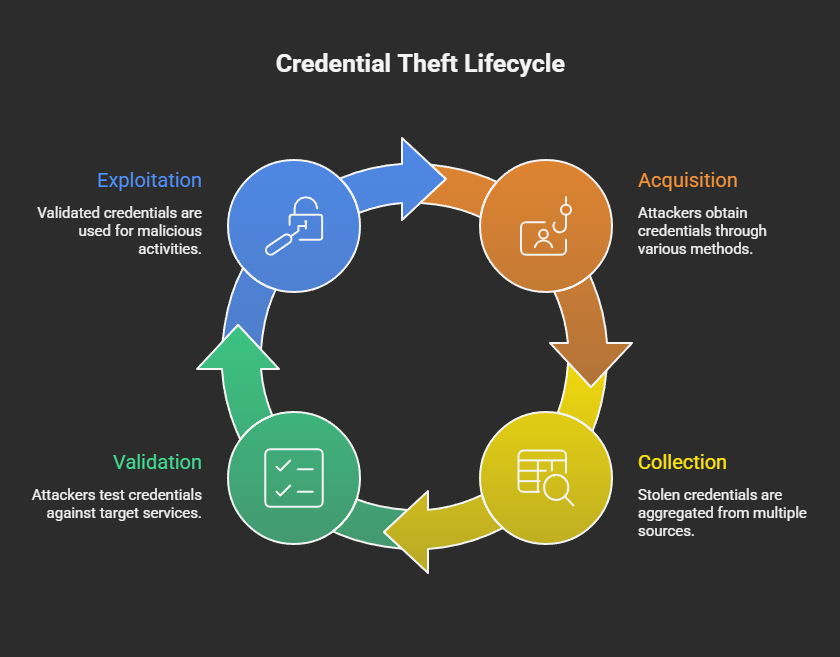
Modern credential theft operates as an industrialized supply chain with four distinct phases. Understanding each phase helps security teams position detection controls at every stage.
Acquisition. Attackers obtain credentials through phishing campaigns, infostealer malware, social engineering, or exploitation of exposed credential stores. Phishing-as-a-Service (PhaaS) platforms — available for $200-$300 per month — drove 63% of account compromises in 2025, using adversary-in-the-middle (AitM) techniques to bypass MFA and steal session tokens (eSentire 2025).
Collection. Stolen credentials are aggregated from credential stores, OS memory dumps, browser password vaults, and network interception. Infostealer malware harvested 1.8 billion credentials in the first half of 2025, an 800% increase, across 5.8 million compromised hosts (Flashpoint 2025 infostealer analysis).
Validation. Attackers use automated tools to test harvested credentials against target services at scale. Credential checking tools validate stolen pairs rapidly, separating active accounts from expired credentials.
Exploitation. Validated credentials enable account access, lateral movement, privilege escalation, data exfiltration, and ransomware deployment. The fastest 25% of intrusions reached data exfiltration in just 72 minutes in 2025 — down from 285 minutes in 2024 — while the average eCrime breakout time fell to 29 minutes (CrowdStrike 2026 Global Threat Report).
The credential theft lifecycle from initial acquisition to exploitation.
The dark web credential economy amplifies every phase. A record-breaking leak in February 2026 exposed 16 billion compiled credentials on the dark web, and the Verizon DBIR 2025 found that only 49% of a median user's passwords across services were unique — meaning 51% password reuse fuels credential stuffing at massive scale.
Types of credential theft attacks
Attackers use a broad range of credential theft techniques, many of which are formally cataloged under MITRE ATT&CK tactic TA0006 (Credential Access). The MITRE ATT&CK framework documents 17 techniques with over 50 sub-techniques under this tactic. Here are the primary categories.
Credential dumping (T1003). Attackers extract credentials directly from operating system memory, the Active Directory database, or domain controller replication. Techniques include LSASS memory extraction (T1003.001), NTDS file access (T1003.003), and DCSync attacks (T1003.006). Tools like Mimikatz are commonly associated with credential dumping in post-compromise scenarios.
Brute force attacks (T1110). Password spraying (T1110.003) tests common passwords across many accounts to avoid lockouts, while credential stuffing (T1110.004) leverages previously breached pairs against new services.
Credential harvesting from password stores (T1555). Attackers target browser-stored credentials (T1555.003) and password managers (T1555.005). According to the Picus Red Report 2026, T1555 (Credentials from Password Stores) appeared in 23.49% of all attacks analyzed — making it one of the most commonly observed credential theft techniques.
Credential phishing. Spear phishing attacks use fake login pages, business email compromise, and voice phishing to trick users into submitting credentials. PhaaS platforms have industrialized this vector.
Kerberoasting (T1558.003). Attackers request Kerberos service tickets for service accounts and crack them offline to recover plaintext passwords, enabling privilege escalation.
Network interception (T1557). Adversary-in-the-middle attacks, including LLMNR/NBT-NS poisoning (T1557.001), intercept authentication traffic on the network to capture credentials in transit.
Unsecured credentials (T1552). Credentials stored in plaintext files (T1552.001) or accessible via cloud instance metadata APIs (T1552.005) are directly harvested by attackers with system access.
MFA bypass (T1556.006, T1621). Attackers modify authentication processes or exploit MFA fatigue through repeated push notification bombing to bypass multi-factor protections.
MITRE ATT&CK credential access mapping
The following table maps key MITRE ATT&CK credential access techniques to their attack methods and detection approaches.
Extract credentials from Windows LSASS process memory
Monitor for LSASS access by non-standard processes
T1003.003
OS Credential Dumping: NTDS
Access Active Directory domain database file
Detect ntdsutil.exe usage and volume shadow copy creation
T1003.006
OS Credential Dumping: DCSync
Abuse domain controller replication protocol
Monitor for unusual replication requests from non-DC hosts
T1110.003
Brute Force: Password Spraying
Test common passwords against many accounts
Alert on distributed authentication failures across accounts
T1110.004
Brute Force: Credential Stuffing
Use breached credential pairs against new services
Detect high-volume login attempts from unusual sources
T1555.003
Credentials from Password Stores: Web Browsers
Extract browser-stored credentials
Monitor file access to browser credential databases
T1555.005
Credentials from Password Stores: Password Managers
Target third-party credential vaults
Detect unauthorized access to password vault files
T1056.001
Input Capture: Keylogging
Record keystrokes to capture credentials as typed
Monitor for keylogger process indicators and API hooks
T1557.001
Adversary-in-the-Middle: LLMNR/NBT-NS Poisoning
Spoof name resolution for credential interception
Monitor for LLMNR/NBT-NS responses from unexpected hosts
T1558.003
Steal or Forge Kerberos Tickets: Kerberoasting
Request and crack Kerberos service tickets offline
Alert on high-volume Kerberos service ticket requests
T1558.001
Steal or Forge Kerberos Tickets: Golden Ticket
Forge TGTs using stolen KRBTGT hash
Detect TGT anomalies and unusual domain authentication
T1539
Steal Web Session Cookie
Acquire session cookies for authenticated access
Monitor for session token reuse from new locations
T1528
Steal Application Access Token
Acquire OAuth or API tokens for service access
Track OAuth grant patterns and token usage anomalies
T1552.001
Unsecured Credentials: Credentials in Files
Search for plaintext credentials in files and scripts
Scan repositories for secrets; alert on credential file access
T1552.005
Unsecured Credentials: Cloud Instance Metadata API
Query cloud metadata endpoints for credentials
Monitor metadata API access patterns from workloads
T1556.006
Modify Authentication Process: MFA
Disable or modify MFA mechanisms
Detect MFA configuration changes and policy modifications
T1621
MFA Request Generation
Bypass MFA via push notification fatigue
Alert on repeated MFA push requests in short timeframes
T1606.002
Forge Web Credentials: SAML Tokens
Forge SAML tokens for federated access
Monitor for SAML assertion anomalies and signing changes
The Picus Red Report 2026 also noted a 38% drop in ransomware deployment, signaling a broader shift toward credential-enabled "silent residency" — where attackers use stolen credentials to maintain persistent, stealthy access rather than deploying noisy malware.
Emerging credential theft vectors
The credential theft landscape is evolving rapidly beyond traditional password theft. Several vectors that competitors consistently miss represent growing enterprise risk.
Token and session theft (T1539, T1528). Modern credential theft increasingly targets authentication tokens and session cookies rather than passwords. Session cookie theft bypasses MFA entirely because the attacker inherits an already-authenticated session. OAuth token abuse grants persistent API access that survives password resets. This vector is growing as organizations adopt cloud-first and SaaS-heavy architectures.
Infostealer malware evolution. Infostealers are expanding from Windows to macOS, with Microsoft researchers documenting cross-platform variants like DigitStealer, MacSync, and AMOS using fileless execution and AppleScript automation. New delivery methods like ClickFix (fake CAPTCHA traps) are bypassing traditional email security controls.
AI-powered credential theft. The IBM X-Force 2026 Threat Index reported over 300,000 ChatGPT credentials appearing on the dark web and a 44% overall increase in attacks. Stolen credentials are being used to weaponize agentic AI systems — what SecurityWeek describes as the "blast radius problem" — where compromised credentials grant access not just to individual accounts but to entire automated workflows. Agentic AI security is becoming a critical concern as AI agents inherit the permissions of their service accounts.
Cloud credential targeting. Credential theft is the leading technique against cloud security infrastructure, with Thales reporting it affects 67% of organizations. The Unit 42 2026 report found that 99% of cloud users, roles, and services had excessive permissions — including unused access for 60 or more days — creating an expansive attack surface for stolen cloud credentials.
Common signs of credential theft
Credential theft often goes unnoticed because attackers use legitimate credentials instead of exploiting systems directly. While a single event may appear harmless, a combination of unusual authentication and user behaviour can indicate that credentials have been compromised. Security teams should investigate for signs such as:
Login attempts from unusual locations or impossible travel scenarios.
Repeated failed authentication attempts followed by a successful login.
Unexpected multi-factor authentication (MFA) prompts reported by users.
Logins from unfamiliar devices, browsers, or IP addresses.
Unusual privilege escalation or access to systems not typically used by the account.
New API tokens, session tokens, or OAuth permissions created without authorization.
Access to sensitive data or cloud resources outside normal working patterns.
Authentication activity occurring at unusual times or across multiple geographic locations.
Because attackers increasingly rely on valid credentials to blend in with legitimate users, these behavioural indicators are often the earliest signs of an active credential theft attack. Detecting them quickly can help security teams contain compromised accounts before attackers achieve lateral movement, persistence, or data exfiltration.
Credential theft in practice
Real-world breaches demonstrate how credential theft unfolds from initial access to catastrophic impact. These case studies share a common pattern: a single stolen credential, absent or bypassable MFA, and massive downstream consequences.
Snowflake data breach (2024).Threat actor UNC5537 used credentials stolen via infostealer malware — some dating back to 2020 — to access approximately 160 Snowflake customer instances, including AT&T, Ticketmaster, and Santander Bank. None of the impacted accounts had MFA enabled, allowing single-factor authentication with years-old stolen credentials. The attack chain moved from infostealer infection to credential harvesting to dark web sale to account takeover and data exfiltration across 160 organizations. (Cloud Security Alliance analysis; Google/Mandiant UNC5537 analysis)
Diagram: Snowflake breach attack chain showing the progression from infostealer infection (2020) through credential harvesting, dark web sale, account access without MFA, data exfiltration across 160 instances, to downstream impact on AT&T, Ticketmaster, and Santander. Caption: "Snowflake breach attack chain: how credentials stolen years earlier enabled a massive supply chain breach."
PowerSchool breach (January 2025). A single set of compromised credentials — without MFA protection — gave an attacker access to PowerSchool's customer support portal, ultimately compromising personal data of approximately 62 million students and teachers across 18,000 schools, including SSNs and medical information. (TechTarget PowerSchool analysis)
ShinyHunters SSO campaign (January 2026). Threat group ShinyHunters (tracked as UNC6661) targeted approximately 100 organizations using evolved voice-phishing techniques to steal Okta SSO credentials and enroll attacker-controlled devices in victims' MFA. Targets included Atlassian, Canva, Epic Games, HubSpot, Harvard, and UPenn. Attackers used a real-time web panel to dynamically manipulate phishing pages while speaking to victims on the phone — demonstrating that traditional push-based MFA is no longer sufficient. (ShinyHunters SSO campaign; Google/Mandiant ShinyHunters analysis)
Colonial Pipeline (2021). Attackers used a single set of stolen VPN credentials from a legacy account without MFA to access Colonial Pipeline's network, deploying DarkSide ransomware that shut down fuel distribution across the U.S. East Coast for six days. This case demonstrates that dormant accounts with valid credentials represent critical attack surface.
The pattern across all four incidents is clear: credential theft combined with absent or bypassable MFA and dormant, unmanaged credentials creates single points of failure that enable lateral movement, supply chain amplification, and catastrophic data breaches.
Business impact and cost of credential theft
Credential-based breaches carry measurable financial and operational costs that make the case for investment in credential theft detection and prevention.
Table: Quantified business impact of credential theft in 2025-2026.
The Flare Research 2026 report also found that enterprise identity exposure more than doubled — rising from 6% of infostealer infections in early 2024 to nearly 14% by late 2025. The connection between credential theft and ransomware is direct: 54% of ransomware victims had prior credentials exposed in infostealer logs, with 40% containing corporate email addresses (Verizon DBIR 2025).
These cybersecurity metrics highlight a core challenge: credential-based attacks are both the costliest and slowest to detect, giving attackers nearly 10 months of dwell time before organizations identify and contain the breach.
Detecting and preventing credential theft
Effective credential theft defense requires layered detection and prevention controls. The goal is to reduce both the likelihood of credential compromise and the dwell time after compromise.
Detection approaches
Behavioral analytics. Monitor for anomalous authentication patterns including impossible travel (logins from geographically distant locations in impossibly short timeframes), unusual login times, abnormal resource access, and suspicious privilege escalation. Behavioral detection catches credential abuse that evades static rules and signature-based tools.
Identity threat detection and response (ITDR). ITDR platforms detect credential abuse at the identity layer — monitoring for session anomalies, authentication protocol abuse, privilege escalation, and identity-based lateral movement in real time. ITDR integrates with SIEM and SOAR to automate response playbooks when credential theft indicators surface.
Network detection and response (NDR). Network traffic analysis detects credential exfiltration, command-and-control communication, and lateral movement using stolen credentials — providing visibility even when endpoint agents are compromised or absent.
Honeytokens and canary credentials. Deploy decoy credentials across the environment. When an attacker attempts to use a honeytoken, it generates a high-fidelity alert that confirms credential theft is underway.
Prevention controls
Organizations should implement the following controls to prevent credential theft. Each step addresses a specific stage of the credential theft lifecycle.
Deploy phishing-resistant MFA (FIDO2/passkeys) on all accounts
Screen passwords against compromised credential databases per NIST SP 800-63B
Implement privileged access management with just-in-time provisioning
Monitor the dark web for organizational credential exposure
Deprovision dormant accounts and enforce credential lifecycle management
Deploy password managers to eliminate reuse (51% reuse rate per Verizon DBIR 2025)
Train employees to recognize social engineering and voice phishing
Phishing-resistant MFA as the new baseline
Traditional multi-factor authentication — SMS codes, push notifications, and TOTP — is increasingly bypassable. The ShinyHunters SSO campaign demonstrated real-time MFA bypass via voice phishing and attacker-controlled device enrollment in January 2026 (Google/Mandiant ShinyHunters analysis).
NIST recommends phishing-resistant authenticators — specifically FIDO2/WebAuthn and passkeys — as the standard for strong authentication. CISA has published success stories from federal agencies implementing FIDO2, and the emerging consensus is clear: organizations should deploy phishing-resistant MFA rather than relying on legacy MFA methods that credential theft techniques can defeat.
Credential theft and compliance
Credential theft controls map directly to requirements across major security frameworks and compliance standards. The following crosswalk helps GRC teams connect credential protection investments to audit evidence.
Table: Credential theft controls mapped to major compliance frameworks.
The credential theft landscape is evolving rapidly. Over the next 12-24 months, several trends will shape how organizations approach credential protection and detection.
AI-accelerated credential attacks. The CrowdStrike 2026 Global Threat Report documented an 89% increase in AI-enabled adversary operations and the IBM X-Force 2026 Threat Index reported a 44% overall increase in attacks. AI is enabling attackers to craft more convincing phishing campaigns at scale, automate credential validation, and accelerate post-compromise exploitation. The emergence of AI agent credential theft — with the first infostealers targeting AI agent credentials discovered in February 2026 — signals that the attack surface is expanding into autonomous systems.
Passkey and FIDO2 adoption acceleration. As traditional MFA proves increasingly bypassable, enterprise adoption of passkeys and FIDO2 hardware tokens will accelerate. Regulatory pressure is building: the NIST SP 800-63 rev 4 update and EU NIS2 directive enforcement in 2026 may introduce new phishing-resistant authentication requirements.
Shift from ransomware to silent residency. The Picus Red Report 2026 documented a 38% drop in ransomware deployment, with attackers increasingly using stolen credentials to maintain persistent, stealthy access for data theft and espionage rather than deploying noisy ransomware. This shift demands behavioral detection that identifies credential abuse patterns over extended dwell times.
Convergence of NDR and ITDR. Detection capabilities are merging across network, identity, and cloud layers. Organizations should prioritize platforms that correlate identity signals (impossible travel, privilege escalation, unusual authentication) with network behaviors (lateral movement, data exfiltration) and cloud telemetry to detect credential theft across the entire hybrid environment.
Preparation recommendations. Organizations should accelerate phishing-resistant MFA deployment across all accounts (prioritizing privileged and service accounts), implement continuous credential monitoring against dark web exposure, invest in behavioral analytics that detect credential abuse without relying on signatures, and establish credential incident response playbooks that cover the full credential theft lifecycle.
Modern approaches to credential theft defense
The industry is converging on several defense capabilities for credential theft: ITDR platforms that detect identity-based attacks in real time, behavioral analytics that catch credential abuse without signatures, NDR with identity correlation for network-level visibility, SIEM/SOAR automation for credential incident response, and zero trust architectures that enforce continuous verification.
The most effective approaches share a common principle: assume credentials will be compromised and build detection and response capabilities that catch attackers after initial access but before they achieve their objectives. This means unified observability across network, identity, and cloud — correlating signals across all three layers to surface real credential abuse.
How Vectra AI approaches credential theft defense
Vectra AI's Attack Signal Intelligence analyzes attacker behaviors across network, identity, and cloud to detect credential theft techniques that evade traditional tools. The platform correlates identity-based signals — impossible travel, privilege escalation, unusual authentication patterns — with network behaviors to surface real credential abuse, reducing alert noise while accelerating threat detection and response. With 12 references in MITRE D3FEND (more than any other vendor) and 35 patents in cybersecurity AI, Vectra AI delivers the signal clarity SOC operations teams need to catch credential-based attacks before they become breaches. Explore how Vectra AI's ITDR and NDR capabilities work together to defend against credential theft across hybrid environments.
Conclusion
Credential theft is not just one attack technique — it is the dominant pathway attackers use to enter, persist in, and move through enterprise environments. With 22% of all breaches starting from stolen credentials, 1.8 billion credentials harvested by infostealers in just six months, and breach costs averaging $4.8 million, the threat is both pervasive and quantifiable.
The pattern across every major breach — from Snowflake to PowerSchool to ShinyHunters — reinforces a clear lesson: prevention alone is not enough. Organizations need to assume credentials will be compromised and invest in detection capabilities that catch credential abuse early, before attackers achieve lateral movement, data exfiltration, or ransomware deployment. That means phishing-resistant MFA as a baseline, behavioral analytics across identity and network layers, and unified observability across the full hybrid environment.
The organizations that treat credential theft as a signal problem — not just a prevention problem — are the ones that detect attacks in minutes rather than months.
Credential theft is the unauthorized acquisition of authentication material — such as usernames, passwords, tokens, session cookies, and API keys — used to impersonate legitimate users and gain access to systems and data. It is the single most prevalent initial access vector in enterprise breaches, initiating 22% of all breaches in 2025 according to the Verizon DBIR 2025. Unlike brute force attacks that guess passwords, credential theft targets existing valid credentials through techniques like phishing, infostealer malware, credential dumping, and social engineering. The MITRE ATT&CK framework catalogs 17 techniques under the Credential Access tactic (TA0006), reflecting the breadth of methods attackers employ. Credential theft matters because stolen credentials allow attackers to operate as trusted insiders, making detection significantly harder than detecting traditional malware-based intrusions.
What is the difference between credential theft and credential stuffing?
Credential theft is the broad umbrella category encompassing all methods of stealing authentication material, including phishing, malware, credential dumping, and social engineering. Credential stuffing is one specific technique within this category — classified as MITRE ATT&CK T1110.004 — where attackers use previously breached username-password pairs to attempt logins on other services, exploiting the fact that users commonly reuse passwords across multiple platforms. The Verizon DBIR 2025 found that only 49% of passwords were unique across services, meaning 51% reuse creates a massive attack surface for credential stuffing. In practice, credential theft often feeds credential stuffing: infostealers harvest credentials from one environment, and attackers (or automated tools) test those credentials against hundreds of other services. Both require different detection approaches — credential theft demands endpoint and identity monitoring, while credential stuffing detection relies on analyzing high-volume authentication patterns.
How do hackers steal credentials?
Attackers steal credentials through multiple techniques documented under MITRE ATT&CK TA0006. The most common methods include phishing campaigns using fake login pages, infostealer malware that harvests browser-stored passwords and session cookies, credential dumping from operating system memory (such as LSASS extraction), brute force attacks including password spraying, Kerberoasting to crack Kerberos service tickets offline, network interception via adversary-in-the-middle techniques, keylogging, and exploiting unsecured credentials stored in plaintext files or cloud metadata APIs. In 2025-2026, the credential theft supply chain has industrialized significantly. Infostealer malware harvested 1.8 billion credentials in the first half of 2025 alone (Flashpoint 2025), while PhaaS platforms available for $200-$300 per month enable attackers to launch sophisticated credential phishing campaigns at scale.
How do you prevent credential theft?
Preventing credential theft requires a layered defense strategy. Deploy phishing-resistant MFA (FIDO2/passkeys) across all accounts — NIST and CISA recommend this as the standard because traditional MFA (SMS, push notifications) is increasingly bypassable. Screen all passwords against compromised credential databases per NIST SP 800-63B. Implement privileged access management with just-in-time provisioning so credentials are only active when needed. Adopt a zero trust architecture with continuous verification per NIST SP 800-207. Monitor the dark web for your organization's credentials appearing in infostealer logs and breach compilations. Deprovision dormant accounts immediately — the Colonial Pipeline and Snowflake breaches both exploited credentials from inactive or legacy accounts. Deploy password managers to eliminate the 51% password reuse rate documented by the Verizon DBIR 2025.
What is the cost of a credential-based breach?
Credential-based breaches cost an average of $4.8 million per incident and take approximately 292 days to identify and contain, according to IBM's Cost of a Data Breach 2025 report. This makes credential-based breaches among the costliest and slowest to detect attack types. The financial impact extends beyond direct breach costs. The Verizon DBIR 2025 found that 54% of ransomware victims had prior credentials exposed in infostealer logs — meaning credential theft often precedes even more destructive attacks. Flare Research 2026 reported that 2.05 million infostealer logs exposed enterprise credentials in 2025, with enterprise identity exposure more than doubling from 6% to nearly 14% of infostealer infections. The 292-day detection window means attackers have nearly 10 months to exploit stolen credentials before organizations respond.
How do you detect credential theft?
Detecting credential theft requires multiple detection layers because stolen credentials allow attackers to operate as legitimate users. Key detection approaches include behavioral analytics (monitoring for impossible travel, unusual login times, abnormal resource access patterns, and suspicious privilege escalation), identity threat detection and response (ITDR) platforms that detect credential abuse and session anomalies at the identity layer, network detection and response (NDR) that identifies lateral movement and data exfiltration using stolen credentials, honeytokens and canary credentials that generate high-fidelity alerts when used, and SIEM correlation rules that flag authentication anomalies across multiple systems. The Unit 42 2026 report found that the fastest 25% of intrusions reached data exfiltration in just 72 minutes, underscoring the need for real-time detection that can respond within minutes, not hours. Effective credential theft detection requires unified observability across network, identity, and cloud environments.
What is credential harvesting?
Credential harvesting is the collection phase of credential theft where attackers gather authentication data at scale. Common harvesting techniques include phishing campaigns (sending fake login pages to capture usernames and passwords), infostealer malware (extracting stored credentials from browsers, password managers, and application configurations), web scraping of exposed databases and code repositories, and adversary-in-the-middle techniques that intercept credentials during authentication. Credential harvesting is distinct from credential exploitation — harvesting focuses on collecting the credentials, while exploitation involves using those credentials for unauthorized access. The scale of modern harvesting is staggering: Flashpoint reported that infostealer malware harvested 1.8 billion credentials in the first half of 2025, an 800% increase over the previous six months, across 5.8 million compromised hosts. Harvested credentials are often sold on dark web marketplaces, creating a self-sustaining economy that fuels downstream credential stuffing, account takeover, and lateral movement attacks.