What Are Managed Security Services? A Complete Guide to MSSPs, MDR & SOC-as-a-Service
Key insights
Organizations using MDR services report 73% faster breach containment compared to in-house teams (IBM 2025), translating to millions in avoided recovery costs per incident.
The managed security market has matured beyond perimeter monitoring into MDR, SOC-as-a-Service, and agentic AI-driven operations, with 39% of organizations already adopting agentic AI for security operations (Omdia 2025).
Service pricing ranges from $1,000 to $5,000 monthly for basic managed security, and from $10,000 to $20,000 monthly for comprehensive MDR with active response, compared to $500,000 to $1,000,000 or more annually for an equivalent in-house SOC build (industry estimates).
The attack surface of a modern enterprise spans on-premises infrastructure, multi-cloud environments, identity systems, SaaS applications, and a growing population of unmanaged devices. Securing it requires 24/7 monitoring, behavioral threat detection, and active incident response capabilities that most organizations cannot staff or sustain internally. Managed security service providers exist to close that gap.
This page explains what managed security services are, how MSSPs, MDR providers, and SOC-as-a-Service models differ, what these services actually monitor and deliver, how to evaluate providers, and how compliance requirements are shaping service expectations. It is written for security leaders, SOC practitioners, and IT decision-makers evaluating managed security options.
Managed security by the numbers
The case for managed security is measurable. The following figures represent the operational and financial reality that drives adoption, drawn from named, publicly verifiable research across the threat landscape, workforce, and compliance environment.
These figures describe the structural conditions that managed security services are built to address, breach costs that dwarf service fees, detection timelines measured in months rather than hours, a workforce shortage that makes in-house build unrealistic for most organizations, and an attack methodology that has deliberately outpaced the tools most teams rely on.
What is a managed security service provider (MSSP)?
A managed security service provider (MSSP) is a third-party organization that delivers outsourced security monitoring, detection, and management for an organization's IT infrastructure, networks, and systems. MSSPs operate dedicated security operations centers staffed by analysts around the clock, providing continuous visibility and threat response that would otherwise require significant in-house investment in personnel, technology, and operational infrastructure.
MSSPs emerged as a response to two compounding pressures that most organizations cannot resolve independently.
A global talent shortage. There are 3.5 million unfilled cybersecurity positions globally (ISC2 2024), making it mathematically impractical for most organizations to build and retain equivalent internal capabilities.
Increasingly sophisticated attacks. Modern attacks bypass traditional signature-based controls in 79%–81% of all intrusions (CrowdStrike 2025), requiring continuous behavioral analysis that static rules cannot provide.
MSSPs bridge both gaps by amortizing expertise and tooling costs across their client base, enabling mid-market and enterprise organizations to access threat intelligence teams, detection engineers, and incident responders that would otherwise be out of reach.
The cost comparison makes the build-versus-buy case concrete. Building an in-house security operations center requires the following annual commitments.
$500,000 to $1,000,000 for enterprise-grade SIEM, SOAR, and XDR platforms.
$1,500,000 to $2,500,000 in personnel costs for a 24/7 team of eight to 10 analysts.
An additional 30% to 40% overhead for training, certifications, and turnover-related recruitment.
Managed security services deliver equivalent or greater capability at a fraction of this cost through economies of scale and shared infrastructure.
Why organizations use managed security services
Organizations adopt managed security services when the demands of modern cybersecurity exceed the capacity of internal teams. As attack surfaces expand across cloud, identity, SaaS, and hybrid environments, maintaining continuous monitoring and rapid incident response has become increasingly difficult without dedicated security expertise.
Common reasons organizations invest in managed security services include:
24/7 threat monitoring without staffing an internal security operations center around the clock.
Faster threat detection and response through dedicated analysts, behavioral analytics, and threat intelligence.
Access to specialized security expertise in incident response, threat hunting, cloud security, and compliance.
Lower operational costs compared to building and maintaining a fully staffed in-house SOC.
Support for regulatory compliance with continuous monitoring, audit reporting, and incident response processes.
Scalability as organizations adopt hybrid cloud, SaaS applications, remote work, and new digital services.
For many organizations, managed security services provide a practical way to improve security operations while allowing internal IT and security teams to focus on strategic initiatives rather than continuous monitoring.
Who should use managed security services?
Managed security services are valuable for organizations that need continuous threat detection and incident response but lack the resources to build and operate a 24/7 security operations center. While enterprises have long relied on managed security providers, organizations of all sizes increasingly use MSSPs and MDR services to strengthen security operations as attack surfaces expand across cloud, identity, SaaS, and hybrid environments.
Managed security services are particularly well suited for:
Organizations with small or overstretched security teams that cannot provide continuous monitoring.
Mid-sized and enterprise businesses managing complex hybrid, multi-cloud, or distributed environments.
Highly regulated industries such as healthcare, financial services, government, and critical infrastructure that require continuous monitoring and compliance reporting.
Organizations facing ransomware and identity-based attacks that need faster threat detection and incident response.
Businesses adopting cloud, SaaS, and remote work where traditional perimeter-based security is no longer sufficient.
Companies looking to reduce operational costs while gaining access to specialized security expertise and advanced detection technologies.
For organizations with mature internal SOCs, managed security services can also complement existing capabilities by providing threat hunting, after-hours monitoring, incident response expertise, or specialized services such as Managed Detection and Response (MDR), Managed XDR, or Identity Threat Detection and Response (ITDR).
Core functions: What MSSPs monitor and deliver
MSSPs provide continuous monitoring and management across the security stack. Core service functions include the following.
Managed firewall and network perimeter monitoring.
More advanced providers add threat hunting, forensic investigation, and active incident containment. The scope of monitoring, network only, endpoint-inclusive, cloud-extended, or identity-aware, varies by provider and service tier. Coverage scope is the single most important evaluation criterion.
MSSP vs. MDR vs. SOC: Key differences
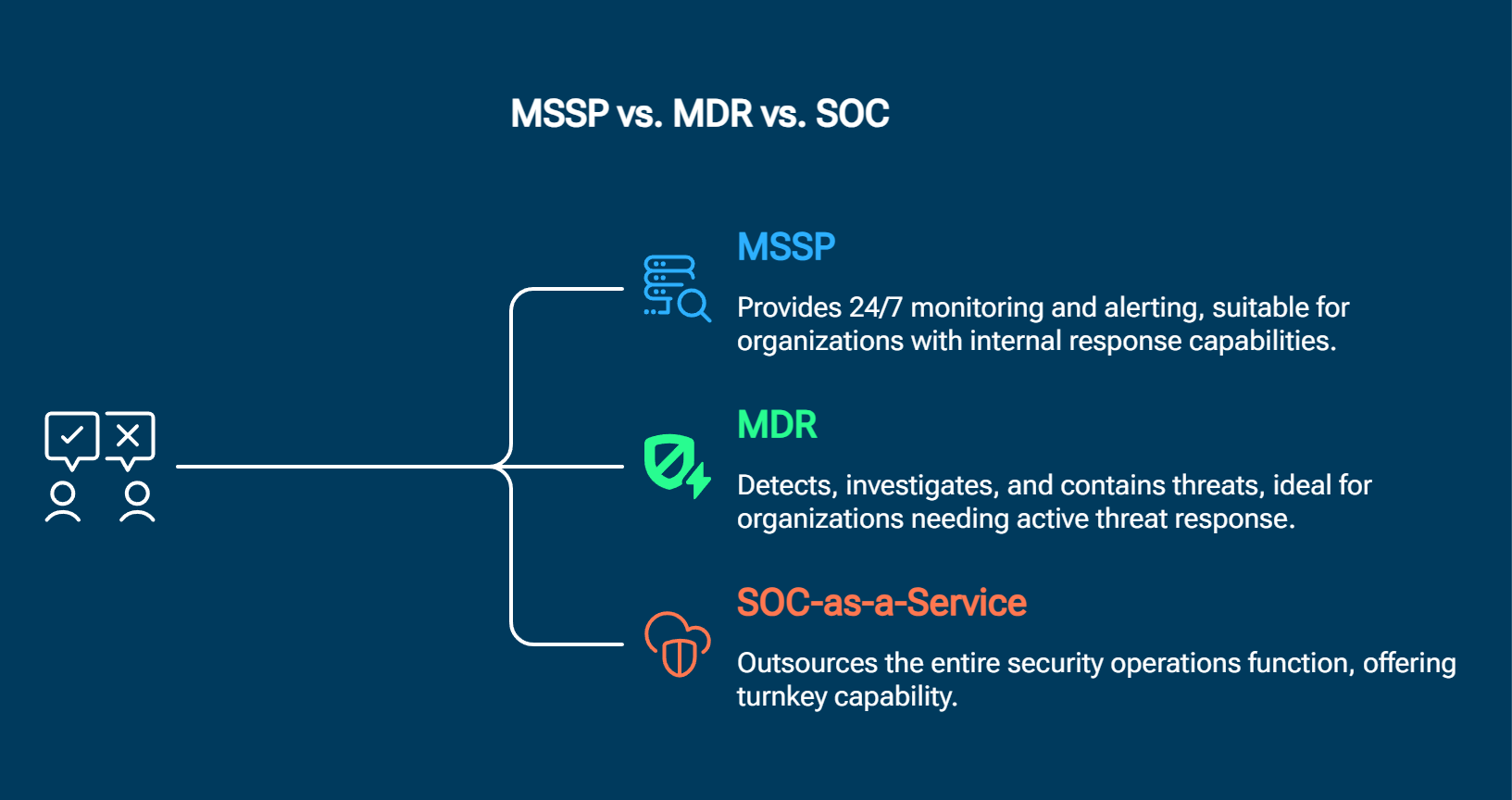
MSSPs monitor and alert. MDR providers detect and contain. SOC-as-a-Service outsources the entire security operations function. These are not interchangeable labels, though many providers use them that way. Coverage scope, response authority, threat hunting depth, and compliance reporting capability differ sharply across models.
MSSPs represent the foundational tier. They provide 24/7 monitoring and alerting through centralized security operations centers, focusing on log collection, correlation, and initial threat identification. When incidents are confirmed, MSSPs typically forward alerts to the client's internal team for investigation and remediation. This model works for organizations that need continuous visibility but retain internal response capability.
MDR evolved because monitoring alone does not stop attacks. MDR providers validate confirmed threats, investigate incidents, and contain them, often isolating hosts, disabling compromised accounts, or blocking malicious traffic without waiting for client authorization. MDR services use behavioral analytics and threat intelligence to detect attacker techniques that bypass signature-based controls, including living-off-the-land attacks that abuse trusted system tools to evade detection, identity abuse, and lateral movement.
Alert forwarding is not attack containment. As breakout times shrink from hours to minutes, the response authority gap between basic MSSP monitoring and active MDR containment has become the difference between a contained incident and a completed attack.
How managed security services work
Managed security operates as a continuous cycle, telemetry is ingested from across the client environment, behavioral models flag suspicious patterns, AI-driven triage filters noise and ranks genuine risk, analysts investigate confirmed threats, and response actions contain active incidents. This cycle runs 24/7 without the staffing constraints that limit in-house operations.
Modern managed security providers deploy technology stacks that ingest telemetry from across the enterprise. Core components include the following.
SIEM platforms for log aggregation and correlation.
SOAR tools for workflow automation and response orchestration.
XDR solutions for unified threat detection across endpoints, networks, cloud environments, and identity systems.
Endpoint protection agents and cloud workload sensors feeding continuous telemetry into detection pipelines.
Machine learning models analyze these inputs, identify anomalies, and rank alerts by threat severity and business impact. The result is measurably lower false positive rates than traditional rule-based tools produce.
Analysts work in tiered structures to handle escalating complexity.
Level 1 handles initial triage and alert processing.
Level 2 conducts deeper investigations and incident analysis.
When critical incidents occur, dedicated incident response teams mobilize immediately to contain threats before damage spreads.
The shift from reactive to predictive security
AI-enhanced managed detection has compressed detection timelines from months to hours. Traditional security operations average 181 days to identify breaches (IBM 2025). Leading MDR providers detect known attack patterns in hours or minutes through continuous learning algorithms that improve accuracy across the client base.
The mechanism behind this compression is behavioral analytics operating at provider scale. AI processes trillions of daily signals across provider environments, identifying threats before they manifest into incidents. Behavioral models and threat intelligence anticipate attacker actions, disrupting attack chains before critical assets are compromised.
This is not a marginal improvement. 181 days of dwell time gives attackers months to establish persistence and exfiltrate data. Detection measured in hours closes that window before the attacker completes their objective.
Integration with existing infrastructure
API-first architectures let managed security providers connect with existing SIEM platforms, identity management systems, endpoint tools, and ITSM platforms without custom development.Hybrid deployment options include the following.
Virtual appliances for on-premises or hybrid environments.
Cloud-hosted platforms for cloud-native architectures.
Containerized services that adapt to specific architectural and data residency requirements.
Managed security providers maintain certified expertise across AWS, Azure, and Google Cloud, deploying cloud-native security tools that use platform-specific capabilities while maintaining unified visibility through centralized management consoles. The integration model determines how quickly a provider reaches full operational coverage, and what the coverage gap looks like during transition.
Types of managed security services
Beyond MSSP, MDR, and SOC-as-a-Service, three specialized service categories now address attack surfaces that general-purpose providers miss.
Managed SIEM services handle SIEM platform deployment, configuration, tuning, and maintenance, the log management and correlation workload that overwhelms internal teams. Managed Extended Detection and Response (XDR) unifies security telemetry across endpoints, networks, cloud workloads, and identity systems, revealing multi-stage campaigns that single-domain tools miss.
Emerging service categories
Managed Identity Threat Detection and Response (ITDR) addresses the reality that 40% of breaches involve identity compromise (Verizon DBIR 2024). These services monitor Active Directory, Azure AD, and other identity platforms for credential theft, privilege escalation, and lateral movement indicators that signal active identity abuse. Identity-based attacks bypass perimeter defenses by design. Managed ITDR fills the visibility gap that perimeter-focused providers leave open.
AI-powered autonomous SOC services are the newest tier. These platforms investigate alerts, gather forensic evidence, determine root causes, and execute response actions with minimal human intervention. 39% of organizations have begun adopting agentic AI for security operations (Omdia 2025), with rapid acceleration expected through 2026.
Managed Cloud Security Posture Management (CSPM) continuously assesses cloud environments against security best practices, compliance frameworks, and organizational policies. Automated remediation handles common misconfigurations immediately. Complex issues receive detailed remediation guidance. The result is cloud governance without requiring deep cloud security expertise internally.
How much do managed security services cost?
The cost of managed security services varies depending on the size of the organization, the number of assets being monitored, the required response capabilities, and the complexity of the environment. Organizations typically pay a monthly subscription based on factors such as endpoints, cloud workloads, users, data volume, or the level of managed service provided.
Typical pricing considerations include:
The number of endpoints, servers, and cloud resources under management.
Whether the service includes MSSP, MDR, Managed XDR, or SOC-as-a-Service capabilities.
The scope of monitoring across network, endpoint, identity, cloud, SaaS, and IoT environments.
Response services such as incident investigation, containment, digital forensics, and threat hunting.
Compliance and reporting requirements for frameworks such as NIS2, HIPAA, PCI DSS, or SOC 2.
Basic managed security services typically start around $1,000–$5,000 per month, while enterprise MDR or fully managed SOC services can range from $5,000 to $20,000+ per month, depending on coverage and service levels.
When evaluating cost, organizations should compare subscription pricing against the expense of building and operating an internal 24/7 SOC, including technology licensing, staffing, training, and ongoing operational overhead.
Managed security services in practice
Small and medium businesses typically invest $1,000 to $5,000 monthly for basic managed security. Enterprise packages range from $5,000 to $20,000 monthly. Both access security capabilities that previously required eight-figure budgets.
Cost-benefit analysis framework
Quantifying managed security value requires analysis beyond simple cost comparisons. Building an effective in-house SOC involves three categories of capital commitment.
Technology investment:
$500,000 to $1,000,000 annually for enterprise-grade SIEM, SOAR, and XDR platforms.
Major platform upgrades every three to five years, often adding millions in unplanned expense.
Personnel costs:
$1,500,000 to $2,500,000 annually for a basic 24/7 team of eight to 10 analysts.
An additional 30% to 40% for training, certifications, and turnover-related recruitment.
Average turnover rates could exceed 25% annually in many SOCs, driven by alert fatigue and analyst burnout.
Operational overhead:
Ongoing threat intelligence subscriptions and infrastructure maintenance.
Technology refresh cycles that accumulate outside the core platform budget.
Total costs that quickly exceed $3 million annually when all factors are included.
Managed security services provide predictable operational costs with defined service levels and transparent pricing. The total cost of ownership comparison typically shows managed services delivering equivalent or superior protection at 40% to 60% lower total cost, with the additional benefit of risk transfer to providers with proven track records, deep expertise, and financial resources to maintain cutting-edge defenses (IBM 2025).
Detecting and preventing threats with managed security
79%–81% of attacks operate without malware (CrowdStrike 2025 Global Threat Report). Attackers use legitimate tools and stolen credentials to evade detection. Signature-based controls cannot catch these attacks. Behavioral analytics operating across billions of events daily can.
Managed security providers detect threats that in-house teams miss, not because of superior effort, but because of scale, behavioral modeling, and continuous threat intelligence aggregated across their client base.
The role of AI in modern threat detection
Machine learning models refine detection accuracy through two complementary approaches.
Supervised learning trains on labeled attack data, recognizing known threat patterns with increasing precision across the provider's entire client base.
Unsupervised learning identifies anomalies without prior knowledge, discovering zero-day techniques and novel attack patterns that signature libraries do not cover.
Threats identified at one organization immediately improve protection across the entire customer network. False positive reduction is a direct operational outcome: AI-powered correlation engines analyze context, user behavior, and threat intelligence to score alert fidelity. Obvious false positives are dismissed automatically. High-confidence threats are escalated. Analysts focus on complex investigations requiring judgment rather than processing alert queues.
Addressing specific threat vectors
Three primary vectors dominate modern attacks.
Ransomware remains the dominant threat category. Ransomware-as-a-Service platforms have democratized sophisticated attacks across multiple threat actor groups. Managed security providers counter ransomware through layered defenses: endpoint detection and response, network segmentation monitoring, and behavioral analytics that identify preparation activities, shadow copy deletion, mass file access, before encryption begins.
Supply chain attacks target the trust relationships between organizations and their software providers. Managed providers maintain threat intelligence on supply chain risks, monitor for indicators of compromise related to third-party tools, and deploy compensating controls when vulnerabilities emerge in widely used software.
Identity-based attacksaccount for 40% of all breaches (Verizon DBIR 2024). Managed security providers monitor authentication patterns, privilege usage, and account behavior for anomalies indicating compromise. MFA enforcement, privileged access management, and continuous identity hygiene assessments prevent many identity-based attacks before they escalate into lateral movement across network, cloud, and identity layers.
Managed security outcomes: What good looks like
The cases below are drawn from documented customer outcomes. Each connects directly to a technical or strategic point covered earlier on this page.
Globe Telecom (2024 to 2025): From 16-hour response to 3.5 hours
Globe Telecom, protecting services for over 80 million customers, faced a structural challenge that large-scale MSSP monitoring alone could not solve: overwhelming alert volume that buried genuine incidents. After deploying managed detection and response with behavioral AI prioritization, the organization achieved the following results.
99% reduction in alert noise.
96% reduction in escalations.
Incident response time reduced from 16 hours to 3.5 hours, a greater than 75% improvement in containment speed on confirmed attacks.
This case directly illustrates the alert triage problem described in the "How managed security services work" section. Behavioral AI filtering converted 16 hours of manual escalation into 3.5 hours of targeted response, not more analysts.
Luxgen Motor (2024): Enterprise-grade security outcomes with fewer than five people
Luxgen Motor achieved a 92.6% reduction in alert noise and a 95.3% reduction in escalations with a security team of fewer than five people. The outcome demonstrates that managed detection does not require headcount to scale; it requires behavioral triage that eliminates low-value signals before they reach human analysts.
This case connects directly to the cost-benefit analysis framework. The organization accessed enterprise-grade security outcomes without adding headcount, the same economic logic that makes managed security compelling against the $1.5 million to $2.5 million annual personnel cost of an equivalent in-house 24/7 team.
Key takeaway: Effective managed security is not defined by the volume of alerts monitored. It is defined by containment speed and accuracy when an attacker is confirmed in the environment. In every case above, containment before impact depended on behavioral detection operating across the full network, not on the size of the internal security team.
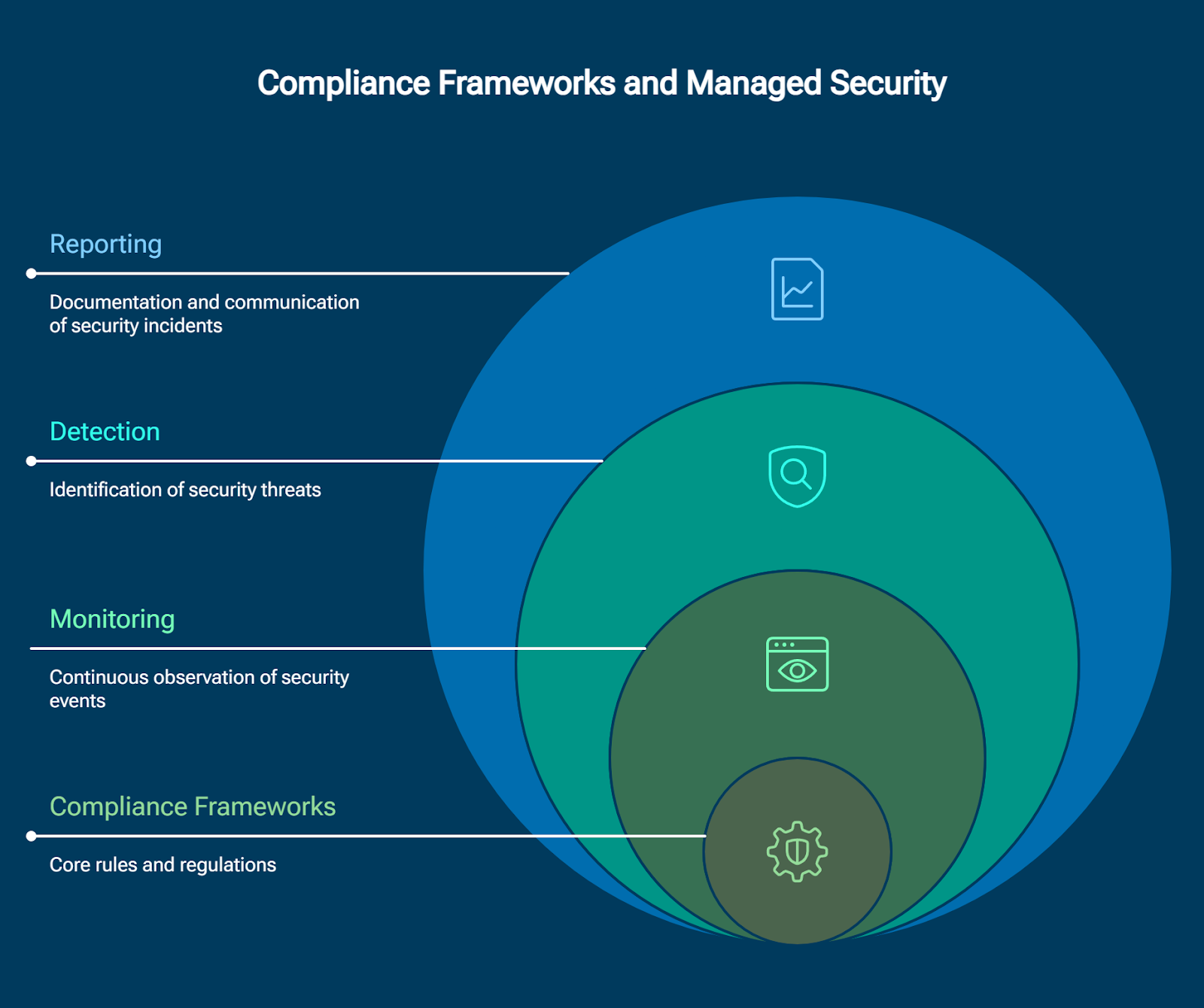
SEC disclosure rules now require public companies to report material incidents within four business days. NIS2 imposes rapid incident notification on EU organizations. HIPAA mandates access management, encryption, and audit logging, and healthcare breaches cost an average of $7.42 million per incident (IBM 2025). Managed security providers deliver continuous monitoring, rapid incident reporting, and auditable evidence of control effectiveness by design. Periodic internal audits cannot match that cadence.
The regulatory landscape has shifted toward continuous, evidence-based security requirements across all major jurisdictions.
SEC Cybersecurity Disclosure Rules require public companies to report material incidents within four business days while maintaining comprehensive risk management programs.
NIS2 Directive (EU) introduces rapid incident notification and accountability frameworks for senior management, with specific requirements varying by member state.
HIPAA demands comprehensive security controls including access management, encryption, and audit logging. Average breach costs for healthcare organizations reach $7.42 million, significantly higher than the global average (IBM 2025).
PCI DSS, SOC 2, and SWIFT create overlapping requirements for financial services organizations, accelerating the need for providers with pre-built compliance packages that map continuous monitoring to regulatory control frameworks
Managed security providers maintain pre-built compliance packages addressing common frameworks, accelerating implementation while ensuring consistent coverage. Their experience across hundreds of implementations identifies common pitfalls and optimization opportunities that improve both security posture and operational efficiency.
Audit-ready reporting and continuous compliance monitoring
Continuous compliance monitoring closes the gap between periodic assessments. Managed security platforms evaluate posture against regulatory requirements in real time, identifying deviations before they become audit findings. Dashboards give executives, audit committees, and regulators direct visibility into compliance status.
Automated reporting streamlines regulatory submissions and stakeholder communications. Pre-built templates address common requirements. Customization options accommodate unique organizational needs. When incidents occur, managed services produce forensic reports documenting timelines, impact assessments, and remediation actions that satisfy disclosure requirements while protecting legal privilege.
Can you prove right now, not after an audit, that your controls are working? That is the question regulators are asking. Continuous compliance monitoring is how organizations answer it
How to choose the right MSSP
Selecting a managed security provider is a security architecture decision, not a procurement exercise. The provider's coverage model, detection methodology, response authority, and integration depth determine whether active attacks are contained or merely observed.
Coverage scope and detection depth
What does the provider actually monitor? Network-only visibility leaves endpoint, identity, and cloud blind spots. Ask specifically which telemetry sources are ingested, which attack techniques are detected, and how MITRE ATT&CK coverage maps across the kill chain. Providers that cannot answer at the technique level are relying on generic claims.
Response authority and containment capability
Does the provider monitor and alert, or monitor and respond? An MSSP that forwards alerts for client-side action provides no containment during an active attack. MDR providers with pre-authorized response authority isolate hosts, disable compromised accounts, and block malicious traffic within minutes of confirming a threat. That capability gap determines whether attacks are contained or completed.
Mean time to detect and respond benchmarks
Request provider-specific MTTd and MTTr metrics across incident types. Not industry averages, the provider's own numbers from their own client base. Leading MDR providers detect known attack patterns in hours or minutes. Providers that cannot share specific benchmarks should be treated with skepticism.
Integration model and deployment timeline
How does the provider integrate with existing SIEM, SOAR, identity management, and endpoint tools? Does integration require full platform replacement, or does it augment existing investments? What does the coverage gap look like during the transition period? Get a realistic deployment timeline, not a sales timeline.
Compliance and reporting capability
Does the provider generate the specific compliance reports your regulatory obligations require? Not generic security reports, framework-specific outputs for NIS2, SOC 2, PCI DSS, HIPAA, or SEC requirements as applicable. How are incident reports structured? Do they satisfy disclosure requirements without additional processing?
Threat intelligence and detection velocity
How quickly does the provider deliver detection coverage for new attacker techniques? Providers dependent on signature updates operate on lag cycles that active attackers exploit. Behavioral AI-driven providers deploy new detection coverage within days or hours of identifying new techniques based on observed attacker behavior. The difference between those two timelines is the window an attacker has to operate undetected.
How Vectra AI approaches managed security
79%–81% of modern attacks execute without malware (CrowdStrike 2025). Log aggregation, rule matching, and alert forwarding cannot detect what does not trigger a signature. Vectra AI is built on a different architecture: behavioral AI that identifies how attackers move across the network, not what signatures they leave behind.
The Vectra AI approach to managed security is built on five interconnected layers.
Attacker behavior modeling grounded in MITRE ATT&CK
Vectra AI's detection starts with security research, not anomaly scoring. Detection engineering and data science teams map attacker behaviors directly to MITRE ATT&CK tactics across network, identity, cloud, and SaaS domains. Every detection aligns to how attackers actually progress through the cyber kill chain, not to statistical deviations that lack intent or context. Behaviors modeled include the following.
Credential abuse and initial access.
Lateral movement and privilege escalation.
Command-and-control and persistence.
Data staging and exfiltration.
Detections are explainable, repeatable, and defensaws.amazon.comsasasasible, with clear linkage between attacker technique and defensive outcome. Security teams can trust these detections and justify them to regulators, boards, and peers.
Real-time streaming analysis via Jetstream
Jetstream is a distributed, streaming-first architecture that processes network and identity telemetry in motion, not after collection. Batch-based, log-centric systems analyze data retrospectively. Jetstream ingests, enriches, and correlates telemetry continuously as events occur across the hybrid enterprise.
Jetstream handles high-throughput network flows, identity events, and metadata streams without introducing latency or requiring full packet capture. It detects behavioral patterns, tracks attacker progression, and generates attack signal while activity is unfolding. For managed security operations, speed becomes a defensive advantage instead of a liability.
Metadata Signal Fabric for high-fidelity, low-noise signal
Vectra AI's Metadata Signal Fabric extracts, normalizes, and enriches security-relevant metadata from across the hybrid enterprise, without relying on full packet capture, raw logs, or isolated alerts. Sources include the following.
Network flows and traffic metadata.
Identity events from Active Directory, Azure AD, and cloud identity providers.
Cloud activity across AWS, Azure, and Google Cloud workloads.
SaaS interactions from Microsoft 365 and connected applications.
This metadata is continuously enriched with identity, asset role, behavior history, attack stage, and risk posture context. It is then correlated across domains and time. Detections, investigations, and response workflows all operate on the same consistent, contextualized view of the environment. Analysts get deep visibility without the storage, performance, and operational overhead of packet-heavy systems.
Multi-layer attribution across identities, hosts, and privileges
Attackers abuse identities, impersonate services, and move laterally across systems. Attribution must go beyond IP addresses or single-event correlation. Vectra AI's Multi-Layer Attribution continuously links activity across users, service accounts, workloads, hosts, and infrastructure by combining network behavior, identity context, and privilege intelligence. Specific capabilities include the following.
Host ID for persistent tracking of systems even as IP addresses change.
Kingpin for revealing high-risk identities and access relationships that attackers target to gain control.
Together, these layers ensure activity is attributed to the true entity behind it, not just the surface-level signal, enabling more accurate prioritization and safer automated response.
AI-driven triage and 360 Response
Vectra AI's AI Agent continuously analyzes behavior across network, identity, cloud, and SaaS to separate real risk from anomaly. It automatically triages events, correlates related activity across domains, and prioritizes hosts and identities based on attack progression and potential impact. Dynamic attack graphs map how behaviors connect, revealing scope and intent in real time.
When investigation confirms an active attack, 360 Response turns detection into coordinated, multi-layered enforcement. Response actions include isolating hosts, disabling or resetting compromised accounts, and blocking malicious traffic through authoritative enforcement tools, automatically or manually. This is the response authority gap that separates behavioral MDR from alert-forwarding MSSP models.
Capability
Function
Managed security outcome
Attacker behavior modeling
Maps detections to MITRE ATT&CK kill chain
Detections aligned to real attacker techniques, not statistical noise
Jetstream real-time engine
Processes telemetry in motion at enterprise scale
Attackers detected while active, not after impact
Metadata Signal Fabric
Enriches and correlates signal across domains
High-fidelity signal without full packet capture overhead
Multi-layer attribution
Links activity to true identity across privilege and access
Accurate prioritization, no false attribution to the wrong entity
AI Agent triage
Automatically correlates and prioritizes risk
Analysts focus on confirmed threats, not alert queues
360 Response
Coordinated containment across device, identity, and network
Active containment without waiting for manual approval cycles
Conclusion
Most organizations do not lose to attackers because they failed to buy the right tool. They lose because their security operations cannot see what is happening across the full network in real time, and cannot respond fast enough when they do. Managed security services close both gaps: continuous visibility across every environment where attackers operate, and containment authority that does not wait for a human to approve every response action before the attacker completes their objective.
The value of managed security is not the number of alerts processed. It is the gap between detection and containment, and whether that gap is measured in minutes or months.
Before selecting or renewing a managed security provider, apply these diagnostic questions to your current environment.
What percentage of devices on your network, including unmanaged, IoT, and OT systems, are visible to your current monitoring stack? What happens when an attacker moves between the ones that are not?
When your provider confirms a threat, how many minutes does containment take? Does it require your team to authorize each response action before it executes?
Can your provider show you MITRE ATT&CK technique-level coverage across your environment, or do they report coverage in general terms without mapping to specific adversary behaviors?
If a privileged account on your network starts authenticating to new cloud resources at 2 AM, what is the first automated action your detection stack takes? When does a human analyst see it?
What compliance report would your provider produce if a regulator requested evidence of continuous monitoring and incident response effectiveness within 24 hours of a disclosed breach?
An MSSP monitors your environment and forwards alerts to your team for investigation and response. MDR providers validate confirmed threats, investigate incidents, and actively contain attacks, often isolating compromised systems or disabling accounts without waiting for client authorization. The defining difference is response authority. MSSPs observe and notify. MDR providers observe and act.
Is an MSSP the same as a SOC?
No. A SOC is an internal function staffed by your own analysts using your own tools. An MSSP provides outsourced security operations, a shared SOC delivered as a service. Some organizations use both: an MSSP or MDR provider for 24/7 monitoring and response, with an internal SOC team focused on strategic security architecture, policy, and high-complexity investigations.
How quickly can threats be detected with managed services?
Traditional security operations average 181 days to identify breaches (IBM 2025). Leading MDR providers detect known attack patterns in hours or minutes through behavioral analytics and continuous monitoring. Containment timelines depend on the provider's response authority model, specifically whether pre-authorized containment is in scope, or whether alerts require client approval before action.
Can managed security services help with compliance?
Yes. Managed security services directly support NIS2, SOC 2, PCI DSS, HIPAA, and SEC cybersecurity disclosure requirements. Providers deliver continuous monitoring that satisfies ongoing risk management requirements, automated incident reporting that meets regulatory disclosure timelines, and audit-ready reports documenting control effectiveness. Verify specific framework support before selection, compliance capability varies by provider.
How do I choose the right managed security provider?
Evaluate based on coverage scope (what telemetry is ingested), response authority (monitoring vs. active containment), MITRE ATT&CK coverage depth, integration compatibility with your existing stack, compliance reporting capability for your specific regulatory obligations, and MTTd/MTTr benchmarks from the provider's own client base. Request a proof of concept or pilot before committing to a long-term agreement.