Threat detection software explained: a vendor-neutral buyer's guide
Key insights
Threat detection software is an umbrella category, not a single product. It spans endpoint (EDR), network (NDR), cross-telemetry (XDR), logs (SIEM), managed services (MDR), and identity (ITDR) — and the right answer is usually a combination, not one winner.
Detection methods range from exact-match signatures to behavioral analytics, and each catches a different slice of attacker activity. Signatures miss zero-day and self-rewriting malware; behavioral analytics catch the credential abuse and lateral movement that signatures cannot.
Choose by criteria, not by ranking. Telemetry breadth, false-positive control, MITRE ATT&CK coverage, integration, analyst support, and total cost matter more than any vendor's self-reported leaderboard position.
Detection is necessary but imperfect — organizations catch only one in seven attacks (Picus Blue Report 2025), and in 2026 detection tools themselves became an active attack surface. Owning a tool is not the same as being protected.
Validate detection against current adversary behavior with adversary emulation, and layer telemetry across endpoint, network, and identity rather than relying on a single endpoint agent.
Almost every guide to threat detection software ends with the same conclusion: the company that wrote it sells the best one. This is not that guide. Threat detection software is one of the most fragmented, acronym-heavy categories in security, and the honest truth is that there is no single best tool — only the right fit for your environment, your team, and your risk. That gap matters because the stakes are rising fast. Across 160 million simulated attacks, the Picus Blue Report 2025 found that organizations detect only one in seven attacks, and the 2025 SANS Detection and Response Survey found that 73% of teams name false positives as their number-one challenge. This guide explains what the category is, how detection actually works at the method level, how the acronyms differ, what to evaluate, what it costs, and where it falls short — so you can choose with a framework instead of a brand ranking.
What is threat detection software?
Threat detection software is software that continuously monitors endpoints, networks, logs, cloud workloads, and identities to identify malicious or anomalous activity, then raises an alert or triggers a response. It does not promise to block every attack. Its job is to find the activity that prevention missed — early enough that an intrusion never becomes a breach.
That distinction is the whole point. Modern security operates on a simple assumption: smart, well-resourced attackers will eventually get past your preventive controls. Once you accept that, the priority shifts from keeping everyone out to finding the ones who get in — fast. Detection software is the discipline that makes that possible. For the broader concept of what threat detection is across people, process, and technology, the dedicated topic page goes deeper. Here, the focus is the software.
One clarification up front, because it shapes everything that follows: "threat detection software" is an umbrella term, not a product. It spans endpoint detection and response (EDR), network detection and response (NDR), extended detection and response (XDR), security information and event management (SIEM), managed detection and response (MDR), and identity threat detection and response (ITDR). Most buyers run several of these at once. The sections below disambiguate each one and explain how they fit together, so the acronyms stop being a source of confusion and start being a map.
Threat detection vs threat prevention vs antivirus
These three terms get used interchangeably, but they do different jobs. Prevention blocks known-bad activity before it executes — think firewall rules, allow-lists, and email filtering. Detection assumes something slipped through and looks for malicious or anomalous behavior already inside the environment, whether active or dormant. Legacy antivirus is a narrow, signature-only subset of endpoint prevention that matches files against a database of known malware. Antivirus still has a place, but on its own it cannot see credential abuse, fileless attacks, or behavior that has no signature. Detection software is what catches what prevention and antivirus do not. And detection is distinct again from threat hunting, the proactive, human-led search for threats that automated detection has not yet flagged.
How threat detection software works
Most buyer guides skip straight to product lists and never explain the mechanism. That is a mistake, because understanding how detection works is the single best way to evaluate it. At the simplest level, every detection platform runs the same pipeline: it gathers telemetry, makes sense of it, applies logic to spot suspicious activity, and decides what deserves a human's attention.
Here is that pipeline as a sequence:
Collect telemetry from endpoints, network, logs, and identity.
Normalize raw data into a consistent, queryable format.
Apply detection logic — signatures, rules, and analytics.
Correlate related events across sources into one picture.
Score and prioritize by severity and confidence.
Alert the analyst or feed a case for investigation.
Optionally trigger an automated response to contain the threat.
The interesting part is step three, because "detection logic" is not one thing. There are several distinct methods, and each one is good at catching a different kind of attacker activity — and blind to others. A useful way to think about it: signatures are like a bouncer checking IDs against a list of known troublemakers, while behavioral analytics is like a bouncer who notices that a regular is suddenly acting nothing like themselves. You want both at the door.
Detection methods compared
There are four to five core detection methods, depending on how you count, and the strongest platforms blend them. Signature-based detection matches activity against known indicators — fast, precise, and effectively blind to anything new. Rule-based detection fires when conditions you define are met, which is powerful but only as good as the rules someone wrote. Anomaly detection flags statistical deviations from a baseline. Heuristic detection uses experience-based logic to spot likely-malicious characteristics. And behavioral detection, often powered by user and entity behavior analytics (UEBA), baselines normal behavior for users and machines, then surfaces meaningful deviations.
Table 1: How each detection method maps to what it reliably catches, what it tends to miss, and a representative threat.
Detection method
What it catches
What it misses
Example threat
Signature-based
Known malware, known IOCs, known exploits
Zero-day, polymorphic and self-rewriting malware
A novel ransomware variant with no published signature
Rule-based
Defined conditions (failed-login bursts, known TTPs)
Anything outside the rules you wrote; silent gaps
A new attack path no rule anticipates
Anomaly-based
Statistical deviations from a learned baseline
Slow, low-and-slow activity that hides in the noise
A spike in outbound data from one host
Heuristic
Suspicious characteristics by experience-based logic
Carefully crafted activity that mimics legitimate use
Stolen-credential logins to systems a user never touches
The practical lesson is that no single method is sufficient. Signature-based detection misses zero-day and self-modifying threats by design — and as later sections show, attackers now use AI to rewrite malware on the fly specifically to defeat signatures. Behavioral and anomaly methods are what catch the modern attacker who is not running malware at all but is instead abusing valid credentials. A real-world pattern makes this concrete: an account suddenly making remote-desktop connections to a hundred-plus internal systems is invisible to a signature engine, because nothing about it matches known-bad. To behavioral analytics, it is a glaring anomaly consistent with lateral movement, which maps to the MITRE ATT&CK technique for Remote Services (T1021).
Telemetry breadth matters as much as method. Detection draws from endpoint, network, log, cloud, and identity sources, and blind spots open up wherever a source is missing. Living-off-the-land attacks are the classic example — an attacker using built-in tools like PowerShell looks identical to a legitimate administrator, and default endpoint logging frequently omits the command-line arguments that would distinguish them, as Elastic's analysis of detecting command and scripting interpreters details. That gap is not theoretical: incomplete telemetry is the leading cause of silent detection failure, a finding the Picus Blue Report 2025 ties directly to the industry's poor detection rate.
Detection software categories: EDR, NDR, XDR, SIEM, MDR, and ITDR
Here is the section that resolves the single biggest source of buyer confusion: the acronym soup. These are not competing products you must choose between. They describe where each tool looks — endpoint, network, logs, identity, or a managed combination. Understanding the map is what lets you assemble coverage instead of agonizing over a false either-or.
Each category gets a short definition and a pointer to its dedicated guide. None of them is deep-dived here on purpose — the goal of this page is the map, not the territory.
Endpoint detection and response (EDR) watches endpoint devices — laptops, servers, workstations — for malicious processes, files, and behaviors. It is the most widely deployed starting point and the layer most teams already own. See the full endpoint detection and response (EDR) guide.
Network detection and response (NDR) analyzes network traffic and metadata to spot threats that never touch a managed endpoint, including lateral movement between systems. It is where credentialed east-west activity gets caught. See network detection and response (NDR).
Extended detection and response (XDR) correlates telemetry across endpoint, network, identity, and cloud into a single, stitched picture, reducing the manual work of piecing separate alerts together. See extended detection and response (XDR).
Security information and event management (SIEM) aggregates and analyzes logs and events from across the environment for both detection and compliance evidence. It is the log backbone many programs are built on. See SIEM.
Managed detection and response (MDR) is a service, not a sensor — an external team that runs detection and response on your behalf, wrapping any of the above with human expertise. See managed detection and response (MDR).
Identity threat detection and response (ITDR) focuses on identity and credential abuse — the attack surface where most modern intrusions now begin. See identity threat detection and response (ITDR).
Two adjacent categories round out the picture. Cloud detection and response extends detection into cloud workloads and control planes, often alongside CNAPP and CWPP tooling. And threat intelligence tools, sometimes called threat intelligence platforms, are not detectors at all — they aggregate and distribute the indicators and context that feed your detection logic. The distinction matters for buyers: a threat intelligence platform tells you what to look for, while detection software does the looking. "Advanced threat detection" is best understood not as a separate product tier but as the application of these behavioral and correlation-driven techniques against sophisticated, evasive adversaries — the deeper treatment lives on the behavioral threat detection page. One more category worth naming for completeness is insider threats detection, which applies behavioral analytics specifically to risky activity from people who already have legitimate access.
The market reflects how fast these categories are expanding. The XDR segment alone is projected to grow from $7.92 billion in 2025 to $30.86 billion by 2030, a 31.2% compound annual growth rate, according to MarketsandMarkets XDR sizing. The MDR segment is forecast to rise from $4.19 billion in 2025 to $11.30 billion by 2030, a 21.95% rate, per Mordor Intelligence's MDR market report. The growth is being driven by exactly the complexity this section describes — buyers assembling multiple layers rather than betting on one.
How the categories work together
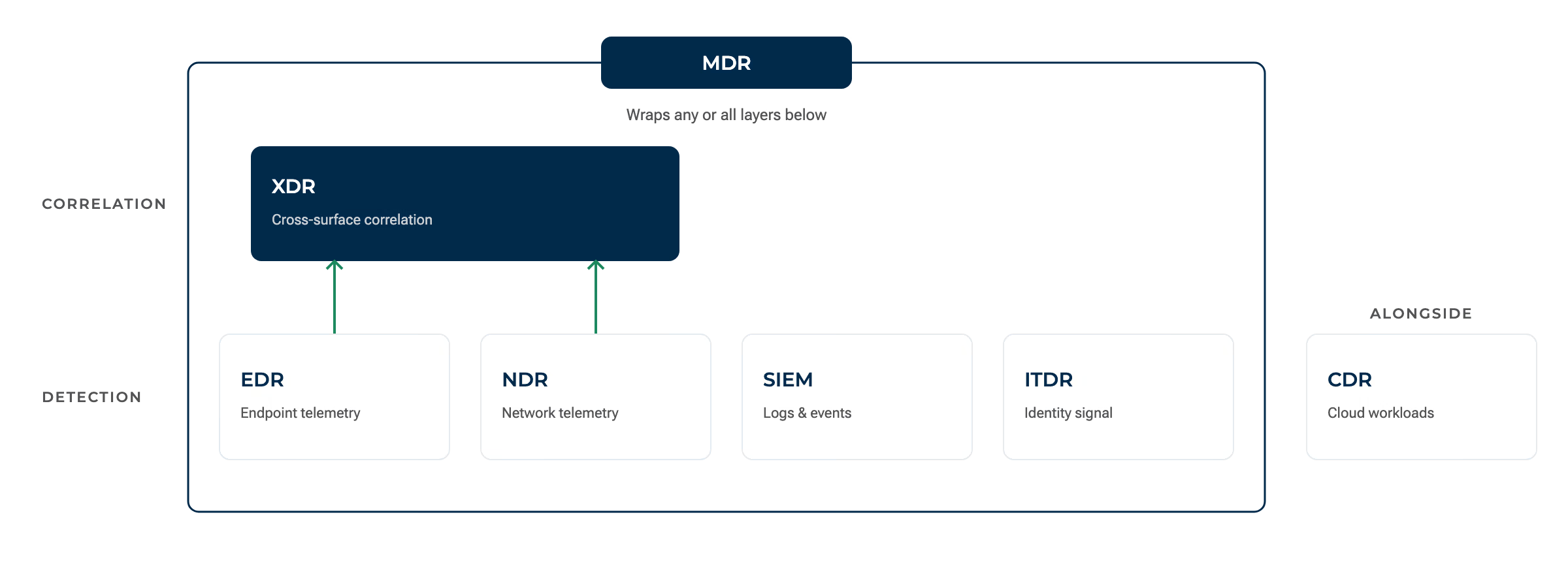
The categories are layers, not rivals. Endpoint (EDR) and network (NDR) telemetry feed into XDR for cross-surface correlation. Logs flow into SIEM for analysis and retention. Identity signal flows into ITDR. And managed detection (MDR) can wrap any or all of them when you lack the staff to run them yourself.
A layered map showing endpoint telemetry (EDR) and network telemetry (NDR) feeding upward into XDR for correlation; logs and events feeding into SIEM; identity signal feeding into ITDR; and a managed-service layer (MDR) wrapping the entire stack. Cloud detection and response sits alongside, extending coverage into cloud workloads.
Most enterprises run several of these simultaneously. The objective is integrated signal across attack surfaces — not one tool to rule them all. A team with strong endpoint coverage but no network or identity visibility has a structural blind spot no amount of EDR tuning can close. The next section turns that insight into a selection framework.
Table 2: A category map showing what each detection software category monitors, when it is the best fit, and where to learn more.
Category
What it monitors
Best when
Learn more
EDR
Endpoint devices and processes
Endpoints are your primary risk and you want a foundation
EDR guide
NDR
Network traffic and metadata
You need to see lateral movement and unmanaged devices
NDR guide
XDR
Correlated cross-surface telemetry
You want stitched signal instead of siloed alerts
XDR guide
SIEM
Logs and events
You need centralized analysis and compliance retention
SIEM guide
MDR
A managed service over any layer
Your team is small and you need expert coverage fast
MDR guide
ITDR
Identity and credential abuse
Identity is your fastest-growing attack surface
ITDR guide
How to choose threat detection software
This is where most guides hand you a ranked list and call it analysis. Instead, here is a criteria-driven framework — because the best threat detection software in 2026 is genuinely situational. A 30,000-employee bank with a mature SOC and a four-person team running lean make completely different correct choices. What does not change is the set of criteria you should evaluate against.
Start with a checklist. The features that separate effective detection software from shelfware are consistent across environments:
Detection method coverage — does it blend signature, rule, anomaly, and behavioral methods, or rely on one?
Telemetry breadth — does it see endpoint, network, identity, and cloud, or just one surface?
False-positive management — does it reduce noise, or add to it? This is the single most-cited operational pain.
MITRE ATT&CK coverage — how broad is detection across the tactics and techniques relevant to your environment?
Integration and automation — does it connect cleanly to your SOAR, ITSM, and ticketing, or create another silo?
Scalability — will it keep up as data volume and headcount grow?
Deployment model — agent-based, agentless, or both, and does that fit your estate?
Analyst-led investigation support — when automation is inappropriate, does it give analysts the context to investigate fast?
Total cost of ownership — license, data, retention, tuning, and staff, not just the sticker price.
A vendor-neutral evaluation checklist
Turn those features into an RFP-grade matrix. For each criterion, know why it matters, how to assess it objectively, and what a red flag looks like. The biggest evaluation trap is "AI-washing" — claimed autonomy or efficacy that independent testing does not support. Treat any vendor metric you cannot reproduce as marketing until proven otherwise.
Table 3: An RFP-style evaluation matrix translating each buying criterion into an objective assessment method and a red-flag threshold.
Criterion
Why it matters
How to assess
Red-flag threshold
Telemetry breadth
Blind spots become breaches
Map the tool's sources against your attack surface
Endpoint-only with no network or identity option
False-positive control
Noise drowns real signal
Run a proof of value and measure alert volume vs true positives
Analysts spend most of their time triaging noise
MITRE ATT&CK coverage
Shows real, mapped detection depth
Request a technique-level coverage map for your environment
A single marketing "coverage %" with no detail
Behavioral detection
Catches credential abuse signatures miss
Test against credentialed lateral-movement scenarios
Detection relies on signatures and static rules alone
Integration
Prevents another silo
Verify native SOAR, ITSM, and SIEM connectors
Manual export is the only integration path
Analyst support
Speeds investigation when automation can't
Evaluate the investigation and context workflow
Alerts arrive with no context or correlation
Validation transparency
Separates proof from marketing
Ask for independent or emulation-based results
Only self-reported, non-reproducible metrics
The reason validation transparency sits on that list is the efficacy gap covered later in this guide: across the industry, most attacks are not detected. Treat detection as a capability you must verify against real adversary behavior, never as a feature you can assume works because the datasheet says so.
Now match categories to your situation. The decision matrix below is the vendor-neutral substitute for a "winner" — it maps environments and team realities to the best-fit detection category.
Table 4: A decision matrix mapping common environments and team sizes to the best-fit detection category.
Use case / environment
Team size
Best-fit category
Endpoint-heavy, building a foundation
Any
EDR as the base layer
Hybrid network with lateral-movement risk
Lean to mid
EDR plus NDR for east-west visibility
Multiple siloed tools, alert overload
Mid to large with a SOC
XDR to correlate, or SIEM to centralize
Compliance-driven logging and retention
Any
SIEM for centralized log analysis
Identity-first or cloud-heavy estate
Any
ITDR and cloud detection and response
Limited staff, need coverage now
Fewer than 5 FTEs
MDR to wrap detection with expertise
On the "most reliable threat detection software" and "threat detection software companies" questions buyers often search for: reliability is a property of fit and validation, not of brand. The most reliable choice is the one whose telemetry matches your environment, whose detections you have tested against your own attack scenarios, and whose noise your team can actually action. The vendor landscape spans endpoint-focused providers, network and identity specialists, full-platform XDR vendors, managed-service operators, and a healthy open-source ecosystem — covered in the cost section below.
In-house tooling vs outsourced MDR
A recurring decision deserves its own answer: should you run detection in-house or buy managed detection and response? The honest framing is a trade-off, not a verdict. Lean teams — typically fewer than five full-time security staff who wear many hats and may not have a dedicated SOC — frequently get faster, better value from MDR, because it delivers 24/7 expert coverage without the hiring and tuning burden. Larger teams with SOC maturity, established processes, and the headcount to staff investigation often prefer to run tooling in-house for control and customization. The deciding questions are whether you can staff detection around the clock, whether you have the expertise to tune and validate it, and whether your risk profile demands a level of customization a managed service cannot match. Many organizations land on a hybrid — in-house XDR or SIEM with managed augmentation for after-hours coverage.
What threat detection software costs
Pricing is the question almost every buyer asks and almost no guide answers. The reason is that figures are genuinely volatile and vary widely by vendor, segment, and data volume. What follows are indicative ranges, each labeled with a source and year — treat them as a starting point for budgeting, not quotes, and re-verify at purchase.
There are three dominant pricing models. Per-endpoint or per-user monthly pricing is most common in the SMB and mid-market, where endpoint detection runs roughly $5 to $16 per endpoint per month based on 2026 market data from G2's small-business category and broadly consistent per-device endpoint figures. Log-volume or data-ingestion pricing dominates cloud and SIEM tooling, where cost scales with how much telemetry you collect and how long you retain it. Enterprise deployments are frequently quote-based, with total contracts commonly reaching into six figures and beyond once telemetry, retention, integrations, and managed services are bundled.
Table 5: Pricing models by segment with indicative 2026 ranges and the factors that drive total cost. Ranges are 2026 estimates and shift frequently.
Pricing model
Typical segment
Indicative range (2026)
Cost drivers
Per endpoint / user, monthly
SMB and mid-market
~$5–$16 per endpoint/month
Endpoint count, feature tier
Log volume / data ingestion
Cloud and SIEM
Scales with data ingested and retained
Telemetry volume, retention period
Enterprise quote-based
Large enterprise
Commonly six figures and up
Scope, integrations, managed add-ons
Managed service (MDR)
Any, especially lean teams
Bundled into a service fee
Coverage hours, environment size
The biggest budgeting mistake is anchoring on license cost alone. Total cost of ownership is driven as much by data and people as by software. Telemetry volume and retention can dwarf the license line; managed services trade capital for coverage; and integration and tuning consume staff time that rarely appears in the quote. Factor all of it.
There is also a powerful cost lever that listicles rarely mention: open source. Several well-regarded open-source projects deliver real detection capability at no license cost — the trade-off is the in-house expertise needed to deploy and maintain them. On the network side, Suricata, Snort, and Zeek provide intrusion detection and traffic analysis. For SIEM and endpoint, Wazuh and Security Onion are widely used. For threat intelligence, OpenCTI and MISP aggregate and share indicators, and OpenVAS covers vulnerability scanning. These are open-source projects rather than commercial products, and they are a legitimate option for teams with the skills to run them — or a way to prototype before committing budget.
Where threat detection software falls short
This is the section other buyer guides leave out, and it is the most important one. Detection software is necessary, but it is not magic — and pretending otherwise sets teams up to be blindsided. The honest picture, backed by 2025 and 2026 data, is that most attacks go undetected, false positives are getting worse, and in the last year detection tools themselves became a target.
1 in 7 attacks detected. Across 160 million simulated attacks, organizations triggered a meaningful alert on roughly 14% of them — Picus Blue Report 2025.
Start with that efficacy gap. The Picus Blue Report 2025 found organizations detect only one in seven attacks, and it broke down why detections fail: about 50% of failures trace to log-collection issues, 24% to performance problems, and 13% to misconfiguration. In other words, the tools are frequently installed and "running" while quietly missing the activity they were bought to catch.
Why detection tools miss attacks
False positives are the day-to-day face of the problem. The 2025 SANS Detection and Response Survey found 73% of organizations name false positives as their number-one challenge, and the share reporting "very frequent" false positives rose from 13% to 20% year over year. Every false alert is time an analyst spends not investigating a real one. That is how attacks slip through teams that own perfectly capable software — the signal is there, buried in noise no one can clear.
Table 6: The Picus Blue Report 2025 breakdown of why detections fail, by primary cause.
Failure cause
Share of failures
Log-collection issues
~50%
Performance problems
~24%
Misconfiguration
~13%
Silent failure compounds it. A SIEM rule that never fires looks identical to one that has nothing to report. Logging that omits command-line arguments cannot distinguish a malicious PowerShell session from a legitimate one. And living-off-the-land techniques — attackers abusing the legitimate tools already on a system — are specifically designed to look normal, mapping to MITRE ATT&CK's Command and Scripting Interpreter technique (T1059). None of these gaps shows up on a feature comparison, which is why validation matters more than datasheets.
Then there is the newest pressure: AI. Adversaries have moved evasion from theory into operational tradecraft. In 2025, researchers documented self-rewriting malware that queries large language models mid-execution to regenerate and obfuscate its own code — the families known as PROMPTFLUX and PROMPTSTEAL — producing polymorphic samples engineered to defeat static signatures, as covered by CSO Online. In June 2026, a major endpoint-security vendor's threat unit reported a development lab that used AI agents to orchestrate roughly 80 modules implementing more than 70 evasion techniques against multiple leading endpoint products, as reported by Help Net Security and corroborated by Infosecurity Magazine. Importantly, the researchers cautioned that the lab's own documentation appeared to overstate its success — likely an AI hallucination unsupported by the test data — so the takeaway is the capability and the trend, not any headline success rate. The defensive lesson is consistent across all of it: behavioral, context-driven, multi-telemetry detection holds up against techniques that defeat static signatures.
When the detection tool is the target
The freshest 2026 development reframes the whole category: the detection tool itself can be the way in. In May 2026, a widely deployed endpoint security product — Trend Micro's Apex One — was hit by an in-the-wild zero-day, CVE-2026-34926, which was added to the CISA Known Exploited Vulnerabilities Catalog with a federal patch deadline, as documented by BleepingComputer. Separately, a leading endpoint-detection platform had vulnerabilities reported that let a standard user disable its protection updates — silently degrading detection from the inside, as covered by BleepingComputer; because that reporting traces to a single primary outlet citing the vendor, the in-the-wild attribution is best treated as vendor-stated.
The point is not to single out any product — every vendor patches vulnerabilities, and these made the news precisely because the products are so widely used. The point is the principle: owning detection software is not the same as being protected. Attackers now go after the defensive control plane — agents, update channels, and management layers — directly. This guide describes only the existence and impact of these issues, never how to perform them; the constructive response is defensive.
So how do you respond? Validate detection against current adversary behavior rather than assuming it works:
Run adversary emulation to test what your tools actually catch.
Map detection coverage to the MITRE ATT&CK techniques relevant to you.
Confirm telemetry and log collection are complete, not just configured.
Layer endpoint, network, and identity signal instead of trusting one agent.
Re-validate after every major change, because coverage drifts.
This is also where threat hunting earns its place — proactively searching for what automated detection missed. And it is the honest answer to a question buyers ask constantly: does threat detection software prevent ransomware? It detects and can help contain ransomware behavior — encryption activity, lateral spread, suspicious access — but no tool fully "prevents" it, and the right posture is to validate detection against how ransomware operators actually behave today. Dwell time underscores the stakes: the global median sat at 14 days in 2025 per Mandiant's M-Trends 2026 incident-response data, with ransomware making up about 13% of investigations. A separate, differently-scoped dataset has circulated a much higher "average time to identify" figure of roughly 181 days — the two are not measuring the same thing and should not be conflated, but both make the same point: attackers often have far more time inside than defenders assume. And the cost of that time is concrete. The Illumio 2025 Global Cloud Detection and Response Report found that 92% of organizations experienced security incidents, and incidents involving lateral movement averaged more than seven hours of downtime.
Threat detection software and compliance
For many buyers, detection software is also a compliance instrument — the evidence that satisfies an auditor that monitoring controls exist and work. The key is to map capabilities to specific control requirements rather than to logos. Three frameworks come up most often.
The NIST Cybersecurity Framework 2.0 makes the Detect (DE) function the primary home for detection software, organized into two categories: DE.CM (Continuous Monitoring) and DE.AE (Adverse Event Analysis). These were consolidated from the three Detect categories in the older version 1.1, so mapping older documentation forward is worth a check. PCI DSS 4.0.1 Requirement 10 governs logging and monitoring, requiring log integrity, centralized collection, timely review, and retention of at least 12 months with three months immediately available, as RSI Security's Requirement 10 guidance explains. SOC 2 leans on the security and availability criteria, where detection tooling supplies the continuous control-monitoring evidence — the alerting and incident-response trail auditors expect.
On MITRE ATT&CK coverage, a question buyers ask directly: expect breadth across the tactics and techniques relevant to your environment, and treat it as a buying criterion rather than a single marketing percentage. Coverage is meaningful only when it is mapped to the threats you actually face. The MITRE ATT&CK framework gives you the common language to assess and compare it.
Table 7: A crosswalk mapping detection capabilities to specific framework controls with an example for each.
Capability
Framework / control
Example
Continuous network and endpoint monitoring
NIST CSF 2.0 DE.CM
Monitoring traffic and hosts to surface potential events
Adverse-event analysis and correlation
NIST CSF 2.0 DE.AE
Correlating alerts into a confirmed incident
Centralized logging and 12-month retention
PCI DSS 4.0.1 Requirement 10
Retaining logs with three months immediately available
Documented alert-to-response workflow for auditors
Modern approaches to threat detection
Where is the category heading? Detection is converging on AI-driven, behavior-based, multi-telemetry analysis focused on identity — because that is where modern attacks now operate. Several trends are reshaping it at once. AI and behavioral analytics are moving from differentiator to baseline, with autonomous-SOC assistance helping small teams cover more ground. Detection and threat intelligence are converging, so context arrives with the alert rather than in a separate tool. Identity has become the new center of gravity, as a growing share of intrusions are malware-free and rooted in credential abuse rather than malicious files. And the heavy capital flowing into the space — SecurityWeek tracked 26 cybersecurity acquisitions in May 2026 alone, with detection and AI-security a dominant theme — signals that consolidation and AI investment will keep accelerating.
What should you look for as the category evolves? Integrated signal across attack surfaces, AI that multiplies the reach of a small team rather than just adding alerts, and evidence of resilience against current adversary behavior — including the AI-accelerated evasion documented earlier. The reports converging on this picture, from the AI-evasion research to the self-rewriting malware families, all point the same way: static, single-layer detection is losing ground, and behavior-driven, identity-aware, multi-telemetry detection is where durable coverage now lives.
How Vectra AI thinks about threat detection
Vectra AI starts from a simple premise — assume compromise. Smart attackers will get in, so the priority is producing high-fidelity attack signal across network and identity, the surfaces where malware-free, identity-based attacks now concentrate. The approach emphasizes reducing noise so that lean teams can act on what matters, rather than drowning in alerts that no one can triage. That philosophy — how Vectra AI detects attacks by prioritizing signal over volume and extending network detection and response and identity coverage beyond the endpoint — reflects the same lesson this guide keeps returning to: detection has to be validated against how attackers actually operate, not assumed from a datasheet. For the broader discipline, the threat detection topic page goes deeper.
Conclusion
Threat detection software is not a single purchase with a single right answer — it is a layered capability you assemble to fit your environment, your team, and your risk. The honest version of the buying decision starts with understanding how detection actually works at the method level, mapping the categories of EDR, NDR, XDR, SIEM, MDR, and ITDR to where you most need visibility, and evaluating candidates against concrete criteria rather than self-reported rankings. It also means confronting the limits head-on: most attacks still go undetected, false positives are getting worse, and in 2026 detection tools themselves became an attack surface. None of that argues against detection — it argues for doing it well. Validate your tools against how attackers actually behave, insist on telemetry breadth across endpoint, network, and identity, and treat any metric you cannot reproduce as marketing until proven otherwise. The organizations that get this right are the ones that stop chasing a "best" tool and start building integrated, validated signal they can act on.
To go deeper on the discipline behind the software, explore how Vectra AI detects attacks across network and identity, or start with the foundational threat detection topic page.
FAQs
What is threat detection software?
Threat detection software is software that continuously monitors endpoints, networks, logs, cloud workloads, and identities to identify malicious or anomalous activity, then raises an alert or triggers a response. It is an umbrella category rather than a single product, spanning endpoint detection and response (EDR), network detection and response (NDR), extended detection and response (XDR), security information and event management (SIEM), managed detection and response (MDR), and identity threat detection and response (ITDR). Its purpose is to find the threats that prevention missed — early enough that an intrusion does not become a breach. Unlike legacy antivirus, which matches files against known-malware signatures, modern detection software blends multiple methods, including behavioral analytics, to catch credential abuse, fileless attacks, and activity that has no signature at all. The category exists because prevention alone is not sufficient: well-resourced attackers eventually get past preventive controls, and detection is the discipline of finding them once they are inside. Most organizations run several detection categories at once and aim for integrated signal across their attack surfaces.
What is the difference between XDR, EDR, SIEM, and MDR?
These four describe where detection happens and who runs it. EDR (endpoint detection and response) watches endpoint devices — laptops, servers, and workstations — for malicious processes and behaviors. SIEM (security information and event management) aggregates and analyzes logs and events from across the environment, serving both detection and compliance retention. XDR (extended detection and response) correlates telemetry across endpoint, network, identity, and cloud into a single stitched picture, reducing the manual work of connecting separate alerts. MDR (managed detection and response) is different in kind — it is a service rather than a sensor, an external team that runs detection and response on your behalf and can wrap any of the other categories with human expertise. The practical distinction is scope and ownership: EDR is endpoint-focused, SIEM is log-focused, XDR is correlation-focused across surfaces, and MDR is about who operates the capability. They are layers that work together, not mutually exclusive choices. A common pattern is EDR plus SIEM for foundation and retention, XDR to correlate the signal, and MDR to provide expert coverage when an in-house team cannot staff detection around the clock.
How much does threat detection software cost in 2026?
Threat detection software follows three main pricing models, and total cost depends heavily on data and people, not just licenses. Per-endpoint or per-user monthly pricing is most common in the SMB and mid-market, where endpoint detection runs roughly $5 to $16 per endpoint per month based on 2026 market data. Log-volume or data-ingestion pricing dominates cloud and SIEM tooling, where cost scales with how much telemetry you collect and how long you retain it. Enterprise deployments are frequently quote-based, with total contracts commonly reaching six figures and beyond once telemetry, retention, integrations, and managed services are bundled. These figures are volatile and vary widely by vendor and segment, so treat them as budgeting starting points and re-verify at purchase. The most common costing mistake is anchoring on license price alone — data volume, retention, tuning, and staff time often dominate the true total cost of ownership. Open-source projects such as Suricata, Snort, Zeek, Wazuh, Security Onion, OpenCTI, and MISP offer a no-license-cost path for teams with the in-house expertise to deploy and maintain them, and can also serve as a way to prototype before committing budget.
Does threat detection software prevent ransomware?
Not entirely — threat detection software detects and can help contain ransomware behavior, but no tool fully prevents it. Detection platforms can flag the activity that precedes and accompanies a ransomware attack: anomalous credential use, lateral movement between systems, suspicious access to file shares, and the encryption behavior itself. Behavioral and network detection are particularly valuable here because ransomware operators increasingly rely on stolen credentials and legitimate tools rather than detectable malware, and they move laterally before encrypting. Catching that movement early is often the difference between an isolated incident and an enterprise-wide event. However, "prevent" overstates what any single tool can promise. Attackers acquire new techniques quickly, and 2026 research showed adversaries using AI to generate evasion variants faster than static signatures can keep up. The right posture is to validate detection against how ransomware operators actually behave today — using adversary emulation — and to layer endpoint, network, and identity coverage rather than relying on one agent. Dwell-time data reinforces the urgency: attackers frequently remain inside environments for days or longer before detection, giving them ample time to stage an attack.
Can AI fully replace human analysts in threat detection?
No — AI multiplies the reach and speed of a security team, but human oversight remains necessary, especially as adversaries weaponize AI for evasion. AI and machine learning genuinely transform detection: they baseline normal behavior, surface anomalies at a scale no human could match, automate triage, and stitch related events into coherent attack stories. For lean teams, that force-multiplication is the difference between coverage and chronic blind spots. But several limits keep humans in the loop. Detection still produces false positives that require judgment to resolve, novel and ambiguous situations need human context, and high-stakes response decisions carry consequences that warrant a person's accountability. The risk grows sharper as attackers turn AI against defenders — 2026 saw AI-orchestrated evasion tooling and self-rewriting malware designed specifically to defeat automated detection, which makes experienced human analysts more valuable, not less. The most effective model is augmentation: AI handles scale, speed, and the repetitive triage that burns analysts out, while humans focus on investigation, validation, and decisions that require judgment. The goal is to multiply a small team, not eliminate it.
What MITRE ATT&CK coverage should I expect?
Expect coverage breadth across the tactics and techniques most relevant to your environment, and treat it as a buying criterion rather than a single marketing percentage. MITRE ATT&CK is a framework that catalogs real-world adversary tactics and techniques, giving defenders a common language to assess and compare detection depth. A meaningful coverage answer is technique-level and environment-specific — it shows which techniques a tool detects across the tactics you actually face, such as the credentialed lateral movement captured in Remote Services (T1021) or the living-off-the-land execution captured in Command and Scripting Interpreter (T1059). Be skeptical of any vendor that reduces coverage to one headline percentage with no detail behind it, because raw technique counts can be inflated by counting partial or low-fidelity detections. When evaluating, request a coverage map aligned to your environment, ask how detections were validated, and prioritize depth against the techniques attackers most use against organizations like yours over sheer breadth. Coverage is also not static: as MITRE ATT&CK versions advance and adversaries adopt new techniques, coverage drifts, so treat it as something to re-validate periodically rather than a one-time checkbox.
What is the best open source threat detection software?
There is no single best open-source option — the right choice depends on which surface you need to cover and how much in-house expertise you have. For network detection, Suricata and Snort are widely used intrusion-detection engines, and Zeek excels at network traffic analysis and rich metadata. For SIEM and endpoint detection, Wazuh provides log analysis, file-integrity monitoring, and host-based detection, while Security Onion bundles a full monitoring stack — including Suricata and Zeek — into a single distribution. For threat intelligence, OpenCTI and MISP aggregate, structure, and share indicators that can feed your detection logic, and OpenVAS covers vulnerability scanning. These open-source projects can deliver genuinely capable detection at no license cost, which makes them attractive to budget-constrained teams and a useful way to prototype before buying commercial tooling. The trade-off is operational: open-source detection requires staff with the skills to deploy, tune, integrate, and maintain it, and it typically lacks the vendor support, managed services, and turnkey correlation that commercial platforms provide. For teams with the expertise, a well-run open-source stack is a legitimate option; for lean teams without it, the maintenance burden often outweighs the license savings.