Attack surface monitoring explained: the continuous change-detection layer
Key insights
Monitoring is the continuous change-detection layer. It watches assets you already know about for drift, distinct from discovery (finding assets) and management (the full lifecycle).
The defining property is "continuous." Point-in-time scans miss the rapid change that creates exposure between assessments, which is why unknown and unmanaged assets remain a leading breach origin.
Monitoring nests inside ASM and CTEM. It is a function within attack surface management, which in turn feeds the broader continuous threat exposure management program.
Cadence should match risk tier. Critical external and cloud assets need continuous watching; lower-risk internal assets can run on a schedule with event-driven triggers layered on top.
The AI and agentic surface is the new frontier. Shadow AI, agent identities, and MCP servers create a surface most monitoring programs do not yet cover.
Attack surface monitoring is the continuous change-detection layer that watches your known assets for risk-relevant drift. It is the part of your exposure program that never sleeps — flagging the new open port, the expired certificate, or the storage bucket that turned public overnight. Yet the term gets tangled with discovery, with management, and with vulnerability scanning, leaving many teams unsure whether they need a dedicated capability at all.
This guide untangles that confusion. It defines monitoring precisely, walks through how the monitoring loop works mechanically, and disambiguates it from attack surface management and continuous threat exposure management (CTEM). It then covers what to monitor, how often, how to measure effectiveness, and why the AI and agentic layer is becoming the hardest surface to watch. Whether you are a SOC lead scoping a monitoring program or a CISO who needs board-ready metrics, this is the foundational reference.
What is attack surface monitoring?
Attack surface monitoring is the continuous practice of watching an organization's known internet-facing and internal assets for changes that introduce risk — new open ports, expired certificates, exposed services, or configuration drift. It runs continuously, distinguishing it from point-in-time discovery or periodic vulnerability scans.
That distinction matters because three related ideas are routinely confused. Discovery is the act of finding assets — enumerating subdomains, scanning IP ranges, and surfacing the forgotten staging server nobody remembered. Monitoring is the act of watching assets you already know about and detecting when they change. Management is the full lifecycle — discovery plus inventory plus monitoring plus prioritization plus remediation. Monitoring is a function within attack surface management, not a synonym for it.
The defining property is the word continuous. An attack surface is not static. Cloud resources spin up and tear down in minutes. Certificates expire on their own schedule. A developer flips a configuration flag and a private bucket becomes public. The exposure that hurts you is rarely the one a quarterly assessment captured — it is the one that appeared the day after. Monitoring exists to close that gap by detecting change as it happens rather than on a calendar.
A core concept here is configuration drift: the gradual, often unintended divergence of a system's live state from its known-good baseline. Drift is how a hardened asset quietly becomes a soft target. A firewall rule loosened for a troubleshooting session and never reverted, a debug endpoint left enabled after a release, or a permissions change that widened access — each is drift, and each is exactly what monitoring is built to catch.
This is why monitoring matters: unknown and unmanaged assets are a leading origin of breaches, and the problem is getting worse. Roughly 69% of organizations reported attack surface growth in surveys around 2022, a figure that climbed to 73–74% of organizations attributing incidents to unmanaged or unknown internet-facing assets in 2025 research (CSO Online). As the surface expands, the volume of change expands with it — and manual, periodic review stops being viable. Continuous monitoring is the response to a surface that changes faster than humans can track.
How attack surface monitoring works
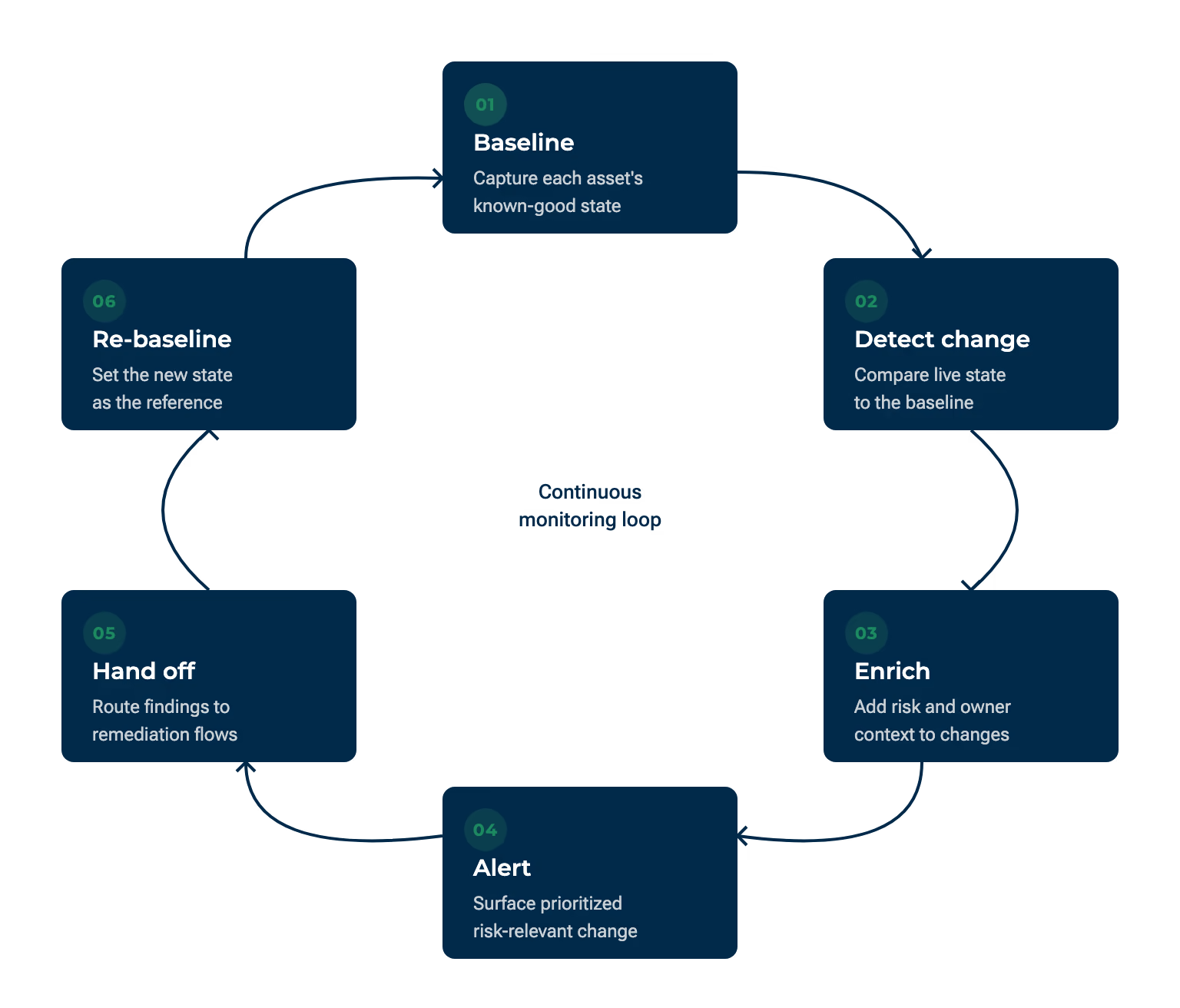
Monitoring runs as a continuous loop. It establishes a baseline of known assets, detects changes against that baseline, enriches each change with context, alerts on risk-relevant findings, hands off for remediation, and then re-baselines so the new state becomes the reference point. The cycle never stops.
The loop runs in six steps:
Baseline every known asset and its state.
Detect changes against that baseline continuously.
Enrich each change with risk context.
Score and filter to suppress benign noise.
Alert on risk-relevant, prioritized changes.
Hand off to remediation, then re-baseline.
Baseline. The loop starts with a known-good snapshot of each asset: its open ports, running services, certificate details, DNS records, and configuration state. The baseline is the reference against which all later change is measured. Without an accurate baseline, "change" has no meaning.
Detect. Monitoring continuously compares live state to the baseline. Detection draws on two technique families. Passive monitoring observes existing telemetry — DNS records, certificate transparency logs, network metadata, and cloud control-plane logs — without touching the asset. Active monitoring deliberately probes assets, querying ports and services much as an attacker performs reconnaissance. Mature programs blend both: passive for breadth and low footprint, active for depth and confirmation.
Enrich. A raw change — "port 8080 is now open" — is not yet actionable. Enrichment adds context: which asset, what business function, whether the service is known-vulnerable, whether the asset is internet-facing, and who owns it. Enrichment is what turns a stream of diffs into prioritized risk.
Score and filter. Not every change matters. A load balancer rotating an IP is expected; a database port opening to the public internet is not. Scoring and filtering suppress benign churn so analysts see signal, not noise. This step is where many programs succeed or fail — too little filtering buries teams in alerts, too much hides real exposure. Adding business context and risk scoring here is the single most effective way to keep false positives down.
Alert and hand off. Risk-relevant, prioritized changes generate alerts routed to the right owner, ideally with enough context to act without a separate investigation. Handoff connects monitoring to remediation workflows, integrating findings into ITSM, ticketing, or SOAR systems so a change becomes a tracked action — a ticket, a runbook, or an automated rollback — rather than another unread alert.
Re-baseline. Once a change is reviewed and resolved (or accepted), the baseline updates so the new state becomes the reference. Re-baselining prevents the same expected change from alerting forever. Automation underpins the entire loop: authoritative guidance recommends continuous external discovery with at least a daily refresh, and the volume and velocity of change on a modern surface make automated data collection a requirement, not a luxury (NCSC).
Monitoring vs vulnerability scanning
The most common confusion is monitoring versus vulnerability scanning, because both inspect assets and both surface risk. They answer different questions. A vulnerability scan asks, "what known weaknesses exist on this asset right now?" — matching software versions and configurations against a database of known flaws, typically on a schedule. Attack surface monitoring asks, "what changed on my surface that introduces new risk?" — watching continuously for drift, new exposure, and state change.
Scanning is depth-first and point-in-time; monitoring is change-first and continuous. A scan run on Monday tells you nothing about the port that opened on Wednesday. Monitoring catches the Wednesday change but does not, on its own, deep-test every asset for every known flaw. The two are complementary: monitoring detects that an asset changed, and vulnerability management assesses whether the changed asset is now exploitable. Neither replaces the other, and detection downstream depends on both — for attacker activity that follows an exposure, network detection and response provides the in-network signal that scanning and monitoring cannot.
Attack surface monitoring vs ASM vs CTEM
The three terms describe nested scopes, not competing alternatives. Monitoring is a continuous function. ASM is the discipline that contains it. CTEM is the strategic program that operationalizes both. Understanding how they nest resolves most of the vendor-driven terminology confusion.
Layer
Scope
Primary output
Cadence and owner
Attack surface monitoring
A single function: watch known assets for change
Change alerts, drift detection
Continuous; SOC or security operations
Attack surface management (ASM)
A discipline: discover, inventory, monitor, prioritize
Asset inventory, risk-ranked exposures
Ongoing; security engineering
Continuous threat exposure management (CTEM)
A program: scope, discover, prioritize, validate, mobilize
Validated, business-aligned remediation
Continuous program loop; CISO and cross-functional
Table: How attack surface monitoring, ASM, and CTEM differ in scope, primary output, cadence, and owner.
Attack surface management is the broader discipline. It discovers assets, maintains an inventory, monitors them for change, and prioritizes the resulting exposures. Monitoring is one of those four activities — the watching part. External attack surface monitoring is simply ASM monitoring scoped to internet-facing assets, the slice an external attacker can see; it rolls up into the same discipline rather than standing apart.
Continuous threat exposure management (CTEM) sits above ASM. Defined as a five-stage program — scope, discover, prioritize, validate, and mobilize — CTEM is the strategic layer that decides which exposures matter to the business and drives them to closure (Gartner). ASM supplies CTEM's discovery and inventory; monitoring supplies the continuous change signal that keeps that inventory current.
So when does each term apply? Use monitoring when you mean the continuous detection of change. Use ASM when you mean the full discipline of discovering and managing exposure. Use CTEM when you mean the organization-wide program that ties exposure reduction to business priorities. The market for these capabilities reflects the ambiguity — estimates of the attack surface management segment range from roughly USD 1.25 billion to USD 2.35 billion for 2026 depending on how analysts draw the boundaries. The takeaway is structural: monitoring ⊂ ASM ⊂ CTEM.
What to monitor across your attack surface
A complete program watches four surfaces. Each carries a distinct change pattern, and the fourth is one most teams do not yet cover.
External-facing assets. The internet-facing layer an outside attacker sees first. Monitor domains and subdomains, public IP ranges, TLS certificates and their expiry, open ports, and exposed login portals and services. Attacker reconnaissance starts here, mapping public infrastructure through active scanning (T1595) and gathering victim network information (T1590) before any intrusion. Changes on this surface — a new open port, a freshly exposed admin panel, a dangling DNS record — are the highest-priority signals because they are visible to everyone.
Internal assets. The surface behind the perimeter. Monitor configuration drift on servers and network devices, newly stood-up internal services, and changes to lateral-movement paths. Internal change is subtler than external change but no less important: it is how an attacker who is already inside finds a route deeper.
Cloud assets. The most volatile surface. Monitor storage buckets and their access policies, identity and permission misconfigurations, APIs, and ephemeral resources that exist for minutes. Forgotten or temporary cloud assets that were never decommissioned are a recurring pattern — continuous discovery and change detection close the gap between when an asset is created and when security becomes aware of it. Cloud's speed is precisely what makes continuous monitoring non-negotiable, and this surface intersects closely with cloud security.
The AI and agentic surface. The emerging frontier, and the surface most monitoring programs miss entirely. This layer includes shadow AI — unsanctioned AI tools employees adopt without review — along with the identities and credentials that autonomous agents hold, vector databases, and MCP servers (Model Context Protocol servers, the integration endpoints that connect AI agents to tools and data). These are new, internet-reachable, often highly privileged endpoints that classic CMDBs and vulnerability scanners miss entirely. Each is a new asset class with its own drift: an agent's permissions widen, a connector exposes data, a model endpoint goes public. In 2026 research, 92% of security professionals reported concern about the security impact of AI agents (Cloud Security Alliance). Monitoring this surface — including detecting shadow IT and shadow AI the inventory missed — is a core part of emerging agentic AI security practice.
Monitoring cadence and event triggers
Cadence should match risk. Monitoring everything continuously is expensive and noisy; monitoring everything on a slow schedule misses fast-moving exposure. The answer is to tier assets by risk and set frequency accordingly, then layer event-driven triggers on top. Authoritative guidance treats continuous external discovery with a daily refresh as the baseline, not the ceiling (NCSC).
Asset risk tierRecommended cadenceExample assetsCritical external and cloudContinuousInternet-facing apps, public APIs, exposed cloud storageHigh internalNear-real-time or hourlyDomain controllers, privileged hosts, sensitive data storesStandardDaily to weeklyProduction internal services, lower-sensitivity workloadsLowWeekly to monthlyIsolated or low-impact assets
Asset risk tier
Recommended cadence
Example assets
Critical external and cloud
Continuous
Internet-facing apps, public APIs, exposed cloud storage
High internal
Near-real-time or hourly
Domain controllers, privileged hosts, sensitive data stores
Standard
Daily to weekly
Production internal services, lower-sensitivity workloads
Low
Weekly to monthly
Isolated or low-impact assets
Table: Monitoring cadence matched to asset risk tier.
Critical external and cloud assets need continuous watching because they are exposed to the entire internet and change frequently — these are the assets where minutes matter. Stable internal assets can run on a longer schedule without meaningfully increasing risk.
Event-driven triggers complement scheduled cadence. Rather than waiting for the next interval, monitoring fires on specific events: a new deployment, a configuration change, a newly discovered asset, a DNS or certificate change, a merger or acquisition, or a new vulnerability affecting your stack. A practical rule is to tie an event trigger to every newly disclosed exploited vulnerability — when a flaw lands on the CISA Known Exploited Vulnerabilities catalog and it affects an edge appliance you run, that should trigger an immediate re-scan rather than wait for the schedule. Event triggers catch the exact moments when drift is introduced, closing the window between a change and its detection. The goal throughout is balance — enough coverage to catch real exposure, enough filtering to avoid the alert fatigue that causes teams to tune monitoring out entirely.
Measuring monitoring effectiveness (KPIs)
Monitoring is only as good as what it catches and how cleanly it surfaces it. Four KPIs capture effectiveness without drowning teams in metrics (SOC metrics reference).
Metric
Definition
Target range
How to measure
Mean time to detect (MTTD)
Time from a change occurring to it being detected
Minutes to hours for critical assets
Timestamp delta: change event vs detection event
Mean time to remediate (MTTR)
Time from detection to the change being resolved or accepted
Hours to days by risk tier
Timestamp delta: detection vs closure
Asset coverage
Share of known assets under active monitoring
100% critical, over 80% all assets
Monitored assets ÷ total inventoried assets
Alert false-positive rate
Share of alerts that are benign or non-actionable
Trend down, under 10%
False alerts ÷ total alerts
Table: Core attack surface monitoring KPIs with definitions, target ranges, and measurement methods.
Each KPI ties directly to effectiveness. A low MTTD means exposure is caught fast, shrinking the window an attacker can use, and a low MTTR means it is closed quickly once found. High asset coverage means few blind spots — unmonitored assets are exactly where surprise exposure hides, so 100% coverage of critical assets is the non-negotiable target. A low false-positive rate keeps analysts engaged; a noisy program trains people to ignore it, which is worse than no program at all. Baseline each metric over a few cycles before setting internal targets, then track the trend rather than any single reading.
Attack surface monitoring in practice
Real incidents show what unmonitored change costs. The pattern repeats: an asset drifts from its known-good state, no one is watching that surface, and the exposure becomes a breach.
Monitoring catches forgotten on-prem entry points and drift
Tabiq
Public, auth-less cloud storage bucket
2026
Continuous cloud monitoring flags a newly public bucket early
CISA contractor exposure
Public code repository with secrets
2026
Monitoring extends to code and credential surfaces, not just hosts
Table: Recent incidents, the unmonitored asset behind each, and the monitoring lesson each illustrates.
The Optus breach traced to an exposed subdomain and a vulnerable API reachable from the public internet, affecting roughly 9.5 million people (SecurityScorecard). The exposure linked to Cerner / Oracle Health showed how legacy "data migration" servers become a forgotten on-prem entry point when no one is watching for drift (Saptang Labs). In 2026, the Tabiq incident exposed roughly 1 million records through a public, authentication-less cloud storage bucket — exactly the newly public bucket a change-detection rule is built to flag (Privacy Guides). The same period saw a contractor expose federal passwords and cloud keys on a public code repository, a textbook unmonitored internet-facing asset noted by CISA (TechCrunch). These cases span the US, Australia, and Japan, but the common thread is universal — unmonitored change. In each, continuous monitoring of the affected surface would have surfaced the drift while it was still a finding, not yet a headline. Mask any discovered secrets as <REDACTED> and treat sample domains like example.com as the safe convention when documenting findings internally.
Compliance and framework mapping
Continuous monitoring maps cleanly to major security frameworks, satisfying control requirements that increasingly assume ongoing — not annual — visibility.
Framework
Control or tactic
How monitoring maps
NIST CSF
Identify (ID.AM) and Detect (DE)
Maintains current asset inventory and detects change and anomalies
CIS Controls v8
Controls 1, 2, and 7
Inventories enterprise and software assets; supports continuous vulnerability management
MITRE ATT&CK
Reconnaissance (TA0043)
Counters active scanning and network-information gathering against your surface
Table: How continuous attack surface monitoring maps to NIST CSF, CIS Controls v8, and MITRE ATT&CK reconnaissance.
Continuous monitoring directly supports the Identify and Detect functions of the NIST Cybersecurity Framework — particularly asset management (ID.AM) — and satisfies CIS Controls 1, 2, and 7. It also counters the MITRE ATT&CK reconnaissance tactic (TA0043) by watching the same surface attackers probe. Compliance contexts such as SOC 2, ISO 27001, and PCI DSS all assume an accurate inventory and continuous vulnerability management — treating monitoring as continuous rather than periodic is what turns these from checkbox exercises into genuine control.
Modern approaches to attack surface monitoring
Modern monitoring is shifting from inventory-centric to signal-centric. Platforms now unify continuous discovery, change detection, and risk context in one place rather than stitching together point tools, and the leading edge extends that coverage to the AI and agentic surface. The question is no longer "what assets do we have?" but "which changes carry real attacker interest?" — especially as adversaries increasingly log in with valid credentials rather than break in. Evaluating attack surface monitoring tools against that signal-centric bar, rather than a feature checklist, is the more useful frame.
How Vectra AI thinks about attack surface monitoring
Vectra AI starts from a simple premise: the modern network is the attack surface, spanning on-premises, cloud, identity, and AI infrastructure. Resilience comes from unified observability, clear attack signal, and informed action — so monitoring change across that whole surface is foundational, not optional. Attack Signal Intelligence prioritizes the changes and exposures that map to how attackers actually operate, and network exposure management together with network detection and response extend that signal-centric view from the surface inward. The result is monitoring as a source of prioritized signal — including the emerging AI security surface — not just a longer list of assets.
Conclusion
Attack surface monitoring is the continuous change-detection layer that keeps the rest of your exposure program honest. Discovery finds your assets and management organizes the work, but monitoring is what notices the moment a known-good asset drifts into a liability — the new open port, the public bucket, the over-permissioned agent. Its defining property is that it never stops, because the attack surface never stops changing.
The path forward is practical: baseline your assets, tier them by risk, monitor critical external and cloud surfaces continuously, layer event-driven triggers, and measure with KPIs that keep the program honest. Then extend coverage to the AI and agentic layer before it becomes the blind spot attackers reach first.
To go deeper on the surrounding disciplines, learn more about attack surface management, continuous threat exposure management (CTEM), and network detection and response.
FAQs
What is the difference between an attack surface and a threat surface?
An attack surface encompasses all the points where an attacker could potentially gain access to a system — every open port, exposed API, user credential, and physical access point. A threat surface is a broader concept that layers external context on top of the attack surface. It includes the attack surface itself plus external threat factors such as the active threat actor landscape, exploits currently circulating in the wild, and geopolitical conditions that may increase risk to specific sectors or regions.
For security teams, the practical distinction matters for prioritization. Two organizations may have identical attack surfaces, but the one operating in a highly targeted industry (such as defense or critical infrastructure) faces a larger threat surface because more adversaries are actively seeking to exploit those entry points. Attack surface management focuses on what you control — your assets and exposure. Threat surface awareness adds intelligence about who is likely to target you and how.
What is the difference between attack surface management and vulnerability management?
Attack surface management is a superset of vulnerability management. Vulnerability management focuses on known assets and known flaws — scanning inventoried systems for CVEs and prioritizing patches. ASM starts earlier in the process by discovering assets you did not know existed — shadow IT, forgotten cloud instances, unmanaged third-party connections — and then continuously monitoring the full surface for changes.
The key distinction is scope. Vulnerability management asks, "What flaws exist on our known systems?" ASM asks, "What systems do we have, and which ones are exposed?" Organizations that rely solely on vulnerability management risk missing the assets that were never inventoried in the first place.
How often should organizations assess their attack surface?
Continuously. The industry has moved decisively from periodic quarterly or annual assessments to continuous automated monitoring. Cloud attack surfaces change faster than on-premises environments, with workloads, containers, and serverless functions spinning up and down in minutes. Ninety percent of incidents are enabled by misconfigurations that can appear at any time, according to Unit 42's 2026 Global Incident Response Report. CISA BOD 26-02 reflects this shift by mandating ongoing edge device inventory rather than one-time audits. Organizations that still rely on periodic scans operate with a stale picture of their exposure.
What is cyber asset attack surface management (CAASM)?
CAASM is a Gartner-defined category focused on aggregating asset data from multiple sources — CMDB, endpoint agents, cloud provider APIs, vulnerability scanners, identity platforms — to create a comprehensive, deduplicated inventory of all cyber assets. Where EASM looks outward at internet-facing assets visible to external attackers, CAASM looks inward to consolidate internal asset visibility. The two disciplines are complementary. EASM discovers what attackers can see from outside the perimeter. CAASM ensures internal teams have a unified, accurate view of everything inside the perimeter. Together they provide the complete inventory that ASM requires.
What is the biggest attack surface risk in 2026?
Edge device exploitation and identity compromise are the two largest attack surface risks heading into 2026. The 2025 Verizon DBIR found that 22% of exploitation breaches targeted edge devices — firewalls, VPNs, routers, and remote access gateways — with an eightfold year-over-year increase. Meanwhile, 3.3 billion compromised credentials are in circulation according to Flashpoint's 2026 Global Threat Intelligence Report. CISA responded by issuing BOD 26-02 mandating edge device inventory and decommissioning of end-of-support equipment. The convergence of these two risks — exposed edge devices and compromised identities — creates compound attack paths that traditional perimeter defenses cannot address.
How does attack surface management relate to zero trust?
Zero trust is a security framework that eliminates implicit trust for any user, device, or connection. It directly reduces the attack surface by enforcing least-privilege access and micro-segmentation, limiting what an attacker can reach even after gaining initial access. ASM provides the visibility foundation that zero trust requires. You cannot enforce least-privilege access controls on assets you do not know exist. By continuously discovering and cataloging all assets, identities, and connections, ASM gives zero trust architectures the complete inventory needed to define and enforce access policies effectively.
What is the ASM market size?
The global ASM market was valued at approximately $1 billion in 2025, with projections reaching $5 billion or more by 2034 at a 21% CAGR. The $7.75 billion ServiceNow acquisition of Armis in late 2025 further validates the market's growth trajectory and signals that ASM is moving from standalone tooling to integrated enterprise platform capability. Market size estimates vary across research firms, but the directional trend is consistent: organizations are investing heavily in attack surface visibility as digital environments grow more complex.