Security incident investigation explained: how SOC teams turn an alert into answers
Key insights
In cybersecurity, an incident investigation is the analytical phase that turns a triaged alert into a confirmed, scoped, and explained incident.
A repeatable security incident investigation runs seven steps — validate, scope, collect, reconstruct, map, document, and report.
Median time from initial access to attacker hand-off fell to 22 seconds in 2025 (M-Trends 2026), so even "routine" alerts deserve fast validation.
Unit 42 research (2026) found identity weaknesses in roughly 90% of investigations, so identity and SaaS logs now matter as much as disk.
Mean time to investigate (MTTI) is the metric this phase owns. Drive it down, and dwell time falls with it.
Search for "incident investigation" and most results cover workplace accidents — OSHA programs, near misses, and safety committees. This guide covers the other meaning. A security incident investigation is the analytical discipline a SOC uses to turn a suspicious alert into a confirmed, scoped, and explained attack. The work is detective casework. An alert is a clue, not a conclusion, and the investigator follows it through evidence, timelines, and behavioral patterns until the full story emerges. The job has never been more time-pressured, with attacker hand-offs now measured in seconds. The sections below cover the seven-step workflow, evidence and chain of custody, timeline reconstruction, MITRE ATT&CK mapping, the metrics that prove speed, and where AI genuinely helps.
What is incident investigation?
The term belongs to two professions. In workplace safety, an incident investigation examines accidents and near misses to find root causes and prevent recurrence — the meaning OSHA regulates and the one most search results describe. In cybersecurity, the same term means reconstructing a digital attack from the traces it leaves behind.
Two meanings, one term. Workplace-safety teams investigate physical incidents to prevent injury. Security teams investigate digital incidents to confirm, scope, and explain an attack. This guide covers the cybersecurity meaning, often searched as "security incident investigation."
A security incident investigation is the analytical process of confirming whether a security alert represents a real attack, then determining what happened, how far it spread, and why. Investigators validate the alert, scope affected systems and accounts, collect and preserve evidence, reconstruct the attack timeline, and report findings that drive containment and recovery.
What is incident investigation in cybersecurity meant to produce? Three outputs. First, scope — which hosts, identities, and data the attacker touched, and whether the incident rises to a reportable data breach with regulatory deadlines attached. Second, root cause — the underlying weakness that let the attack succeed. Third, a defensible record that stands up to executives, auditors, regulators, and sometimes courts.
The two domains share real heritage. Root cause analysis techniques such as the 5 Whys, and the distinction between immediate and root causes, originate in safety practice. A cybersecurity incident investigation reuses that scaffolding on different evidence — logs, memory captures, network records, and identity activity instead of a physical scene.
In short, an incident investigation in cybersecurity is the analytical phase that turns a triaged alert into a confirmed, scoped, and explained incident. The rest of this guide is the craft of doing that quickly and defensibly.
Where investigation fits in the incident response lifecycle
Investigation is not a standalone discipline. It is the Detection & Analysis phase of the broader incident response lifecycle — incident response (IR) runs from preparation through recovery, and the full lifecycle is explained on its own page. Investigation is also the middle phase of the unified threat detection, investigation, and response (TDIR) workflow.
Triage decides, investigation explains, and response acts. Triage is the rapid gate that screens an alert and escalates it if it looks real. Investigation is the deeper analytical work that confirms the incident, scopes it, and finds the cause. Response then contains, eradicates, and recovers.
An alert reaches investigation only after SOC analyst triage judges it worth the effort. The gate matters because investigation is expensive — hours of analyst time spent on a false alarm is the waste triage exists to prevent.
Who should be on the team? A lead investigator and the analysts who triaged the alert form the core. System, identity, and cloud owners join as scope demands, and legal and communications engage once breach notification looks possible.
Triage escalates the alert, investigation explains it, and response contains it — investigation is the analytical heart of the lifecycle.
The security incident investigation workflow, step by step
How do you conduct an incident investigation? Workplace-safety training teaches four-step and six-step versions of the incident investigation process. The cybersecurity workflow runs seven steps, because digital evidence demands dedicated reconstruction and mapping stages:
Validate the alert — confirm a true positive before committing effort.
Collect and preserve evidence — volatile sources first, chain of custody always.
Reconstruct the timeline — correlate events across every telemetry source.
Map behaviors to MITRE ATT&CK and identify root cause.
Document findings as you go — defensible notes, timestamps, and hashes.
Produce the investigation report and hand off to response.
Validate (step 1). Enrich the alert, compare artifacts against known indicators of compromise (IOCs), and check whether related detections fired elsewhere. Scope (step 2). Scope determination pivots outward from the first confirmed artifact — which accounts authenticated to the affected host, which systems those accounts touched, and which data those systems hold. Revisit scope as evidence accumulates. Steps 3 through 5 get their own sections below. Document (step 6) as you work — contemporaneous notes with timestamps and file hashes make findings defensible. Report (step 7). A practical incident investigation report template covers detection method, confirmed scope, reconstructed timeline, root cause, and corrective actions.
The work happens across a SIEM and endpoint detection and response (EDR) in tandem, as the OpenClassrooms incident-investigation course frames it. The SIEM answers pointed questions — which accounts touched this host in the past 24 hours? — while EDR and network detection and response (NDR) tooling enables behavioral search around the processes and connections involved. That is how to investigate a SIEM alert in practice: query for surrounding activity, then pivot into endpoint and network telemetry to test what it did.
The 2026 exploitation of CVE-2026-50751 shows the workflow under pressure. The flaw — a CVSS 9.3 authentication bypass in a widely deployed remote-access VPN gateway, exploited in the wild by a Qilin ransomware affiliate — forced investigators to reconstruct identity-based initial access, then trace staging and exfiltration through a legitimate file-transfer tool, all on a CISA-mandated patching clock.
The workflow maps cleanly to NIST guidance. Investigation corresponds to the incident response lifecycle's classic Detection & Analysis phase, and NIST SP 800-61 Rev. 3 — which reorganizes incident response around CSF 2.0 through the NIST incident response project — maps that work to the Detect and Respond functions.
Investigation sub-step
IR lifecycle phase
CSF 2.0 category
Validate the alert
Detection & Analysis
DE.AE (adverse event analysis)
Determine initial scope
Detection & Analysis
DE.AE, DE.CM (continuous monitoring)
Collect and preserve evidence
Detection & Analysis
RS.AN (incident analysis)
Reconstruct timeline and correlate events
Detection & Analysis
DE.AE, RS.AN
Map to ATT&CK and find root cause
Detection & Analysis
RS.AN
Document and report findings
Detection & Analysis, feeding response
RS.AN
Table: investigation sub-steps mapped to the incident response lifecycle phase and the CSF 2.0 categories used by NIST SP 800-61 Rev. 3.
Investigating your first 15 minutes
The first minutes follow a tight loop. Enrich the alert with asset criticality, user role, and threat intelligence. Check the asset and account for unusual recent behavior. Search for related alerts across the environment. That is how SOC analysts confirm a real security event quickly.
The 2026 reality makes the discipline urgent. M-Trends 2026 found the median time from initial access to attacker hand-off collapsed to 22 seconds in 2025, down from more than eight hours in 2022. Treat a "routine" commodity-malware alert as a possible precursor to a secondary intrusion — brokered access may already be in someone else's hands.
A repeatable investigation runs seven steps — validate, scope, collect, reconstruct, map, document, report — and the first 15 minutes decide how well the other six go.
Collecting evidence and preserving chain of custody
Evidence collection follows the order of volatility. Capture what disappears fastest first, and preserve everything before you analyze it — memory vanishes on reboot while disk persists for months.
Evidence type
Volatility
Where to collect
Preservation note
Memory and live system state
Highest — lost on reboot
Running hosts via EDR live response
Capture first, record hashes and collection time
Network connections and sessions
High — ages out within hours
NDR sensors, firewall and VPN logs
Export session data before it rolls over
Identity and SaaS logs
Medium — bound by retention windows
Identity provider (IdP) and Active Directory sign-ins, OAuth grants, API-key activity
Extend retention, export before windows lapse
Disk and file artifacts
Lowest — persists until overwritten
Forensic disk images
Image with write blockers, analyze copies only
Table: order of volatility for evidence collection — collect from the top down, preserving each source before analysis.
Chain of custody is the documented record of who collected each item, when, how, and who has handled it since — the discipline that lets findings hold up under legal, regulatory, and executive scrutiny. It begins with the investigator's first action, not when lawyers arrive. Full-rigor forensics at this layer is the domain of digital forensics and incident response (DFIR), executed within the broader response discipline.
The evidence mix has shifted. Unit 42 research found identity weaknesses in roughly 90% of investigations in 2026, yet many guides still over-index on disk forensics. An identity lateral movement investigation pulls IdP and Active Directory sign-ins, OAuth grants, API-key usage, and session-token data, then correlates impossible travel and looks for use of alternate authentication material (T1550).
Two 2026 cases sharpen the lessons. In a record education-sector breach, investigators confirmed a roughly four-day dwell window and revoked the attacker's access — but the organization ultimately relied on attacker-supplied "shred logs" as proof of data destruction, a novel and legally fraught form of evidence. Always separate attacker-claimed scope from evidence-confirmed scope. And a months-long third-party intrusion at a major US public health system — at least 1.8 million people affected (TechCrunch, 2026) — shows the other hard case: an entry point entirely outside the breached organization.
Collect volatile evidence first, document custody rigorously, and treat identity and SaaS logs as seriously as disk.
Timeline reconstruction and event correlation
Among incident investigation methods, timeline analysis is the core skill. Timeline reconstruction orders events from every available source — EDR, SIEM, network, identity, and SaaS logs — into a single chronological narrative of the attack. Event correlation is its engine, connecting entries that look benign in isolation but together reveal the attack chain.
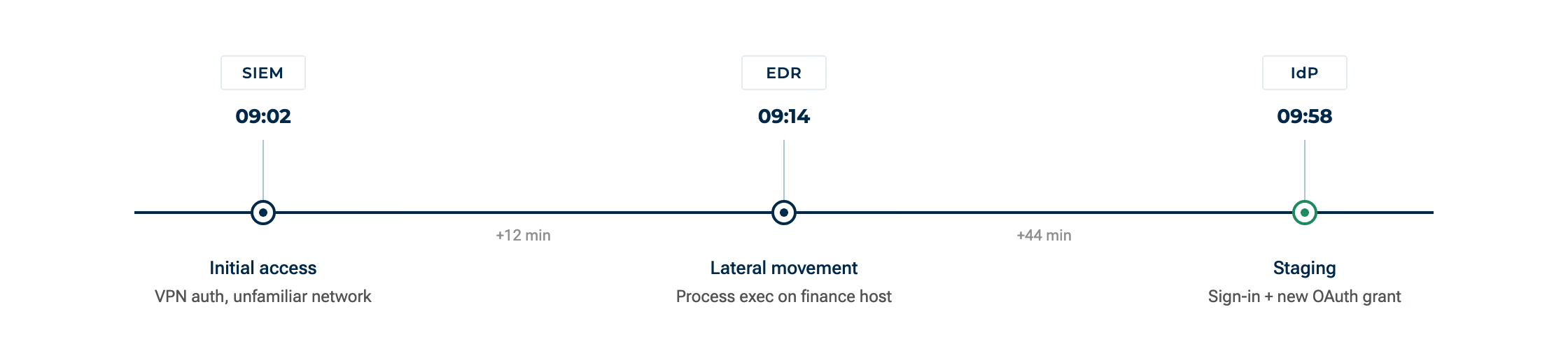
Consider an illustrative example. The SIEM holds a VPN authentication for a service account from an unfamiliar network at 09:02. EDR records an unusual process execution on a finance workstation at 09:14. The identity provider then logs a sign-in for the same account from a second host at 09:58, followed by a new OAuth grant. Each event might survive triage alone. Stitched into one super-timeline, they narrate initial access, lateral movement, and staging — and show exactly where to look next.
Diagram: an annotated super-timeline merging three sources into one chronology — a SIEM VPN authentication from an unfamiliar network, an EDR process execution minutes later, and an identity-provider sign-in with a new OAuth grant an hour after that — labeled initial access, lateral movement, and staging.
Retention decides whether the timeline can be built at all. M-Trends 2026 put the global median dwell time at 14 days for 2025, up from 11 the prior year, with espionage-linked intrusions — a 122-day median dwell — forming the long tail of the blend. Stealthy intrusions can outlive standard 90-day log windows, so extend retention and centralize edge-device logs before you need them.
The same correlation skills power proactive threat hunting, which searches for attack narratives before any alert fires. Timeline reconstruction stitches EDR, SIEM, and identity events into one story — correlation reveals the chain that single alerts hide.
Mapping findings to MITRE ATT&CK and finding root cause
As findings accumulate, investigators map each observed behavior to MITRE ATT&CK tactics and techniques. The shared vocabulary speeds scoping and makes handoffs unambiguous — "something weird on host 12" becomes a precise claim other analysts can test against the ATT&CK knowledge base.
Investigative question
Tactic
Technique ID
Detection idea
How did the attacker get in?
Initial access (TA0001)
Varies by vector, such as an exploited edge device
Correlate edge-gateway authentication anomalies with first internal activity
Hunt for stolen session tokens reused across identity logs
What left the environment?
Exfiltration (TA0010)
Varies, often legitimate transfer tools
Alert on unusual outbound volume from staging hosts
Table: mapping investigative questions to MITRE ATT&CK, with a detection idea for each.
The lateral-movement row is the worked example from the timeline above. A stolen session reused on a second host maps to T1550, which tells the team to scope every system that token could reach.
ATT&CK mapping explains the how, and root cause analysis explains the why. The 5 Whys method, borrowed from safety practice, keeps asking why until the answer is systemic. The alert fired because malware executed, because a session token was stolen, because the credential was never rotated, because no policy required it. The immediate cause is the malware — the root cause is the policy gap.
One 2026 pattern complicates the analysis. M-Trends 2026 found a division-of-labor model — initial-access brokers handing pre-staged access to follow-on actors — in 9% of 2025 investigations, up from 4% in 2022. The visible immediate cause, such as a commodity infostealer, may mask a hand-off already underway. Map every behavior, then ask the 5 Whys until the answer is something you can fix.
Investigation metrics: why speed matters
Mean time to investigate (MTTI) — the average time from escalation to explained incident — is the metric investigation owns, tracked alongside mean time to acknowledge (MTTA) in broader cybersecurity metrics programs. Mean time to respond (MTTR) belongs to the response phase.
One disambiguation before the numbers. The widely cited 73% figure is a ranking, not a false-positive rate — in the SANS 2025 survey, 73% of teams ranked false positives their #1 detection challenge, and the share seeing them "very frequently" rose from 13% to 20% year over year. That noise drives alert fatigue and buries the alerts that matter.
Metric or stat
Value
Year
Source
Initial-access-to-hand-off time
22 seconds, down from more than eight hours in 2022
Table: the 2026 stat ledger — why investigation speed matters.
The counter-signal is encouraging. With 52% of 2025 intrusions detected internally, up from 43%, investigation capability is improving even as the blended median rises. MTTI is where dwell time is won or lost — benchmark it, and drive it down.
Modern and AI-assisted approaches to security incident investigation
AI SOC investigation tooling spans a spectrum. Manual investigation means analysts query each console themselves. AI-assisted triage uses machine learning to enrich, correlate, and prioritize alerts. Agentic investigation goes further — AI agents autonomously work Tier-1 alerts, correlating them into one incident storyline, suppressing false positives, and closing low-risk cases with a written rationale. In 2026, the agentic tier is real for triage but unproven for autonomous response on identity actions.
Early adopters report striking results — analyst triage time cut by 60-80% and alert noise down by as much as 70% (Help Net Security, 2026) — but treat these as illustrative early-adopter claims, not audited benchmarks. A structural caution survives the hype: a VentureBeat analysis of RSAC 2026 launches found leading agentic SOC platforms verify agent identity but not agent behavior — AI agents are now both an investigation tool and a largely un-investigable attack surface.
Tool choice still follows the stage — investigation platforms for end-to-end casework, task-specific forensic utilities for evidence parsing, and case-collaboration tools for documentation and handoffs. The execution layer of playbooks and automated containment belongs to incident response automation. Over the next 12–24 months, the question for SOC operations leaders is whether vendors ship genuine agent-behavior baselines. Until then, AI is real for Tier-1 triage and false-positive reduction, but agent behavior itself is not yet investigable — plan accordingly.
How Vectra AI thinks about investigation
Vectra AI approaches investigation from an assume-compromise starting point: skilled attackers will get in, and the decisive question is how fast defenders can find and explain them. Attack Signal Intelligence applies AI to the early investigative lifting — triaging alerts automatically, stitching related behaviors across network, identity, and cloud into a single prioritized attack narrative, and supporting natural-language investigation so lean teams can scope an incident without manually piecing consoles together. The goal is signal over noise — investigation that starts from an explained attack story, not a pile of disconnected alerts.
Conclusion
Every investigation starts the same way, with an alert of unknown importance, and what happens next separates a contained incident from a months-long compromise. The craft is learnable and repeatable. Validate the alert, scope outward from the first artifact, collect evidence in volatility order, reconstruct the timeline, map behaviors to ATT&CK, document as you go, and report findings that response teams can act on. The 2026 data raises the stakes at both ends — hand-offs measured in seconds punish slow validation, while espionage-length dwell punishes short log retention. Teams that benchmark MTTI and invest in correlation, human or AI-assisted, win that time back. To see where investigation's findings go next, explore how the phase fits the unified threat detection, investigation, and response workflow.
FAQs
What is the difference between incident investigation and incident response?
Investigation determines what happened, how the attacker got in, and how far the compromise spread. Incident response is the broader lifecycle that contains, eradicates, and recovers — investigation is its Detection & Analysis phase, and its findings tell responders exactly what to contain.
What is the difference between alert triage and investigation?
Triage is the rapid decision gate that screens an alert and decides whether it deserves escalation. Investigation is the deeper analytical work that follows a true positive — confirming the incident, scoping affected assets and accounts, and establishing root cause. Triage takes minutes, while an investigation can run from hours to weeks.
How long does a cyber incident investigation take?
It varies with attacker tradecraft, and the most useful benchmark is dwell time. M-Trends 2026 put the global median at 14 days (2025 data), up from 11 — espionage-linked intrusions, with a 122-day median dwell, form the long tail, while many intrusions are detected and explained much faster.
What evidence is required during a digital forensics investigation?
Collect the most volatile evidence first — memory and live system state — then network session data, identity and SaaS logs such as sign-ins, OAuth grants, and API-key activity, and finally disk images. Preserve every item with hashes, timestamps, and a documented chain of custody so findings stay defensible.
What is DFIR and how does it relate to investigation?
Digital forensics and incident response (DFIR) is the deep-forensic execution layer of investigation — disk, memory, and artifact analysis applied at full rigor. It operates within the broader incident response discipline.
How does AI accelerate incident investigation?
AI is most mature at Tier-1 triage — enriching alerts, correlating related alerts into one incident storyline, and suppressing false positives before an analyst looks. Early adopters reported large triage-time and alert-noise reductions in 2026, but the figures are vendor-reported, and autonomous response on identity actions remains unproven.
What is the difference between an incident and a near miss?
A near miss is a workplace-safety concept — an event that could have caused harm but did not. The closest cybersecurity analog is a blocked or failed attack attempt, typically reviewed through detection tuning rather than a full incident investigation.