Proactive threat detection explained: from alert-driven response to a pre-breach posture
Key insights
Proactive threat detection is a continuous, behavior-led security posture — not a product or an alert queue — that surfaces adversaries, exposure, and early-warning signals before they cause damage.
The strongest programs sequence proactive and reactive detection: a mature proactive posture shrinks reactive workload, dwell time, and breach cost.
Dwell time and mean time to detect (MTTD) are the KPIs a proactive program moves. The 2025 global median dwell time was 14 days (M-Trends 2026).
Threat-informed defense, a five-tier maturity model, and exposure reduction turn "proactive" from a slogan into a measurable program mapped to NIST CSF 2.0.
Proactive threat detection is a continuous, behavior-led security posture that looks for adversary activity, exposure, and early-warning signals before they become a breach, rather than waiting for an alert to fire. It is a program, not a single tool. Attackers increasingly operate without malware, abusing valid accounts and native operating-system tools, so a signature-based alert often arrives too late. This guide uses one spine throughout — proactive versus reactive — to show how a pre-breach posture works, how to measure it with threat detection metrics like dwell time, and how it differs from threat hunting and predictive intelligence. The data backs the shift: in one campaign, a state actor persisted for at least five years using only built-in tools.
What is proactive threat detection?
Proactive threat detection is a security posture that continuously hunts for adversary behavior, exposure, and early-warning signals before impact, instead of responding only after an alert or incident fires. It is a program and a mindset, not a product you switch on.
The distinction from reactive defense matters because the threat landscape has changed. Reactive detection waits for a known signature or indicator of compromise to trip a rule. Proactive detection assumes a capable attacker is already probing — or already inside — and looks for the behavioral traces they leave. This is why the posture, not the tooling, defines it: the goal is to improve your overall security posture by shrinking the window between intrusion and discovery.
Living off the land (LOTL) — attacker tradecraft that uses valid credentials and built-in OS utilities to avoid dropping malware — is the clearest reason waiting fails. When the adversary's activity looks like normal administration, there is no signature to catch. The PRC-linked Volt Typhoon group maintained access to US critical-infrastructure IT environments for at least five years using this approach, per CISA's 2024 advisory. A signature-led, reactive program is effectively blind to that pattern.
Two terms anchor the rest of this guide. Pre-breach describes everything that happens "left of bang" — before an intrusion becomes a reportable breach. Dwell time is how long an adversary stays undetected before discovery. A proactive posture exists to move both in your favor.
Proactive vs reactive threat detection
This is the spine of the topic. Reactive detection is alert-driven, signature- or indicator-triggered, and post-event: it tells you something already happened. Proactive detection is behavior-led, baseline-driven, and pre-impact: it surfaces the adversary's actions while there is still time to act. The common question — "is proactive or reactive security better?" — has a clear answer: both, sequenced. You cannot eliminate reactive response, but a strong proactive posture reduces how often and how severely you fall back on it.
The reason speed matters is stark. In M-Trends 2026, the median time from initial access to hand-off to a secondary threat group collapsed to 22 seconds in 2025, down from more than eight hours in 2022. When attackers move that fast, a purely reactive program is always responding to yesterday's compromise.
Consider a fresh, visceral example. Operation HookedWing — disclosed in 2026 — stole more than 2,000 credentials from over 500 organizations using a custom phishing kit. The payoff was valid logins, not malware. To a signature-based, reactive tool, the subsequent activity looks like legitimate users signing in. Only behavioral and identity analytics — watching for impossible travel, first-seen geographies, or atypical access paths — catch that abuse. Reactive detection has nothing to trigger on; proactive detection does.
Table: How reactive and proactive threat detection differ across six operational dimensions.
Dimension
Reactive detection
Proactive detection
Trigger
A fired alert, signature match, or known indicator of compromise
A deviation from a learned behavioral baseline or an early-warning signal
Detection method
Signature- and rule-based matching against known bad
Behavioral baselining, anomaly detection, and threat-informed analytics
Primary goal
Respond to and contain a confirmed event
Surface adversary behavior and exposure before impact
Data source
Logs and alerts after the fact
Continuous telemetry across network, identity, and cloud
Timing relative to impact
After (right of bang)
Before (left of bang)
Example
Quarantine a host after an antivirus alert
Flag anomalous valid-account logins during credential abuse
Reactive detection is the counterpart to a strong incident response capability, and it will always have a place. The point is sequencing: invest proactively so fewer events ever reach the reactive queue.
How proactive threat detection works
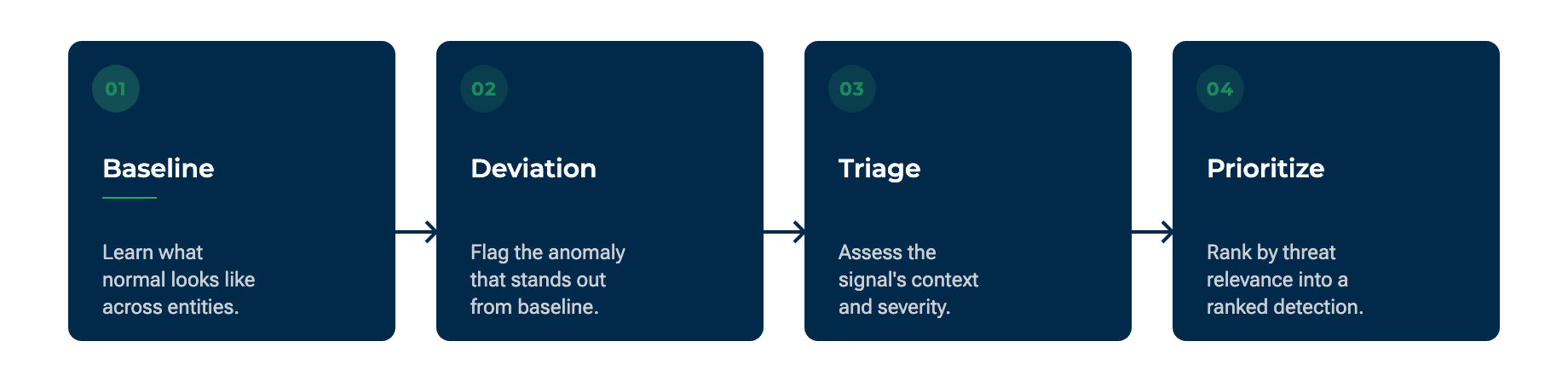
Proactive detection works in three plain-language moves: learn what normal looks like, watch for meaningful deviations, and prioritize the signals that matter most. It starts with behavioral baselining — modeling typical activity for hosts, identities, and network entities, then surfacing rare or anomalous sequences that stand out against that baseline. The mechanism is less about matching known-bad and more about recognizing unusual-for-you.
A key idea is the shift from indicators of compromise (IOCs) to indicators of behavior (IOBs). IOCs are infrastructure artifacts — a malicious IP, a file hash — that an attacker can swap out cheaply. IOBs are behavioral patterns, like the sequence of actions taken to escalate privilege or move laterally, which are far harder for an adversary to change. Proactive detection leans on IOBs precisely because they are durable.
Early-warning signals are the fuel. They include reconnaissance against your perimeter, lookalike-domain or credential-leak activity, anomalous logins such as impossible travel or first-seen geographies, and atypical access paths toward sensitive data or data exfiltration routes. Each is a chance to detect intent before damage.
This is not hand-waving. Peer-reviewed work supports pre-compromise baselining: a 2025 Scientific Reports study describes using unsupervised machine learning to learn host and application baselines and surface rare event sequences for compromise assessment. For mechanism depth, route out rather than re-teach: see network anomaly detection for traffic-based methods, behavioral analytics for entity behavior modeling, and UEBA for user and entity baselining specifics.
Methods and types of proactive threat detection
Proactive threat detection is not one technique but a portfolio. The core methods are:
Behavioral and anomaly-based detection
Threat-informed detection engineering
Deception technology
Exposure and attack-surface monitoring
Human-led threat hunting
Behavioral and anomaly-based detection flags deviations from learned baselines for hosts, identities, and network entities. It is the workhorse method because so much modern intrusion hides inside valid activity — in 2025, Bitdefender found that 84% of high-severity attacks involved living-off-the-land binaries across 700,000 analyzed incidents, exactly the tradecraft signatures miss.
Threat-informed detection engineering builds detections mapped to the specific techniques real adversaries use, rather than generic checklists — the operational backbone covered in the next section. Deception technology plants decoys and honeytokens that legitimate users never touch, so any interaction is a high-fidelity early signal. Exposure and attack-surface monitoring finds weaknesses before attackers do, previewing the pre-breach wedge discussed later.
Human-led threat hunting is the fifth method: analyst-led, hypothesis-driven investigation that complements automated detection. It is one method within the broader posture, not a synonym for it — for the full methodology, see human-led threat hunting. For choosing and comparing tools across these methods, route buyer-intent questions to threat detection software rather than treating this posture page as a product guide.
Why proactive threat detection matters
Dwell time and breach lifecycle are the KPIs a proactive program moves, and the 2026 data shows why waiting is expensive. The global median dwell time was 14 days in 2025, up from 11 days in 2024, per M-Trends 2026 and corroborated by Help Net Security. The rise is not detection getting worse — it reflects caseload composition, as long-term espionage and DPRK IT-worker cases carry a much longer 122-day median that pulls the figure up.
A more encouraging signal sits alongside it: 52% of intrusions were detected internally in 2025, up from 43% the prior year. Organizations are catching more on their own rather than learning of compromise from an outside party — the direct payoff of a maturing proactive posture.
The cost case reinforces the urgency. The Ponemon Institute's Cost of a Data Breach study found the average breach lifecycle reached 241 days in 2025 — the lowest in nine years — while the global average breach cost fell 9% to $4.44 million, down from $4.88 million. Lower is better, but 241 days is still eight months in which a proactive program has room to detect earlier and shrink cyber risk. For the broader KPI set, see cybersecurity metrics.
Table: the core proactive KPIs, their 2026 values, and what a proactive program does with each.
Metric
2026 value
What a proactive program does
Global median dwell time
14 days (2025)
Drives it down with behavioral baselining and early-warning triage
Internal detection rate
52% (up from 43%)
Increases self-detection so fewer breaches are externally notified
Initial access to hand-off
22 seconds (from >8 hours in 2022)
Justifies pre-breach posture over slower reactive response
One methodology caveat: the M-Trends median dwell time (an incident-response caseload median) and the breach-lifecycle figure (a broad breach-population measure) describe different populations and should not be conflated. Each is coherent within its own method.
Threat-informed defense and MITRE ATT&CK coverage
Threat-informed defense turns proactive detection into a measurable program: prioritize detection engineering against the techniques real adversaries use, find your biggest coverage gaps, and close them iteratively. Rather than chasing a generic checklist, you build detections that map to observed adversary behavior — and you can prove your coverage over time.
A proactive posture pays special attention to pre-compromise tactics, the "left of bang" surface. In MITRE ATT&CK terms, that means Reconnaissance (TA0043), including techniques like Active Scanning (T1595), and Resource Development (TA0042), including Acquire Infrastructure (T1583). Watching these tactics surfaces adversary preparation before the first login. Confirm the current ATT&CK version at publish; the framework evolves, but the threat-informed practice does not.
The practice itself is a simple loop, well documented by neutral authorities such as the Center for Threat-Informed Defense Mappings Explorer and its roadmap: map your existing detections to MITRE ATT&CK, identify the top three gaps, build one detection per week, and measure coverage as it climbs. This is where detection engineering becomes a discipline rather than an ad-hoc activity.
Table: example pre-compromise ATT&CK tactics and techniques a proactive posture watches, with a defensive detection idea for each.
Monitor for lookalike domains and leaked-credential exposure tied to your brand
A worked example — mapping a pre-breach signal to ATT&CK
Suppose your team stands up lookalike-domain and credential-leak monitoring. A newly registered domain that closely mimics your brand appears, and a batch of employee credentials surfaces on a leak feed. Defensively, that early-warning signal maps to Resource Development (TA0042) — the adversary is acquiring infrastructure and material to use later. You convert the signal into a tracked detection: enrich it, route it to triage, and watch for follow-on authentication anomalies. The signal stays observational and defensive — the value is seeing preparation early enough to harden accounts and tune detections before any login attempt.
The proactive-detection maturity model
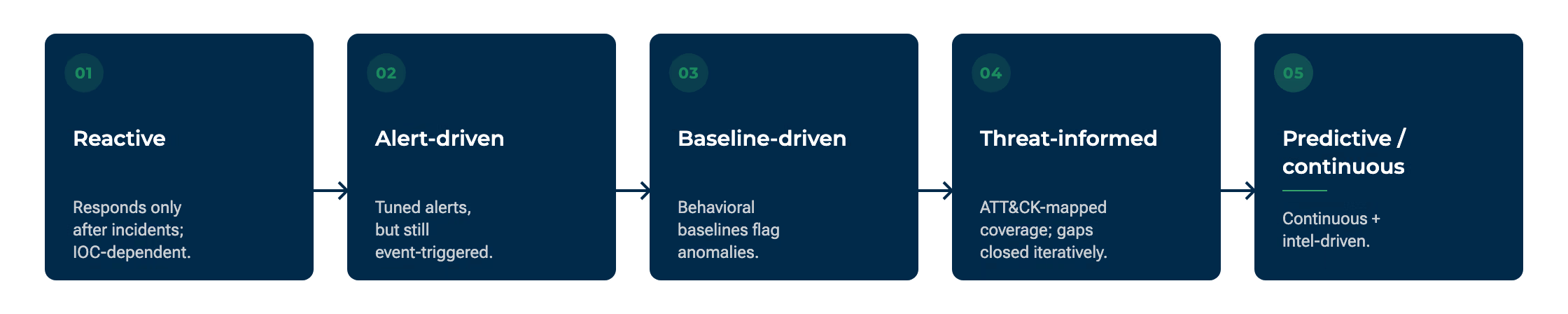
The model below is a practical framework, not a recognized standard — a way for teams to self-assess where they sit and see what "better" looks like. It describes five ascending tiers of proactive posture, each with observable criteria. Adjacent maturity models exist for detection engineering and academic detection levels, but none is framed for a proactive detection posture, which is the gap this fills.
Table: the five maturity tiers and what you would observe at each.
Tier
Posture
What you'd observe
1
Reactive
Responds only after alerts or incidents; signature- and IOC-dependent; no baselining
2
Alert-driven
Tuned alerts and dashboards, but still event-triggered, with limited behavioral context
3
Baseline-driven
Behavioral baselines for hosts, identities, and network; anomaly detection surfaces deviations
4
Threat-informed
Detections mapped to ATT&CK; coverage measured and gaps closed iteratively; exposure reduction integrated
5
Predictive/continuous
Continuous exposure and behavioral detection; early-warning signals and threat intel drive detection engineering at speed
A quick self-assessment — answer yes or no:
Do you maintain behavioral baselines for hosts, identities, and network entities? (Tier 3+)
Are your detections mapped to MITRE ATT&CK with measured coverage? (Tier 4+)
Do you integrate exposure reduction with detection, and does threat intel drive your detection engineering continuously? (Tier 5)
Most teams land at Tier 2 or 3. The value of the model is not the label but the next observable step it makes visible.
Exposure reduction: the pre-breach wedge
A proactive posture reduces both how fast you detect and how much there is to detect, by shrinking the attack surface "left of bang." Pre-breach posture is the sum of two halves: detection readiness and exposure reduction. The less exposure an adversary can reach, the fewer early-warning signals you have to chase in the first place.
How proactive detection differs from hunting and predictive intelligence
Proactive detection is the posture; human-led threat hunting is one hypothesis-driven, analyst-led method within it, and predictive threat intelligence is an input — not a synonym for either. Hunting methodology belongs to human-led threat hunting; predictive intelligence forecasts likely threats and informs your detection engineering, but it does not observe adversary behavior in your environment the way detection does — for that discipline, see threat intelligence tools.
Table: how three adjacent terms relate to proactive detection.
Term
What it is
Relationship to proactive detection
Proactive detection
A continuous, behavior-led posture
The umbrella posture
Human-led threat hunting
Analyst-led, hypothesis-driven investigation
One method within the posture
Predictive threat intelligence
Forecasting likely threats from intel
An input that informs detection engineering
Best practices and compliance alignment
Mature proactive detection rests on a short set of disciplines: establish behavioral baselines, adopt threat-informed detection engineering, integrate exposure reduction, measure dwell time and MTTD, combine automation with analyst expertise, and iterate up the maturity model. None is exotic; the value is in doing them as a governed program rather than a collection of tools.
For GRC readers, the posture maps cleanly to NIST CSF 2.0. Proactive detection operationalizes the Detect (DE) function — specifically continuous monitoring (DE.CM) and adverse event analysis (DE.AE) — and CSF 2.0 added the GOVERN (GV) function, which frames detection as a governed, risk-prioritized program. That governance framing is exactly the posture angle this guide argues for. Cross-link your program to broader compliance and framework work to make the mapping auditable.
Table: how a proactive detection posture maps to NIST CSF 2.0 Detect-function elements.
CSF 2.0 element
What it covers
How proactive detection maps
DE.CM-01
Networks are monitored to find adverse events
Continuous network telemetry and anomaly detection
DE.CM-03
Personnel activity and technology usage are monitored
Identity and entity behavior baselining
DE.CM-06
External service-provider activity is monitored
Third-party and supply-chain access monitoring
DE.CM-09
Computing hardware, software, and runtime environments are monitored
Host, application, and runtime behavioral monitoring
DE.AE
Adverse events are analyzed to characterize incidents
Early-warning signal triage and prioritization
Note that CSF 2.0 has no DE.CM-04; the earlier "malicious code is detected" outcome was folded into DE.CM-09 in the 2.0 revision.
Modern approaches to proactive threat detection
The industry is converging on a behavior-centric, identity-aware, pre-breach posture as the default. Three directions stand out across vendors and frameworks: unified behavioral signal spanning network, identity, and cloud rather than siloed point tools; AI and automation that multiply the output of lean security teams; and measured ATT&CK coverage paired with exposure reduction as a single program. When evaluating a modern approach, look for capabilities rather than logos — integrated behavioral signal across attack surfaces, coverage measurement, exposure reduction, and AI-assisted triage that ranks real attacks above noise.
How Vectra AI thinks about proactive threat detection
Vectra AI approaches proactive threat detection from an assume-compromise philosophy: capable attackers will get in, so the priority is finding their behavior fast across the modern attack surface — network, identity, and cloud. Through Attack Signal Intelligence, Vectra AI focuses on attacker behaviors rather than signatures or static indicators, then prioritizes real attacks over alert noise so lean teams can act before lateral movement turns an intrusion into a breach. That behavior-led, AI threat detection approach is what makes a proactive posture sustainable for teams that cannot watch everything at once.
FAQs
What are 4 methods of threat detection?
Four core proactive methods are behavioral and anomaly-based detection, threat-informed detection engineering, deception technology, and exposure or attack-surface monitoring. A fifth, human-led threat hunting, adds analyst-driven, hypothesis-based investigation on top of automated detection.
Is proactive or reactive security better?
The answer is both, sequenced — not one or the other. A strong proactive posture reduces how often and how severely you fall back on reactive response, shrinking dwell time, reactive workload, and ultimately breach cost.
How do you measure proactive threat detection (dwell time, MTTD)?
The core KPIs are dwell time and mean time to detect (MTTD), which track how long adversaries stay undetected and how fast you find them. The 2025 global median dwell time was 14 days (M-Trends 2026); driving it down shrinks the breach lifecycle and overall cyber risk.
How is proactive threat detection different from threat hunting?
Proactive threat detection is the overall posture; human-led threat hunting is one hypothesis-driven, analyst-led method within that posture. In short, hunting is something you do inside a proactive program, not a replacement for it.
What is the difference between proactive detection and predictive threat intelligence?
Predictive threat intelligence forecasts likely threats from external data and informs what you detect. Proactive detection observes actual adversary behavior in your own environment — the intelligence guides the detection, but the two are not the same.
What is continuous threat exposure management (CTEM)?
CTEM is a continuous program to discover and reduce exposure "left of bang," before exploitation, making it the exposure-reduction half of a pre-breach posture. For the full five-stage walkthrough, see CTEM.