Whaling attacks explained: How executives become high-value targets
Key insights
Whaling attacks target senior executives specifically, exploiting their authority over financial transactions and sensitive data to drive losses that averaged $137,000 per incident in 2024.
AI deepfakes have escalated whaling from email-only fraud to multi-channel impersonation — the 2024 Arup case resulted in $25.6 million in losses from a single deepfake video conference.
Whaling and CEO fraud are distinct threats. Whaling targets the executive directly, while CEO fraud uses the executive's identity to target others — each requiring different defensive postures.
Layered defense is essential. Email authentication (DMARC, SPF, DKIM), executive-specific training, dual-authorization protocols, and behavioral detection must work together.
No competitor in the SERP maps whaling to MITRE ATT&CK or compliance frameworks — understanding the T1566 mapping and regulatory requirements gives security teams a practical advantage.
Business email compromise cost organizations $2.77 billion in 2024 alone, according to the FBI's Internet Crime Complaint Center. Behind this staggering figure lies a particularly dangerous variant of phishing — the whaling attack — where adversaries invest weeks of research to craft a single, devastating message aimed at a CEO, CFO, or board member. As social engineering techniques evolve with AI-generated deepfake video and voice cloning, the stakes for executives and the security teams protecting them have never been higher.
What is a whaling attack?
A whaling attack is a highly targeted form of spear phishing aimed specifically at C-suite executives, board members, and senior leaders who hold authority over financial transactions, strategic decisions, and sensitive organizational data. Unlike broad phishing campaigns that cast a wide net, whaling attackers invest substantial time in reconnaissance and personalization to craft messages that exploit the unique pressures and responsibilities of executive roles.
NIST defines whaling as "a specific kind of phishing that targets high-ranking members of organizations" (CNSSI 4009-2015). What makes whaling particularly dangerous is the combination of high-value targets and increasingly sophisticated delivery methods. The FBI IC3 reports cumulative BEC losses of $55.5 billion over the past decade, with losses accelerating as attackers adopt AI-driven tactics.
Executives are uniquely vulnerable for several reasons. They have the authority to authorize large wire transfers without additional approval. They routinely handle confidential matters that create plausible pretexts for urgent requests. They maintain extensive public profiles — through press releases, SEC filings, LinkedIn, and conference appearances — that provide attackers with detailed reconnaissance material. And according to Proofpoint's threat intelligence, executives face targeted phishing attempts approximately every 24 days on average.
Who do whaling attacks target?
The most common whaling targets include:
CFOs and finance directors — primary targets for wire transfer fraud due to their payment authorization authority
CEOs and COOs — targeted for strategic data and often impersonated to target their subordinates
General counsel and legal officers — exploited through fake legal or regulatory pretexts
Board members and directors — targeted during M&A activity or governance events
Executive assistants and chiefs of staff — targeted as conduits with access to executive communications and calendars
HR directors — targeted for payroll diversion schemes and employee data theft
How whaling attacks work
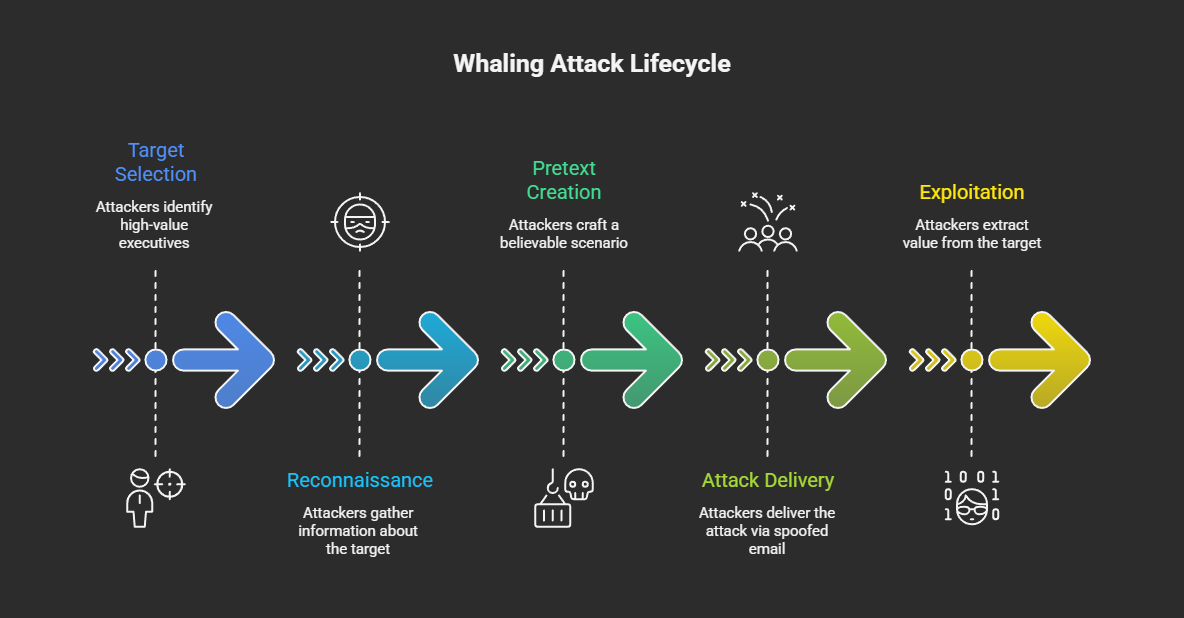
Whaling attackers follow a methodical lifecycle that distinguishes these attacks from opportunistic phishing. Each stage represents both an investment by the attacker and a potential detection window for security teams.
Stage 1: Target selection. Attackers identify high-value executives through corporate websites, SEC filings, press releases, and social media. They evaluate targets based on financial authority, public visibility, and organizational role.
Stage 2: Reconnaissance. Attackers study the target's communication style, business relationships, travel schedule, and ongoing transactions. This phase can last weeks and leverages publicly available information combined with data from previous breaches.
Stage 3: Pretext creation. Attackers craft a believable scenario — an urgent acquisition, a confidential legal matter, a regulatory compliance issue — that aligns with the target's actual business context. The pretext creates urgency while demanding confidentiality, which discourages the target from seeking verification.
Stage 4: Attack delivery. The attack arrives via spoofed email, a compromised business account, or increasingly through multi-channel approaches combining email, phone calls, and video conferencing. According to APWG research, the average BEC wire transfer request reached $128,980 in Q4 2024.
Stage 5: Exploitation. Once the target engages, attackers move quickly to extract value — authorizing wire transfers, harvesting credentials for account takeover, exfiltrating sensitive data, or establishing persistent access for lateral movement across the network.
Diagram: Five-stage whaling attack lifecycle from target selection through exploitation, with detection opportunity markers at each stage transition.
Fraudulent legal or regulatory communications demanding immediate action under penalty
Payroll diversion requests impersonating executives to reroute direct deposit accounts
Malicious attachments disguised as board materials, financial reports, or M&A documents
Types of whaling and key comparisons
Understanding the taxonomy of executive-targeted attacks is essential for building effective defenses. Whaling is not a single attack type but a family of related threats, each requiring specific detection and prevention approaches.
Business email compromise (BEC) is the broadest category, encompassing any email-based fraud using impersonated or compromised business identities. Vendor email compromise (VEC) — a rapidly growing variant that increased 66% in H1 2024 according to Fortra — targets executive-approved vendor payment processes by inserting fraudulent invoices or altering payment instructions. Payroll diversion fraud impersonates executives to reroute employee direct deposits. Multi-channel whaling combines email with phone calls and video conferences to create layered deception.
Whaling vs CEO fraud: a critical distinction
Most industry sources use "whaling" and "CEO fraud" interchangeably, but security practitioners benefit from understanding a directional distinction maintained by Cisco and Proofpoint:
Whaling targets the executive. The C-suite leader is the victim who receives the malicious message and is manipulated into taking action.
CEO fraud impersonates the executive. The C-suite leader's identity is weaponized to target subordinates, vendors, or partners who trust the executive's authority.
This distinction matters because each attack direction requires different controls. Whaling defense focuses on protecting executives through training and verification protocols. CEO fraud defense focuses on validating executive identity through authentication controls and empowering employees to challenge authority-based requests.
Phishing vs spear phishing vs whaling
Comparison of phishing attack types by targeting precision and typical impact.
Attack Type
Target
Personalization
Primary Objective
Phishing
Mass audiences (thousands)
Generic — template-based
Credential harvesting, malware delivery
Spear phishing
Specific individuals or roles
Moderate — role-based context
Data theft, initial access
Whaling
C-suite executives and senior leaders
Extensive — researched personal context
Wire transfer fraud, strategic data theft
CEO fraud
Employees who report to executives
Moderate — impersonates known authority
Wire transfer fraud, payroll diversion
All whaling attacks are a form of spear phishing, and most qualify as BEC. But not all BEC attacks are whaling — BEC also includes lower-level impersonation targeting mid-level employees and accounts payable staff.
AI and deepfake evolution of whaling attacks
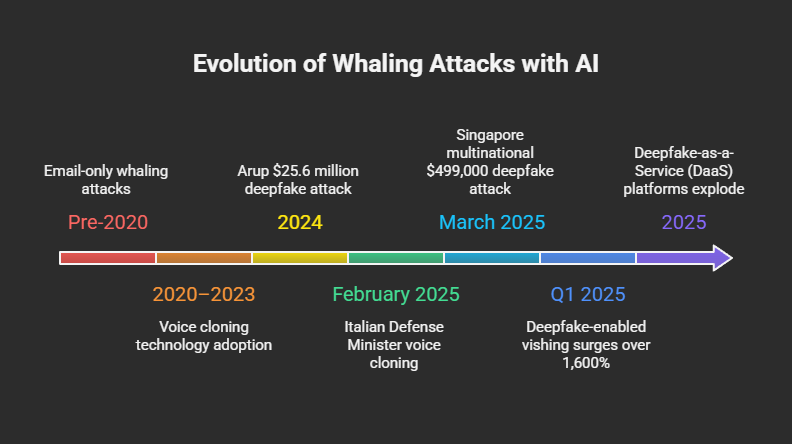
The most significant shift in whaling attack sophistication over the past three years has been the adoption of AI-powered deepfake technology. What was once an email-only threat has evolved into multi-channel executive impersonation campaigns that exploit video, voice, and messaging platforms simultaneously.
Voice cloning technology now requires as little as 20–30 seconds of recorded audio to generate convincing synthetic speech, with some platforms achieving viable results from just three seconds. Deepfake-as-a-Service (DaaS) platforms — which exploded in availability in 2025 according to Cyble — have democratized executive impersonation, making these attacks accessible to technically unsophisticated adversaries.
Timeline: Evolution of whaling attack channels from email-only (pre-2020) through voice cloning (2020–2023) to video deepfake conferences (2024–2026), with key case studies at each phase.
Recent deepfake whaling case studies
Arup ($25.6 million, January 2024). In the most consequential deepfake whaling attack to date, criminals used AI to create fake video likenesses of multiple Arup executives on a video conference call. A finance employee in the Hong Kong office — who initially suspected phishing — was convinced after seeing what appeared to be real colleagues on the call. The employee authorized 15 wire transfers totaling $25.6 million to five attacker-controlled accounts. CNN and the World Economic Forum documented this case as a watershed moment for AI-enabled executive fraud.
Singapore multinational ($499,000, March 2025). Attackers used deepfake technology on a Zoom call to impersonate a company's CFO, convincing a finance employee to transfer funds. The attack combined WhatsApp messages with a deepfake video conference, demonstrating the multi-channel approach that defines modern whaling.
Italian Defense Minister Crosetto voice cloning (February 2025). AI voice clones impersonating Italy's Defense Minister targeted prominent business leaders including Giorgio Armani and Massimo Moratti, extracting approximately 1 million EUR before the scheme was identified.
Whaling in practice
The financial and operational consequences of whaling attacks extend far beyond the initial theft. Executive accountability, reputational damage, regulatory penalties, and business closure are all documented outcomes.
Major whaling and CEO fraud case studies demonstrating escalating sophistication and financial impact.
Year
Organization
Loss Amount
Attack Method
Key Lesson
2024
Arup
$25.6 million
Deepfake video conference
Multi-channel verification required — video calls alone cannot establish trust
Board fired both CEO and CFO for inadequate controls — executive accountability
2015
Ubiquiti Networks
$46.7 million
CEO impersonation email
17 days of wire transfers — dual-authorization could have stopped the chain
The average cost of a BEC data breach reached $4.89 million in 2024 according to IBM's Cost of a Data Breach Report. Organizations with 50,000 or more employees face near-100% weekly BEC risk according to Hoxhunt research, and 63–70% of organizations experienced BEC attempts in the 2024–2025 period.
The Levitas Capital case illustrates an often-overlooked dimension of whaling impact. While direct losses were approximately $800,000, the reputational damage caused the fund's largest client to withdraw, forcing complete business closure. This insider risk pattern — where initial compromise cascades into existential business threats — is increasingly common.
Detecting and preventing whaling attacks
Effective whaling defense requires layered controls spanning email authentication, executive training, behavioral detection, and documented incident response procedures. No single technology or process stops whaling on its own.
Deploy DMARC, SPF, and DKIM email authentication at "reject" policy
Email authentication forms the foundational defense layer against domain spoofing, though it has important limitations.
SPF (Sender Policy Framework) defines which IP addresses are authorized to send email on behalf of your domain
DKIM (DomainKeys Identified Mail) adds a cryptographic signature that verifies email integrity and sender authentication
DMARC (Domain-based Message Authentication, Reporting & Conformance) enforces policy when SPF or DKIM checks fail — set to "reject" to prevent spoofed emails from reaching recipients
Cloudflare provides detailed technical guidance on implementing these protocols. The critical limitation is that email authentication cannot stop attacks originating from compromised legitimate accounts or look-alike domains — which is why behavioral detection and verification protocols are essential complementary controls.
Executive training program design
Executives have unique training needs that generic security awareness programs fail to address. They face different threat profiles, have limited time for training, and may resist standardized approaches they perceive as beneath their expertise level.
Effective executive whaling training programs should use recent case studies — such as the Arup deepfake and Singapore incidents — as scenario models that resonate with business leaders. Simulations should target both executives and their assistants, since executive assistants frequently serve as the actual point of attack. Measuring training effectiveness through click rates, reporting rates, and time-to-report provides accountability data that security teams can present to the board.
Incident response playbook for whaling
When a whaling attempt is detected or succeeds, speed determines whether losses can be contained or recovered. The FBI's BEC guidance emphasizes contacting financial institutions within 48 hours for the best chance of fund recovery.
Immediate containment. Suspend compromised accounts, place holds on pending financial transactions, and notify financial institutions to freeze transfers.
Scope determination. Conduct email forensics to identify all communications from the attacker, review financial transaction logs, and assess whether credentials were compromised.
Notification protocols. Alert legal counsel, compliance teams, executive leadership, and regulatory bodies as required by applicable frameworks.
Recovery actions. Reset credentials for all affected accounts, initiate payment reversal attempts through banking channels, and verify the integrity of all recent executive-authorized transactions.
Post-incident analysis. Document the attack chain, identify control failures, update detection rules, and incorporate lessons into executive training scenarios.
MITRE ATT&CK T1566 mapping
The MITRE ATT&CK framework does not include a specific sub-technique for whaling. Instead, whaling falls under T1566 Phishing as a targeted variant of spearphishing where the targeting criteria is specifically high-ranking organizational members.
MITRE ATT&CK T1566 sub-technique mapping for whaling attack detection.
Deepfake voice calls impersonating executives or authority figures
Behavioral threat detection technologies add a critical layer by identifying anomalous activity patterns after initial compromise — such as unusual data access, unexpected financial transaction sequences, or privilege escalation — that static email analysis cannot detect.
Whaling and compliance
Multiple regulatory frameworks now mandate anti-phishing controls, making whaling defense a compliance requirement as well as a security priority. PCI DSS v4.0 Requirement 5.4.1 made anti-phishing controls mandatory as of April 1, 2025, and Nacha ACH Phase 1 rules effective March 20, 2026 add risk-based monitoring requirements for fraudulently initiated payment entries.
The most effective whaling defense programs combine AI-powered email security with network detection and response (NDR) for post-compromise behavioral indicators, identity threat detection and response (ITDR) for compromised credential monitoring, and operational protocols like out-of-band verification. Deepfake detection technologies are emerging but remain immature — organizations should not rely on them as a primary control.
The key architectural insight is that email gateways alone cannot stop sophisticated whaling. Compromised account-based attacks originate from legitimate email addresses, and deepfake impersonation bypasses visual verification entirely. Defense must extend to detecting the behavioral consequences of successful compromise.
How Vectra AI thinks about whaling defense
Vectra AI approaches whaling defense through the lens of AI-driven security that addresses what happens after an attack bypasses email gateways and initial controls. While email filtering and authentication provide essential first layers, sophisticated whaling attacks — particularly those using compromised accounts or deepfake impersonation — routinely evade these defenses. Attack Signal Intelligence detects the behavioral consequences of successful whaling across network, cloud, and identity attack surfaces, monitoring for anomalous financial transaction patterns, unusual data access, privilege escalation, and command-and-control callbacks that indicate a whaling attack has progressed beyond the initial social engineering phase.
Future trends and emerging considerations
The whaling threat landscape is evolving rapidly, with several developments poised to reshape executive risk over the next 12–24 months.
AI-generated voice and video will become indistinguishable from real communication. As deepfake technology advances and DaaS platforms proliferate, the cost and technical barrier to convincing executive impersonation will continue to drop. Organizations should assume that any unverified communication channel — including video calls — can be compromised, and design verification protocols accordingly.
Regulatory pressure on anti-phishing controls is accelerating. With PCI DSS v4.0 anti-phishing requirements now mandatory and Nacha ACH rules taking effect in March 2026, organizations that lack documented whaling controls face both security and compliance risk. NIS2 enforcement in the EU is adding further reporting obligations for BEC incidents.
AI agents and autonomous workflows will create new attack surfaces. As organizations deploy AI agents with financial authorization capabilities, whaling attackers will shift from targeting human executives to manipulating AI-driven decision systems. Security teams should begin evaluating how automated financial workflows validate identity and intent.
Cross-platform attacks will become the norm. The combination of email, voice, video, and messaging platform compromise seen in the Arup and Singapore cases will standardize. Defense strategies must account for multi-channel verification that does not depend on any single communication platform.
Organizations should prioritize investment in behavioral detection that identifies post-compromise activity regardless of the initial attack vector, executive-specific training programs updated quarterly with recent case studies, and out-of-band verification protocols that require a confirmed secondary channel for all high-value requests.
Conclusion
Whaling attacks occupy a unique position in the threat landscape — they combine the targeting precision of nation-state operations with the financial motivation of organized crime. As AI deepfakes eliminate traditional red flags and Deepfake-as-a-Service platforms lower the barrier to executive impersonation, the organizations best prepared are those that have moved beyond email-centric defense to layered controls spanning authentication, behavioral detection, executive training, and verified operational protocols.
The most important shift for security teams is philosophical. Assume that sophisticated whaling attacks will bypass email gateways. Build detection and response capabilities that identify the behavioral consequences of successful compromise — unusual financial transactions, credential abuse, data access anomalies — regardless of how the initial social engineering was delivered. Map your controls to MITRE ATT&CK and regulatory frameworks to build defensible, evidence-based programs.
For a deeper look at how behavioral detection and Attack Signal Intelligence address post-compromise activity from executive-targeted attacks, explore the Vectra AI platform.
FAQs
What is a whaling attack?
A whaling attack is a highly targeted form of spear phishing aimed specifically at C-suite executives, board members, and senior organizational leaders. The term "whaling" refers to the high-value nature of the targets — the "big fish" in an organization. Unlike mass phishing campaigns that use generic lures against thousands of recipients, whaling attacks involve extensive reconnaissance into the target's role, relationships, communication style, and current business activities. Attackers craft personalized messages that exploit the executive's authority and access to drive financial fraud, data theft, or credential compromise. NIST defines whaling as "a specific kind of phishing that targets high-ranking members of organizations." The FBI reported $2.77 billion in BEC losses in 2024, with whaling representing the highest-value subset of these attacks.
What is the difference between phishing and whaling?
Standard phishing casts a wide net, sending identical or slightly varied messages to thousands or millions of recipients using generic lures such as fake shipping notifications or password reset requests. Whaling inverts this approach entirely — attackers target a single executive or a small group of senior leaders with messages crafted specifically for them. The personalization level is dramatically higher: whaling emails reference real business transactions, ongoing projects, or actual colleagues by name. The financial stakes are correspondingly larger, with average BEC incidents costing $137,000 compared to typical phishing losses that may involve individual credential theft. The key distinction is investment versus scale. Phishing relies on volume, while whaling relies on precision.
What is the difference between spear phishing and whaling?
Whaling is a specialized subset of spear phishing. Both involve targeted attacks against specific individuals, but spear phishing can target anyone — an accounts payable clerk, an IT administrator, or a mid-level manager. Whaling specifically targets executives with C-suite authority, board positions, or senior leadership roles. This distinction matters because whaling attackers face higher investment costs (more reconnaissance required) but pursue significantly larger payoffs (wire transfers in the millions rather than thousands). The defensive implications also differ — whaling defense requires executive-specific training programs and financial authorization controls that standard spear phishing awareness programs do not address.
What is the difference between whaling and CEO fraud?
While many sources use these terms interchangeably, a practical directional distinction exists. Whaling targets the executive — the CEO, CFO, or board member receives the malicious message and is manipulated into taking action. CEO fraud impersonates the executive — the attacker uses the CEO's identity (spoofed email, compromised account, or deepfake voice) to target subordinates, finance teams, or vendors who trust the executive's authority. This distinction has real implications for defense. Protecting against whaling means training executives to recognize attacks aimed at them. Protecting against CEO fraud means training everyone else to verify executive identity before acting on requests, and deploying email authentication to prevent impersonation.
How do whaling attacks work?
Whaling attacks follow a five-stage lifecycle. First, attackers select targets by identifying executives with financial authority through public filings, corporate websites, and LinkedIn profiles. Second, they conduct extensive reconnaissance on the target's communication patterns, business relationships, and current activities. Third, they create a believable pretext — often an urgent acquisition, legal matter, or regulatory issue — that aligns with the target's actual business context. Fourth, they deliver the attack through spoofed email, compromised accounts, or multi-channel approaches combining email with phone and video. Fifth, they exploit the engagement to extract wire transfers, credentials, or sensitive data. The average BEC wire transfer request reached $128,980 in Q4 2024 according to APWG research.
How can you prevent a whaling attack?
Prevention requires layered controls because no single technology stops whaling on its own. Start with email authentication — deploy SPF, DKIM, and DMARC at "reject" policy to prevent domain spoofing. Add AI-powered email security that analyzes behavioral patterns, not just content. Implement dual-authorization protocols requiring two people to approve any financial transaction above a defined threshold. Establish out-of-band verification — when an executive requests a wire transfer via email, confirm by calling a known phone number (never a number provided in the email). Deploy network detection and response to identify post-compromise indicators. Conduct executive-specific phishing simulations quarterly. Enforce phishing-resistant MFA on all executive accounts. Finally, document and rehearse an incident response playbook specific to whaling scenarios.
How does AI make whaling attacks more dangerous?
AI has transformed whaling in three critical ways. First, voice cloning technology now generates convincing synthetic speech from just 20–30 seconds of recorded audio, enabling attackers to impersonate executives over phone calls. Second, deepfake video technology — now available through Deepfake-as-a-Service platforms — allows attackers to create real-time video impersonations of executives in video conferences, as demonstrated by the $25.6 million Arup case. Third, large language models enable attackers to generate highly personalized emails that match an executive's writing style, tone, and vocabulary with minimal effort. Deepfake-enabled vishing surged over 1,600% in Q1 2025, and AI-driven fraud tactics increased 118% year over year. The combined effect is that traditional red flags — poor grammar, generic greetings, unfamiliar communication patterns — are no longer reliable indicators.
Who is most at risk for whaling attacks?
CFOs and finance directors face the highest risk for wire transfer fraud due to their direct payment authorization authority. CEOs are the most commonly impersonated executives, with their identities used to target subordinates and vendors. Executive assistants and chiefs of staff represent a growing target because they often manage executive communications and have delegated authority. HR directors are targeted for payroll diversion schemes. Board members face elevated risk during M&A activity, governance events, and annual reporting periods. Organizations with 50,000 or more employees face near-100% weekly BEC risk according to Hoxhunt research. Manufacturing (27%), energy (23%), and retail (10%) are the most targeted industries.
Can whaling attacks happen over video calls?
Yes, and this represents the most significant evolution in whaling tactics. The 2024 Arup case — in which attackers used deepfake video to impersonate multiple executives on a conference call, resulting in $25.6 million in losses — demonstrated that video calls can no longer serve as a trusted verification channel. The 2025 Singapore case involved a deepfake Zoom call combined with WhatsApp messages to steal $499,000. In February 2025, AI voice clones impersonating Italy's Defense Minister targeted prominent business leaders. DaaS platforms have made video and voice impersonation accessible to adversaries without deep technical expertise. Organizations must establish out-of-band verification protocols that do not rely on any single communication channel, including video.
What should I do if I receive a suspected whaling email?
Do not reply, click any links, or open attachments. Report the message to your security team immediately through your organization's established reporting channel. If a financial transaction has already been initiated, contact your financial institution and request an immediate hold — the FBI emphasizes that reporting within 48 hours provides the best chance of fund recovery. Verify the request through an out-of-band channel by calling the supposed sender at a phone number you already have on file, never a number provided in the suspicious message. Preserve the original email with full headers as forensic evidence. If the attack involved credential entry, immediately reset your passwords and notify your IT team to check for unauthorized access. Document the timeline of events for your incident response team.