Vulnerability assessment explained: the complete guide for security teams
Key insights
Vulnerability assessment is foundational, not optional. With CVE volume growing 22% year over year and 20% of breaches traced to vulnerability exploitation, systematic assessment is a baseline security requirement.
A five-step process turns raw scan data into action. Planning, discovery, scanning, analysis, and reporting form a continuous loop — not a one-time project.
Frequency must match risk, not a calendar. Critical assets need weekly or continuous scanning. Quarterly assessments alone leave 45- to 90-day blind spots while 28% of exploits land within 24 hours of disclosure.
Compliance mandates are expanding. NIS2, DORA, and PCI DSS v4.0 all require documented vulnerability assessment at defined intervals, with penalties reaching 10 million euros.
AI and continuous monitoring are closing the gap. ML-driven prioritization cuts false positives by 92–98%, and continuous threat exposure management extends assessment beyond traditional CVE scanning.
Vulnerability Assessment: Quick Answer
A vulnerability assessment helps organizations find and prioritize security weaknesses before attackers can exploit them. It identifies known vulnerabilities, misconfigurations, outdated software, exposed services, and other security gaps across networks, applications, endpoints, cloud environments, and digital assets.
The goal is not simply to discover vulnerabilities, but to understand which weaknesses pose the greatest risk and should be remediated first. Modern vulnerability assessments combine automated scanning, asset discovery, threat intelligence, and risk-based prioritization to help security teams reduce their attack surface.
Key Takeaways
Vulnerability assessments identify security weaknesses before attackers can exploit them.
The process helps organizations prioritize remediation based on risk, exploitability, and business impact.
Vulnerability assessment is one component of a broader vulnerability management program.
Modern assessments extend beyond CVEs to include cloud misconfigurations, identity exposures, and attack surface risks.
Continuous assessment is increasingly replacing periodic scanning as organizations adopt cloud and hybrid environments.
What is vulnerability assessment?
Vulnerability assessment is a systematic process to identify, classify, and prioritize security weaknesses across an organization's systems, networks, and applications before attackers can exploit them.NIST defines vulnerability assessment as a "systematic examination of an information system or product to determine the adequacy of security measures, identify security deficiencies, provide data from which to predict the effectiveness of proposed security measures, and confirm the adequacy of such measures after implementation."
In practical terms, a security vulnerability assessment gives organizations a structured way to answer a simple question. Where are we exposed? The answer matters more than ever. The VA services market valued at $5.58 billion in 2025 is growing at 9.2% CAGR, reflecting the urgency organizations feel to close visibility gaps.
A critical distinction worth understanding early. Vulnerability assessment is a point-in-time activity — one component within the broader vulnerability management lifecycle. Assessment identifies weaknesses. The vulnerability management lifecycle handles ongoing tracking, remediation, verification, and governance across the entire program.
Vulnerability assessment vs related activities
Understanding where vulnerability assessment fits relative to penetration testing and risk assessment prevents scope confusion and misallocated resources.
Activity
Purpose
Scope
Output
Frequency
Vulnerability assessment
Identify and classify weaknesses
Broad — all assets in scope
Prioritized vulnerability report
Continuous to quarterly
Penetration testing
Validate exploitability of specific weaknesses
Narrow — targeted systems
Exploitation proof, risk narrative
Annual to biannual
Risk assessment
Evaluate business impact of threats
Strategic — business processes
Risk register, mitigation plan
Annual or event-driven
Vulnerability management
Ongoing lifecycle of finding, fixing, verifying
Enterprise-wide, continuous
Remediation metrics, trend data
Continuous
Table: How vulnerability assessment compares to related security activities.
Vulnerability assessment and penetration testing (VAPT) are often discussed together, and for good reason. VA identifies weaknesses broadly through automated scanning, while penetration testing validates whether specific vulnerabilities are actually exploitable through simulated attacks. VA casts a wide net. Penetration testing goes deep. Most mature programs use both — VA for continuous coverage and pen testing for periodic validation of critical exploit paths.
A risk assessment, by contrast, operates at the strategic level. It evaluates the business impact of identified threats and vulnerabilities in the context of organizational priorities, assets, and tolerance for risk.
The vulnerability assessment process
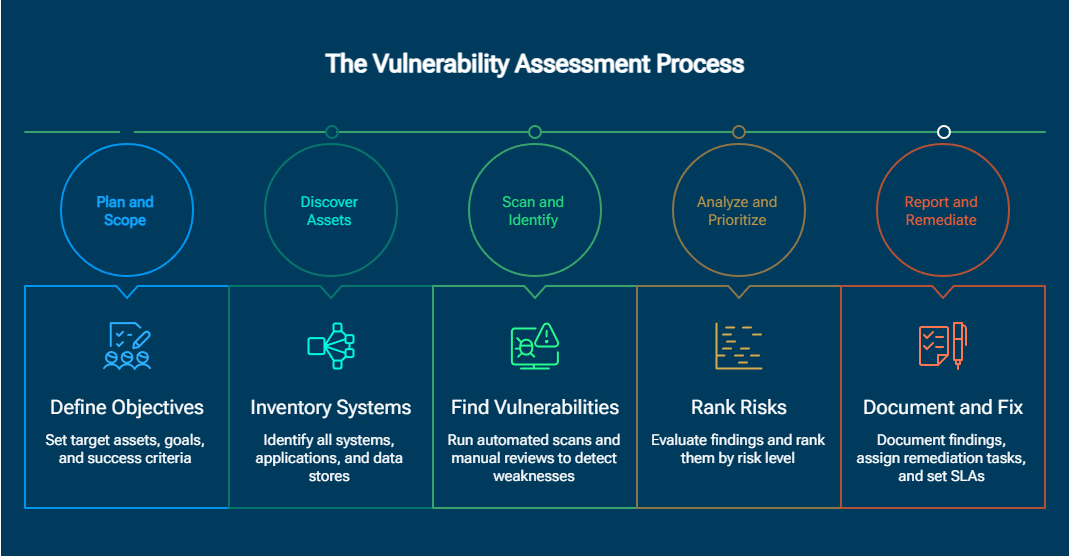
A five-step vulnerability assessment process transforms raw scanning data into actionable remediation priorities. Each step builds on the previous one, and the cycle repeats continuously.
Plan and scope — define target assets, objectives, and success criteria
Discover assets — inventory all systems, applications, and data stores
Scan and identify — run automated scans and manual configuration reviews
Analyze and prioritize — rank findings by risk using multiple factors
Report and remediate — document findings and assign remediation with SLAs
Planning and scoping sets the foundation. Teams define which assets fall within scope — on-premises servers, cloud workloads, containers, IoT devices — and establish what success looks like. Without clear scoping, assessments either miss critical systems or waste cycles on irrelevant targets.
Asset discovery builds a complete inventory. You cannot assess what you do not know exists. This step identifies managed and unmanaged devices, shadow IT, cloud instances, and third-party integrations across the modern network. Organizations moving to hybrid environments frequently discover 15–30% more assets than their CMDB records.
Vulnerability scanning combines automated tools with manual configuration reviews. Automated scanners check systems against known CVE databases, while manual review catches logic flaws and misconfigurations that scanners miss. Understanding how vulnerability scanning works is essential for interpreting results accurately.
Analysis and prioritization is where assessment methodology matters most. CVSS scoring alone is insufficient. Less than 1% of CVEs are ever weaponized, making a CVSS-only approach dangerously noisy. Effective prioritization combines CVSS base scores with Exploit Prediction Scoring System (EPSS) data, asset criticality, threat intelligence context, and business impact. This multi-factor approach ensures that teams fix what matters first — not just what scores highest on paper.
Reporting and remediation closes the loop. A vulnerability assessment report documents findings with risk ratings, affected assets, evidence, and recommended remediations with SLAs tied to severity. Critical vulnerabilities may demand 72-hour remediation windows. Medium-severity findings might carry 30-day SLAs. The report feeds directly into incident response workflows when active exploitation is detected.
The median time to patch sits at 32 days, yet 28% of exploits within 24 hours of disclosure. This gap between discovery and remediation defines the challenge every vulnerability assessment program must address.
Types of vulnerability assessments
Six distinct vulnerability assessment types ensure coverage across every layer of the attack surface. Choosing the right type — or combination — depends on the environment, risk profile, and compliance requirements.
Assessment Type
Target Scope
Key Techniques
When to Use
Network
Routers, switches, firewalls, hosts, ports
Port scanning, service enumeration, protocol analysis
Rogue AP detection, encryption analysis, signal mapping
Quarterly; after wireless infrastructure changes
Table: Six vulnerability assessment types and their target scope.
Network vulnerability assessments evaluate network security infrastructure for open ports, misconfigured services, and known vulnerabilities in network devices. The Verizon 2025 DBIR found that 22% of vulnerability exploitation breaches targeted edge devices — making network assessment a frontline priority.
Web application assessments focus on the application layer, testing for injection flaws, broken authentication, and API misconfigurations. With application complexity growing and CI/CD pipelines accelerating deployment, application vulnerability assessment must integrate directly into the development lifecycle.
Cloud and container assessments address the unique challenges of cloud security — ephemeral workloads, shared responsibility models, infrastructure-as-code templates, and container image vulnerabilities. Traditional scanning tools built for static environments miss these dynamic assets entirely.
Vulnerability assessment in practice
Real-world case studies
Three high-profile incidents illustrate what happens when vulnerability assessment programs fall short.
Equifax (2017). A VA scan targeted the root directory but missed an Apache Struts subdirectory containing CVE-2017-5638. The result was 147 million records exposed and $1.38 billion in total cost. The lesson is clear. Comprehensive asset inventory and correct scan scope are non-negotiable.
MOVEit (2023). CL0P threat actors exploited a zero-daySQL injection vulnerability (CVE-2023-34362) in a widely used file transfer tool. The MOVEit data breach affected 2,700+ organizations and 93.3 million individuals. The lesson is that third-party software requires vendor vulnerability disclosure evaluation and supply chain risk assessment — not just internal scanning.
Stryker (2026). In March 2026, attackers weaponized Microsoft Intune MDM to wipe between 80,000 and 200,000 devices at a major medical technology firm — without deploying any malware. No CVE was involved. The lesson is that vulnerability assessment must extend beyond traditional CVE scanning to cover cloud management plane configurations, identity security, and ransomware-style destruction via legitimate admin tools.
Together, these data breaches demonstrate that effective assessment requires comprehensive scope, third-party awareness, and coverage beyond the CVE database.
Cost and ROI of vulnerability assessment
Vulnerability assessment costs range from $1,000 for small-environment scans to $50,000+ for enterprise-wide engagements, depending on scope, environment complexity, and whether the assessment is internal or third-party. A vulnerability assessment pricing guide breaks typical cost factors down by assessment type. More detailed vulnerability assessment cost benchmarks are available from industry analysts.
The ROI calculation is straightforward. Compare the cost of periodic assessments against the average cost of a breach — which continues climbing year over year. For leadership conversations, frame vulnerability assessment not as an expense but as risk reduction with measurable returns.
How often to assess
Generic "assess quarterly" advice is insufficient. Assessment frequency should match asset criticality, threat exposure, and compliance mandates.
Asset Criticality
Threat Level
Compliance Requirement
Recommended Cadence
Critical (crown jewels, public-facing)
High (actively targeted)
PCI DSS, HIPAA, NIS2
Weekly or continuous
Important (internal apps, databases)
Medium (common attack vectors)
ISO 27001, CIS Controls
Monthly
Standard (workstations, file servers)
Low (limited exposure)
SOC 2, internal policy
Quarterly
Low (isolated, non-sensitive)
Minimal
None specific
Semiannual
Table: Risk-based vulnerability assessment frequency matrix.
The data supports aggressive scanning frequency best practices. Twenty-eight percent of exploits occur within 24 hours of disclosure. Quarterly scanning creates 45- to 90-day blind spots — windows where newly disclosed vulnerabilities sit unpatched and undetected. PCI DSS v4.0 mandates quarterly as a minimum baseline, while CIS Controls v8 recommends weekly scanning for critical assets.
Building an effective vulnerability assessment program
Detection methods and best practices
An effective vulnerability assessment program balances automated vs manual vulnerability assessment approaches. Automated scanning delivers breadth — covering thousands of assets rapidly against known vulnerability databases. Manual testing delivers depth — uncovering logic flaws, business logic vulnerabilities, and complex misconfigurations that automated tools miss.
Best practices for building a mature program include:
Maintain a current asset inventory. You cannot protect what you do not know exists. Include cloud, container, and IoT assets.
Integrate VA into CI/CD pipelines. Shift left by scanning application code and container images before deployment reaches production.
Track remediation with severity-based SLAs. Critical findings demand 72-hour windows. High-severity findings allow seven days. Medium allows 30 days.
Integrate CISA KEV catalog for real-time tracking. CISA adds five known exploited vulnerabilities regularly — 11+ additions in March 2026 alone demonstrate the pace of active exploitation.
Benchmark against KPIs. Track mean time to remediate (target under 32 days to beat industry median), scan coverage rate (target above 95%), and false positive rate (target under 10%).
Managing false positives
Vulnerability assessment false positives are one of the most persistent operational challenges. False positives waste analyst time, erode trust in scanning tools, and drive alert fatigue that causes teams to deprioritize findings — including real ones. Common causes include outdated signature databases, environmental context gaps, and misidentified software versions.
ML-driven false positives in vulnerability scanning reduction strategies now achieve 92–98% reduction rates by correlating scan results with runtime context, reachability analysis, and exploit intelligence. A structured triage workflow — automated deduplication, contextual enrichment, manual review of remaining flags, and confirmed finding handoff — preserves analyst focus for genuine threats.
Only 54% of vulnerabilities are fully remediated according to industry data. Reducing false positive noise directly improves this number by ensuring that remediation capacity goes toward real findings.
Tools and automation overview
Vulnerability assessment tools fall into four primary categories. Network scanners identify infrastructure weaknesses across ports, services, and configurations. Web application scanners test for OWASP Top 10 and API-specific vulnerabilities. Container and cloud scanners address ephemeral workloads and IaC templates. Configuration auditors validate systems against CIS benchmarks and hardening standards.
Rather than recommending specific tools, focus on capabilities. Effective threat detection and assessment tools should provide authenticated and unauthenticated scanning, integration with ticketing and orchestration platforms, risk-based prioritization beyond CVSS alone, and reporting aligned to vulnerability management program KPIs.
Vulnerability assessment and compliance
Major regulatory frameworks mandate vulnerability assessment at defined intervals, making compliance mapping essential for any VA program.
The shift from periodic to continuous vulnerability assessment reflects a fundamental change in threat dynamics. With the forecast of approximately 59,000 CVEs in 2026, point-in-time scanning cannot keep pace.
AI-powered vulnerability assessment uses machine learning for intelligent prioritization, predictive remediation scheduling, and automated triage. ML models correlate CVSS scores, EPSS probabilities, asset criticality, and active threat intelligence to surface the 1–2% of vulnerabilities that genuinely demand immediate attention. However, balance optimism with reality. AI assistants face criticism for speed and accuracy — current AI code review tools achieve only a 56% secure code rate, processing remains slow, and false positives persist.
Continuous threat exposure management (CTEM) extends assessment beyond CVEs to misconfigurations, credential leaks, attack surface exposures, and identity risks. The WEF Global Cybersecurity Outlook 2026 reports that 87% of respondents identify AI-related vulnerabilities as the fastest-growing risk category — underscoring that traditional CVE scanning alone leaves critical blind spots.
AI-specific vulnerability assessment is an emerging discipline covering model scanning, LLM red teaming, prompt injection detection, and AI supply chain validation. As organizations deploy more AI systems, assessing these models for adversarial vulnerabilities becomes as important as scanning traditional infrastructure.
How Vectra AI thinks about vulnerability assessment
Vectra AI operates on an assume-compromise philosophy. Vulnerability assessment identifies weaknesses before exploitation — but attackers will inevitably find gaps that assessments miss. Zero-day vulnerabilities, cloud management plane misconfigurations, and identity-based attacks like the 2026 Stryker incident bypass traditional VA entirely. This is where continuous AI threat detection provides value — not by replacing vulnerability assessment, but by catching what it cannot. When attackers exploit unpatched vulnerabilities or leverage identity threat detection blind spots, Attack Signal Intelligence™ detects the post-exploitation behaviors — lateral movement, privilege escalation, data staging — that reveal an active compromise. Combined with network detection and response, this creates a defense-in-depth model where vulnerability assessment reduces exposure and behavioral detection catches what slips through.
Future trends and emerging considerations
The vulnerability assessment landscape is evolving rapidly across several dimensions. Over the next 12 to 24 months, organizations should prepare for three key developments.
Agentic AI in vulnerability management. AI agents that autonomously discover, validate, and even remediate vulnerabilities are moving from concept to early deployment. These agents combine scanning, prioritization, and ticket creation into automated workflows — potentially collapsing the 32-day median patch window. However, autonomous remediation introduces new risks around change management and unintended consequences, requiring careful governance.
Expanded regulatory mandates. NIS2 enforcement ramping up across the EU in 2026, DORA requirements tightening for the financial sector, and anticipated updates to NIST CSF will increase the compliance burden for vulnerability assessment programs. Organizations should expect more prescriptive requirements around assessment frequency, scope, and documentation — particularly for critical infrastructure sectors.
Convergence of VA and exposure management. The boundary between vulnerability assessment and broader exposure management is blurring. Gartner's CTEM framework projects that organizations adopting continuous exposure management will be three times less likely to suffer a breach by 2026. This convergence means VA programs must expand beyond CVE databases to encompass misconfigurations, identity exposures, and cloud management plane risks — as the Stryker wiper attack analysis vividly demonstrated.
Organizations should invest in building multi-factor prioritization capabilities (CVSS + EPSS + asset context + threat intelligence), expanding assessment scope to cover cloud and identity surfaces, and integrating VA findings directly into detection and response workflows.
Conclusion
Vulnerability assessment remains one of the most fundamental and impactful activities a security team can perform. The process is straightforward — plan, discover, scan, analyze, report — but executing it well requires comprehensive scope, risk-based prioritization, appropriate frequency, and integration with broader security operations.
The threat landscape demands more than annual checkbox exercises. With CVE volumes approaching 59,000 in 2026, exploitation windows measured in hours rather than weeks, and regulatory mandates tightening globally, organizations need assessment programs that are continuous, context-aware, and connected to detection and response workflows.
Start by evaluating your current assessment coverage against the framework in this guide. Identify the gaps — are you scanning cloud workloads? Covering identity configurations? Prioritizing beyond CVSS alone? From there, build toward a program that treats vulnerability assessment not as a compliance obligation but as an operational discipline that reduces exposure before attackers exploit it.
A vulnerability assessment is a systematic process to identify, classify, and prioritize security weaknesses across an organization's systems, networks, and applications. NIST defines it as a "systematic examination of an information system or product to determine the adequacy of security measures." In practice, a security vulnerability assessment uses a combination of automated scanning tools and manual review to discover known CVEs, misconfigurations, missing patches, and insecure defaults across the environment. The process produces a prioritized report that maps findings to risk levels, enabling security teams to focus remediation on the vulnerabilities most likely to be exploited. With 48,185 CVEs published in 2025 and approximately 59,000 forecast for 2026, regular assessment is no longer optional — it is a baseline security requirement for any organization.
What are the four stages of vulnerability assessment?
The traditional four-stage model covers identification, analysis, risk assessment, and remediation. Many organizations expand this to five stages by adding a planning and scoping phase at the start. In the identification stage, automated scanners and manual techniques discover vulnerabilities across in-scope assets. Analysis classifies and validates findings, separating true positives from false positives. Risk assessment ranks each vulnerability using scoring systems like CVSS combined with asset criticality and exploitability data. Remediation translates prioritized findings into action — patching, configuration changes, compensating controls, or risk acceptance. The process should loop continuously rather than ending after a single pass, with each cycle refining scope, improving detection accuracy, and verifying that previous remediations hold.
What is the difference between a vulnerability assessment and a penetration test?
A vulnerability assessment identifies weaknesses broadly through automated scanning and produces a prioritized list of known vulnerabilities. A penetration test validates whether specific vulnerabilities are actually exploitable by simulating real-world attack techniques against targeted systems. VA casts a wide net to find as many weaknesses as possible. Penetration testing goes deep to prove exploitability and demonstrate business impact. Most organizations need both. VA runs frequently — monthly or continuously — for broad coverage. Penetration testing runs annually or biannually against critical systems. Together, vulnerability assessment and penetration testing (VAPT) create a complete picture of both theoretical weaknesses and validated attack paths.
How often should vulnerability assessments be performed?
Assessment frequency should match asset criticality, threat level, and compliance requirements — not a generic calendar schedule. Critical assets and public-facing systems demand weekly or continuous scanning. Internal applications and databases warrant monthly assessment. Standard workstations and low-risk systems can follow a quarterly cadence. The data supports this risk-based approach. Twenty-eight percent of exploits occur within 24 hours of disclosure, meaning quarterly-only scanning creates 45- to 90-day blind spots. PCI DSS v4.0 mandates quarterly as a minimum, CIS Controls v8 recommends weekly scanning for critical assets, and NIS2 expects continuous vulnerability handling for essential entities.
How much does a vulnerability assessment cost?
Costs range from $1,000 for small single-network scans to $50,000+ for enterprise-wide assessments spanning multiple environments, cloud platforms, and application portfolios. Key factors driving cost include scope (number of IPs, applications, and environments), assessment type (network, application, or comprehensive), whether the assessment is automated-only or includes manual validation, and whether it is performed internally or by a third-party firm. The more relevant calculation is ROI. Compare the annual cost of regular assessments against the average cost of a data breach, regulatory fines for non-compliance, and operational disruption from incidents that could have been prevented through earlier detection.
What is the difference between vulnerability assessment and vulnerability management?
Vulnerability assessment is a point-in-time activity that identifies and prioritizes security weaknesses. Vulnerability management is the ongoing lifecycle that encompasses assessment as one component alongside asset inventory, remediation tracking, verification, exception handling, and continuous program governance. Think of it this way. An assessment is a snapshot. Vulnerability management is the motion picture — the ongoing operational discipline of finding, fixing, verifying, and reporting on vulnerabilities across their entire lifecycle. Organizations need both — individual assessments to find problems and a management program to ensure they get fixed and stay fixed.
What is continuous vulnerability assessment?
Continuous vulnerability assessment replaces periodic point-in-time scans with always-on monitoring that detects new vulnerabilities as they emerge. This approach is driven by the reality that new CVEs are published daily and 28% of exploits occur within 24 hours of disclosure — making quarterly or even monthly scanning insufficient for critical assets. Continuous assessment integrates with asset management, threat intelligence feeds, and the CISA Known Exploited Vulnerabilities catalog to automatically flag newly relevant findings. It aligns with the broader continuous threat exposure management (CTEM) framework, which extends beyond CVE scanning to include misconfigurations, identity exposures, and cloud management plane risks.