XDR vs SIEM explained: which to choose, when to run both, and how NDR closes the gap
Key insights
The honest answer is "it depends on your dominant problem." Lead with XDR when detection speed and response matter most; keep SIEM when retention, audit reporting, and heterogeneous breadth dominate. Most organizations run both.
Five things decide the architecture, not the label. A real total-cost-of-ownership model, a regulation-to-capability mapping, the SOC visibility triad, a profile-based decision tree, and the 2026 convergence read matter more than the SIEM-or-XDR question itself.
SIEM's true cost is its staffing multiplier. Total cost of ownership typically runs 2–3× license cost because of SOC staffing and tuning, while a hybrid migration can cut SIEM ingest 30–50% (indicative, sampled Q1 2026).
Compliance is where SIEM stays indispensable. Long-horizon retention and arbitrary-log-source audit reporting are requirements XDR alone rarely satisfies — PCI DSS, HIPAA, EU NIS2, and EU DORA all expect durable, auditable logging.
Neither tool sees the network. In 2024, 44% of unfolding ransomware incidents were spotted during lateral movement — the network-borne signal both SIEM-only and endpoint-only stacks miss, which is why network detection and response is the third leg of a complete SOC.
SIEM (security information and event management) aggregates and correlates logs from across your environment for monitoring, alerting, compliance, and forensic retention. Extended detection and response (XDR) correlates native telemetry across endpoint, network, identity, and cloud for faster, automated detection and response. If you already know the definitions, the real question is the decision: which do you buy first, can XDR replace SIEM, and do you actually need both? This guide answers that with the things the static "101" pages skip — a total-cost-of-ownership model, a regulation-to-capability mapping, the SOC visibility triad that resolves the either/or, a profile-based decision tree, and a current read on whether the distinction even still matters in 2026. The short version: it is an architecture decision, not a binary, and the network visibility gap is the part most comparisons leave out.
What is SIEM and what is XDR?
The difference between XDR and SIEM is one of data and goal: SIEM is a log-aggregation and compliance system-of-record that correlates records from across the environment for breadth and retention, while XDR is fast, cross-telemetry detection and response that correlates native signal across endpoint, network, identity, and cloud. They are related, not interchangeable.
SIEM is built around log aggregation. It ingests logs from endpoints, applications, firewalls, identity providers, and cloud services, then applies correlation rules to surface suspicious activity — and retains that data for compliance reporting and forensic investigation. Common uses are exactly that pairing: centralized log management and audit-ready compliance reporting. Mature SIEM platforms also layer on user and entity behavior analytics (UEBA) to score anomalous behavior on top of raw logs.
XDR is the evolution of EDR. Where endpoint detection and response watches a single surface, XDR "extends" that model to correlate telemetry across multiple surfaces, optimizing for detection speed and automated response rather than long-horizon storage. One related variant worth naming once: open XDR integrates third-party telemetry rather than relying solely on a single vendor's native sensors — covered in the dedicated extended detection and response (XDR) guide.
Is XDR the same as SIEM?
No. SIEM aggregates and correlates logs for monitoring, compliance, and retention, while XDR correlates native telemetry across surfaces for faster automated response — different data and a different goal. They solve different halves of the detection problem, which is why the rest of this comparison focuses on when each one earns its place rather than treating them as substitutes.
XDR vs SIEM: the core differences
SIEM optimizes for breadth and retention; XDR optimizes for speed and automated response — they solve different halves of the detection problem. The matrix below frames the dimensions that actually drive the decision.
Native telemetry across endpoint, network, identity, cloud
SIEM for arbitrary breadth; XDR for rich real-time signal
Detection approach
Correlation rules, often IoC-leaning (IoA vs IoC)
Behavior-led, IoA-leaning analytics
SIEM for known patterns; XDR for attacker behavior
Response
Alerting and workflow handoff
Native, often automated containment
XDR for speed-to-contain
Compliance role
System-of-record for audit and retention
Limited native retention
SIEM for audit reporting
Breadth vs depth
Broad heterogeneous and legacy coverage
Deep correlated coverage on supported surfaces
SIEM for breadth; XDR for depth
Tuning/maintenance burden
High (rule writing, tuning, content)
Lower (vendor-maintained analytics)
XDR for lean teams
Deployment complexity
High (integrations, parsing, storage)
Moderate (native sensors)
XDR for faster time-to-value
Comparing SIEM and XDR across function, data inputs, detection, response, compliance, and maintenance.
Diagram: comparison-matrix graphic rendering the table above as a side-by-side SIEM-versus-XDR grid. Caption: SIEM and XDR compared across function, data inputs, detection approach, response, compliance, breadth, and maintenance.
Telemetry vs logs. Logs are records that systems emit and a SIEM ingests after the fact — structured, but only as rich as what each source chose to write. Telemetry is the rich, continuous signal sensors collect directly, which is why XDR can reason about behavior the log never captured.
IoA vs IoC. An indicator of compromise (IoC) is an artifact left behind — a hash, a domain, an IP — that SIEM rules match well once it is known. An indicator of attack (IoA) is the behavior itself, regardless of artifacts, which is where XDR's cross-surface analytics have the edge against novel or credential-based intrusions.
Visibility vs velocity. This is the non-obvious framing: SIEM buys you visibility — breadth across heterogeneous and legacy sources, plus the retention auditors require — while XDR buys you velocity, detecting and containing faster with less analyst toil. XDR has the edge on detection speed, reduced workload, lateral-movement detection, and lower maintenance; SIEM has the edge on heterogeneous breadth, compliance, forensic depth, and custom detection logic.
The common SIEM failure is operational, not conceptual. In 2025, 50% of SIEM detection-rule failures traced to log-collection problems across 160 million attack simulations (The Hacker News, 2025) — the rules were fine, the data never arrived. The other recurring failure is noise: one Fortune 500 SIEM buried a genuine alert under roughly 5,000 daily false positives behind 900 stale correlation rules (UnderDefense), a textbook case of alert fatigue rather than missing data.
One acronym note, then we move on: EDR covers endpoints, MDR is a managed service wrapping these tools, and SOAR automates response — the deeper EDR vs XDR distinction lives in its own guide.
XDR vs SIEM cost: a TCO comparison
SIEM's true cost is its staffing multiplier; XDR shifts spend from people to platform — so model total cost, not list price. No head-to-head comparison in the search results actually puts numbers on this, so the table below does.
Org size
SIEM-only
XDR-only
Hybrid
SMB
Lower license, but staffing and tuning dominate
~$50K–$200K/yr, minimal SOC overhead
Rarely needed; XDR plus light retention
Mid-market
~$150K–$500K/yr before staffing
~$50K–$200K/yr
XDR for detection plus a lean compliance SIEM
Enterprise
High six figures before staffing
Scales with surfaces covered
~$600K–$1.5M/yr full stack
Indicative annual TCO ranges by organization size and stack, sampled Q1 2026 — figures are volatile estimates, not quotes.
The headline mistake is reading SIEM's license fee as its cost. In practice, SIEM total cost of ownership typically runs 2–3× the license because of the SOC staffing, rule development, and continuous tuning the platform demands (siemcostcalculator.com, 2026). That multiplier is where alert fatigue becomes a line item: every false positive is analyst time, and a mid-market team can spend more on investigating noise than on the software generating it.
XDR changes the shape of the spend rather than only the size. Because the analytics are vendor-maintained and much of the triage is automated, the cost shifts from people toward platform — attractive for the resource-constrained mid-market buyer with a small or no dedicated SOC. The ranges above reflect that: XDR-only lands lower for many mid-market organizations precisely because it does not carry the same staffing tail.
The most effective cost lever is architectural, not a discount. In a hybrid model, you feed high-fidelity, correlated XDR incidents — not raw telemetry — into the SIEM, which can cut SIEM ingest 30–50% over a migration while preserving the compliance system-of-record (siemcostcalculator.com, 2026). Since most SIEM pricing scales with data volume, reducing what you ship into it is the single biggest controllable cost.
One caution on every number here: pricing in this category is volatile. Treat these as indicative ranges sampled Q1 2026 — model your own data volumes and staffing, and never accept a list price as the total cost.
SIEM, XDR, and compliance
Compliance is where SIEM stays indispensable: long-horizon retention and audit reporting are requirements XDR alone rarely satisfies. This mapping is the single strongest concrete argument for keeping a SIEM after you adopt XDR.
Regulation
Requirement
Best covered by
PCI DSS v4.0 Req 10.5.1
Audit logs retained ≥12 months; most recent 3 months immediately available
SIEM
HIPAA 45 CFR 164.316
Security Rule documentation/audit trails retained 6 years
SIEM
GDPR Art. 25
Data-protection-by-design via audit and access logging
SIEM (XDR supports detection)
NIST 800-53 AU
Audit and Accountability controls — logging as the standard mechanism
Which technology best satisfies each control — retention, audit reporting, and incident-reporting deadlines.
The retention requirements are concrete and durable. PCI DSS v4.0 Req 10.5.1 requires audit logs to be kept for at least 12 months, with the most recent three months immediately available (Netizen, 2026) — note that the older "Req 10.7" numbering belonged to PCI DSS v3.2.1. HIPAA's Security Rule (45 CFR 164.316(b)(2)(i)) requires documentation and audit trails to be retained for six years from creation or last-effective date (eCFR, 45 CFR 164.316). Both are long-horizon obligations XDR's native telemetry was not designed to meet.
The EU reporting regimes raise the stakes on speed as well as retention. Under NIS2, the transposition deadline passed on 2024-10-17, and the European Commission issued reasoned opinions to 19 Member States on 2025-05-07 for failing to fully transpose it (European Commission, 2025). The directive itself mandates 24-hour early-warning incident reporting across 18 essential and important sectors, with penalties up to €10M or 2% of global turnover. DORA has been fully applicable since 2025-01-17 and sets a tiered clock for major incidents — initial notification within 4 hours of major classification (and no later than 24 hours from detection), an intermediate report within 72 hours, and a final report within 1 month (EBA Joint Technical Standards; DLA Piper, 2025). Beyond these, NIST 800-53's Audit and Accountability (AU) family and SOC 2 monitoring criteria treat centralized logging as the standard audit mechanism, and GDPR Art. 25 expects data-protection-by-design backed by audit and access logging.
The practical conclusion: XDR strengthens the detection-speed half of these obligations, but it rarely satisfies long-horizon retention or arbitrary-log-source audit reporting on its own. For regulatory compliance, SIEM remains the system-of-record — which is exactly why "replace SIEM" is the wrong frame for regulated organizations.
Where NDR fits: the SOC visibility triad
The SIEM-or-XDR question dissolves into architecture: network detection and response (NDR) covers the lateral-movement blind spot neither tool sees alone. The real answer to "SIEM or XDR?" is often "neither by itself."
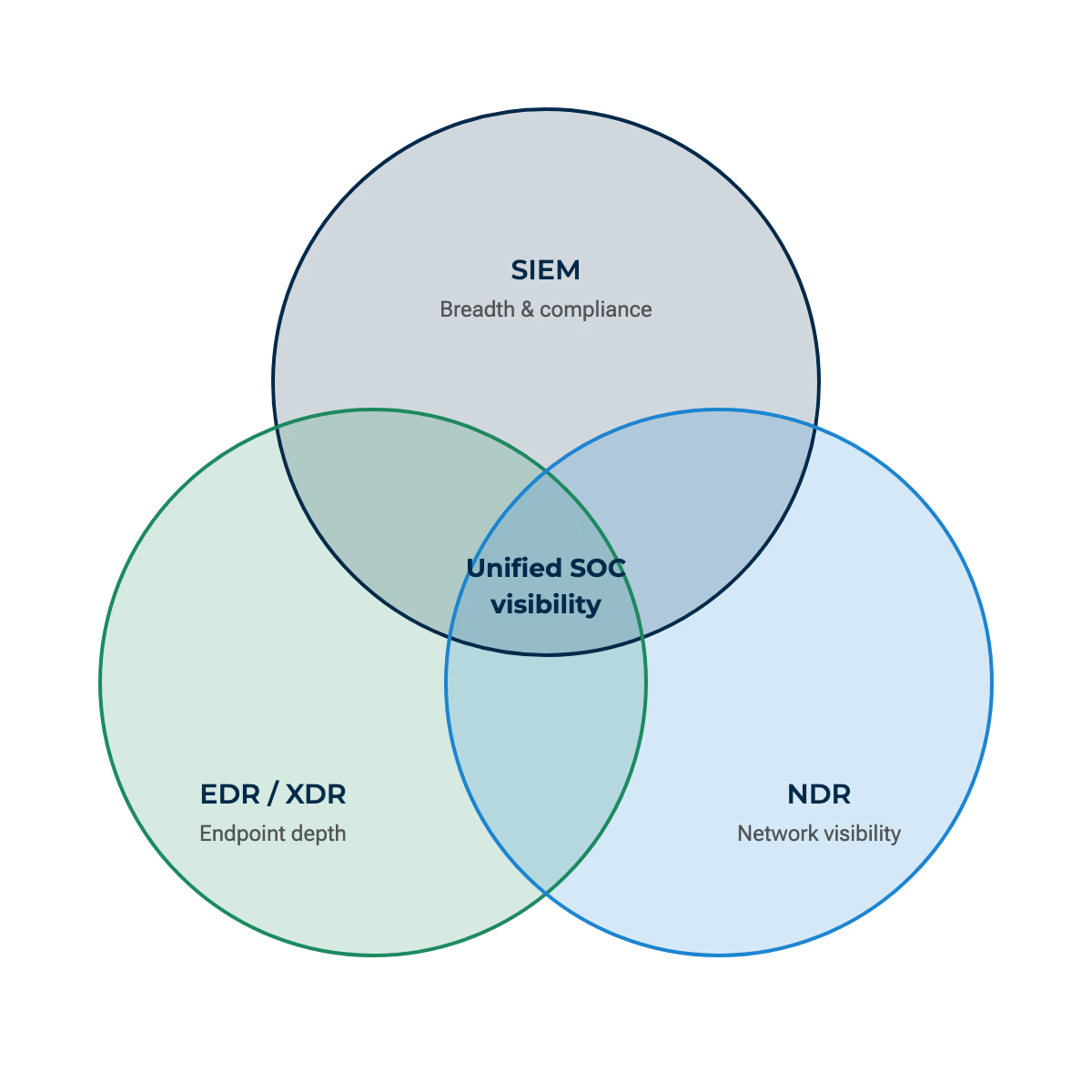
The organizing frame is the SOC visibility triad: SIEM provides breadth and compliance, EDR/XDR provides endpoint depth, and NDR provides the network visibility both lack. The concept originated with Gartner analysts (Barros, Chuvakin, and Belak) in 2019, building on the "SOC nuclear triad" Chuvakin coined in 2015 — treat it as an evolving model rather than a fixed taxonomy, since XDR now blurs the EDR and NDR legs. The deep dive on architecture patterns lives in the dedicated SOC visibility triad guide; here it is the narrative frame, not the target.
Three overlapping circles labeled SIEM, EDR/XDR, and NDR converging into unified SOC visibility. Each leg covers a distinct gap:
SIEM — breadth and compliance: heterogeneous log coverage and the retention auditors require.
EDR/XDR — endpoint depth: rich process- and host-level signal and fast containment on managed devices.
NDR — network visibility: attacker behavior in east-west traffic, including activity on unmanaged devices and stolen-credential movement that endpoints and logs miss.
The gap is empirical, not theoretical. In 2024, 44% of unfolding ransomware incidents were spotted during lateral movement — the network-borne signal a SIEM-only or endpoint-only stack cannot see (Barracuda, 2025). The Akira ransomware case makes it concrete: attackers entered through a deactivated third-party "ghost" account over an open VPN; endpoint XDR blocked pass-the-hash and infostealer lateral movement at 1:17 a.m. (MITRE ATT&CK T1550.002 Pass the Hash); attackers then pivoted to an unprotected server and deployed Akira at 2:54 a.m.; every XDR-protected endpoint was isolated within four minutes (2:54→2:59 a.m.). The post-incident finding was unambiguous — network and identity visibility would have caught the VPN ghost-account activity earlier, and a SIEM-only stack could not see it at all.
This is structural, not a one-off. Aggregate 2025 data shows median dwell time rose to 14 days, exploits remained the top initial-access vector at 32% for the sixth consecutive year, initial-access-to-handoff collapsed to 22 seconds, and 52% of intrusions were detected internally (up from 43% in 2024) (Mandiant M-Trends 2026; SecurityWeek, 2026). When handoff happens in seconds and attackers live on the network for days, the network is where the fight is decided — see NDR vs XDR and SIEM vs NDR for how the network leg pairs with each.
Do I need both? A decision framework and migration path
Most organizations need both — lead with XDR for detection, keep SIEM for compliance, and migrate by cutting SIEM ingest, not capability. Here is the structured way to decide, then a roadmap competitors only gesture at.
Start with the most common question. Can XDR replace SIEM? Not fully — XDR can take over primary detection and response, but SIEM stays for compliance, log retention, and ingesting the heterogeneous and legacy sources XDR sensors do not collect. The cross-source consensus across vendors and market analysis is that most organizations run both; the minority "XDR is overtaking SIEM" view is largely open-XDR-vendor-positioned.
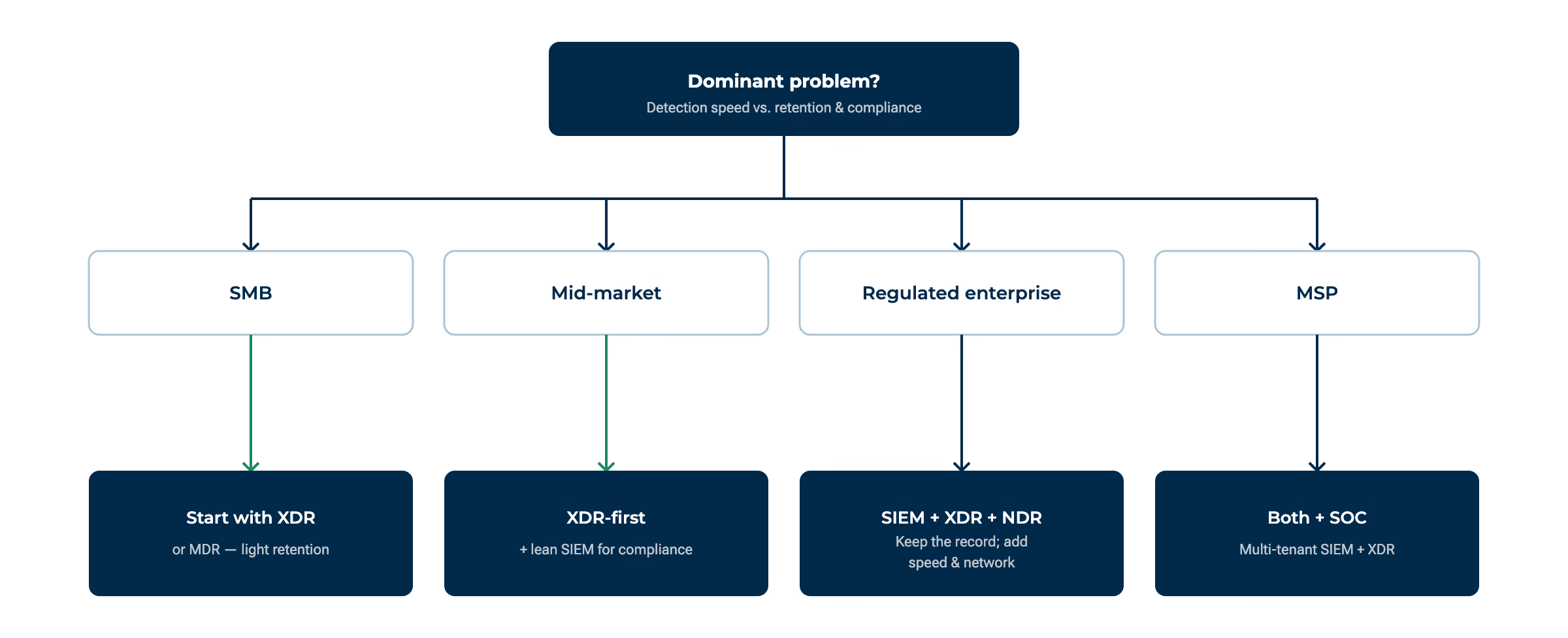
Decision-tree flowchart. Dominant problem → organization profile (SMB / mid-market / regulated enterprise / MSP) → recommended first move (SIEM-first / XDR-first / both). Caption: Decision flowchart routing by dominant problem and organization profile to a SIEM-first, XDR-first, or both recommendation.
The tree runs on your dominant problem: if detection speed and response are the pain, lean XDR; if retention, compliance, and heterogeneous breadth are the pain, keep or lead with SIEM. Then refine by organization profile:
SMB. Start with XDR, or with detection delivered through managed detection and response (MDR). Compliance retention burden is usually light and there is often no dedicated SOC.
Mid-market. Usually XDR-first for detection ROI, then add or keep a lean SIEM for compliance as requirements grow.
Regulated enterprise. Keep SIEM as the compliance system-of-record, add XDR for detection speed, and add NDR for the network-visibility leg.
MSP. Typically needs both plus a SOC — multi-tenant SIEM for client logging and compliance, XDR for cross-client detection.
The hybrid migration path is where the cost and capability goals reconcile. Sequence it deliberately:
Keep SIEM as the compliance system-of-record.
Deploy XDR for primary detection and response.
Validate XDR coverage across your priority surfaces.
Route correlated XDR incidents into the SIEM.
Stop shipping raw telemetry the SIEM no longer needs.
Cut SIEM ingest 30–50% over 6–12 months.
Tune retention to match each compliance obligation.
Re-baseline cost and coverage, then iterate.
Where does SOAR fit?
SOAR (security orchestration, automation, and response) is the response-automation leg, distinct from the visibility triad: it executes playbooks and coordinates actions across tools once a detection fires, rather than generating detections itself. So when teams ask whether they need SIEM, XDR, and SOAR — or how SIEM and SOAR relate — the answer is that SOAR layers automation on top of whatever produces your alerts. For how orchestration and SOAR compare and where each fits, see security orchestration vs SOAR.
Does the SIEM-vs-XDR distinction still matter in 2026?
Yes — the categories are converging commercially, but the architecture question (breadth and retention vs detection speed vs network visibility) matters more than ever, not less. The framing has shifted as next-gen SIEM absorbs XDR-style analytics and XDR adds log management, so buyers increasingly ask whether the label still means anything.
The market data shows both categories growing, at very different rates. The XDR market is projected to grow from $5.53B in 2024 to $30.86B by 2030 at a 31.2% CAGR (MarketsandMarkets) — though that report carries its own internal 31.2%-vs-14.6% CAGR inconsistency, and a divergent analyst using a narrower scope puts XDR at just $4.98B by 2030, so treat the upside as a spread, not a certainty. The SIEM market is projected to grow from $8.39B in 2026 to $13.67B by 2031 at a 10.3% CAGR (MarketsandMarkets / PR Newswire, 2026). Both are growing — convergence is reshaping the categories, not collapsing them into one.
The commercial consolidation is observable in deal activity: a major XDR vendor acquired a leading SIEM's SaaS assets in 2024 to migrate customers onto its next-gen SOC platform, and two SIEM/UEBA vendors completed a private-equity-backed merger the same year. The trade-off convergence brings is deeper vendor lock-in — and the antidote is open standards. The Open Cybersecurity Schema Framework (OCSF) joined the Linux Foundation on 2024-11-19 (the release at that milestone was OCSF 1.3.0, August 2024) and has grown to 200+ organizations and 900+ contributors, with the AWS OCSF Ready Specialization launched on 2025-10-30 (Linux Foundation; AWS, 2025). Adopting OCSF-aligned tooling keeps your detection logic portable as platforms converge.
There is also a "who watches the watcher" wrinkle that argues against treating any single platform as a finish line. Even a leading SIEM platform suffered a critical, actively-exploited unauthenticated remote code execution flaw in 2026 (CVSS 9.8, listed in the CISA Known Exploited Vulnerabilities catalog) that let attackers tamper with the very security data the SIEM stores (NVD CVE-2026-20253; BleepingComputer, 2026). The lesson is not that this favors XDR — it is that the monitoring system is itself attack surface that must be hardened and monitored. The label matters less than whether your extended detection and response (XDR) and logging architecture together cover breadth, depth, and the network.
Modern approaches to detection across SIEM, XDR, and NDR
The market is converging on integrated signal across attack surfaces, AI-driven triage to multiply small teams, and open standards like OCSF that keep detection logic portable, with the hybrid, increasingly agentic SOC as the 2026 operating model. When evaluating any approach, look for cross-surface coverage, signal quality over alert volume, and an architecture that explicitly includes network detection and response.
How Vectra AI thinks about SIEM vs XDR
Vectra AI's view is that the most consequential gap in the SIEM-vs-XDR debate is network visibility. Because attackers increasingly log in rather than hack in — and then move laterally where endpoint and log-centric tools are blind — the network is the attack surface that decides whether an intrusion becomes a breach. Attack Signal Intelligence™ applies that lens: attacker-behavior signal across network and identity is the third leg that turns the SIEM-or-XDR choice into an architecture decision rather than a binary, pairing breadth and depth with the visibility neither tool delivers alone.
Conclusion
SIEM and XDR are not competitors so much as two halves of detection: SIEM gives you breadth, retention, and the compliance system-of-record; XDR gives you cross-surface detection speed and automated response. For most teams the practical move is to lead with XDR for detection, keep a lean SIEM for compliance, and migrate by cutting SIEM ingest 30–50% rather than cutting capability. But the comparison only gets you most of the way. The dimensions that decide your real coverage — total cost of ownership, regulatory obligations, and the lateral-movement blind spot — point past the either/or toward an architecture decision. The strongest stack is not SIEM or XDR; it pairs breadth and depth with network visibility so attacker behavior has nowhere to hide. To go deeper on the network leg, explore how network detection and response completes the SOC visibility triad.
FAQs
Can XDR replace SIEM?
Not fully. XDR can take over primary detection and response, but SIEM remains the compliance system-of-record for long-horizon log retention, audit reporting, and ingesting arbitrary or legacy log sources XDR sensors do not collect. Most organizations run both.
Do I need both SIEM and XDR?
Often yes — lead with XDR for detection speed and keep a lean SIEM for compliance and breadth. The right answer depends on your dominant problem (speed versus retention) and your organization profile; see the decision framework above.
Is XDR the same as SIEM?
No. SIEM aggregates and correlates logs for monitoring, compliance, and retention; XDR correlates native telemetry across endpoint, network, identity, and cloud for faster automated response. Different data, different goal.
Which is better, SIEM or XDR?
Neither is universally better — they optimize for different things. XDR wins on detection speed and response; SIEM wins on breadth, retention, and compliance. The strongest stacks pair both and add network visibility.
How much does a SIEM cost?
SIEM pricing varies widely by data volume, but the bigger driver is total cost of ownership — SIEM TCO typically runs 2–3× license cost because of SOC staffing and tuning. See the TCO table above for indicative ranges (sampled Q1 2026).
Does SIEM or XDR help with NIS2 and DORA compliance?
Both support compliance, but SIEM is typically the system-of-record for the audit logging and retention these regimes expect. NIS2 requires 24-hour early-warning reporting (deadline passed 2024-10-17); DORA (applicable since 2025-01-17) sets a 4-hour/24-hour/72-hour/1-month reporting clock.
Does the SIEM-vs-XDR distinction still matter in 2026?
Yes — even as the categories converge commercially, the underlying architecture question (breadth and retention versus detection speed versus network visibility) still decides your coverage. Open standards like OCSF help limit the lock-in that convergence brings.