Security monitoring explained: the SOC operations umbrella for modern enterprises
Key insights
Cybersecurity monitoring, cyber security monitoring, and security monitoring name the same umbrella discipline — continuous threat visibility across the enterprise attack surface. Network monitoring and threat detection are distinct, narrower concepts.
Breaches now most often start with unpatched exposure (vulnerability exploitation became the top initial-access vector at 31% in 2026), while identity and OAuth-token abuse defeats MFA — both demand continuous, behavior-aware monitoring rather than point-in-time scans.
Enterprise SIEMs detect only 21% of MITRE ATT&CK techniques on average, meaning 79% of attacker behaviors pass undetected without complementary coverage from EDR, NDR, and ITDR.
Recent credential and OAuth-token breaches — Change Healthcare, the Salesloft Drift token theft against Salesforce, and the SK Telecom subscriber breach — bypassed malware, CVEs, and MFA, proving identity and SaaS-token monitoring are now baseline, not optional.
Major compliance frameworks — NIST CSF 2.0, PCI DSS v4.0.1, HIPAA, SOC 2, NIS2, and GDPR — all require continuous monitoring evidence, with the NIS2 Article 23 cascade demanding a 24-hour early warning.
Cybersecurity monitoring — also written "cyber security monitoring" and used interchangeably with "security monitoring" — is the continuous practice of collecting, analyzing, and acting on security-relevant data from across the enterprise attack surface (networks, endpoints, cloud workloads, identities, SaaS applications, and logs) to detect threats before they cause material harm. This page is the canonical home for all three terms. Unlike the broad head term "security monitoring," whose search results mix in consumer home alarms and physical guard services, the "cybersecurity monitoring" search intent is entirely enterprise and cyber — so this guide skips heavy physical-security disambiguation and goes straight to the discipline. If you are evaluating an enterprise cyber security monitoring program — what to instrument, what compliance demands, how to measure effectiveness, and whether to build or buy — this article is the umbrella reference. We connect the seven monitoring domains (network, endpoint, cloud, identity, SaaS, application, and log) to the MITRE ATT&CK coverage benchmark, current breach economics, the major compliance frameworks, and the in-house versus outsourced delivery decision.
What is cybersecurity monitoring?
Cybersecurity monitoring is the continuous practice of collecting, analyzing, and acting on security-relevant data from across an enterprise's attack surface — networks, endpoints, cloud workloads, identities, SaaS applications, and logs — to detect adversary activity before it becomes material harm.
It is the umbrella discipline that gives a security operations center its visibility, fuels detection and response, and produces the evidence auditors expect under frameworks such as NIST CSF 2.0 DE.CM.
The terms "cyber security monitoring," "cybersecurity monitoring," and "security monitoring" describe the same enterprise discipline. They are aliases, not separate practices, and this page treats them as one. The spaced form "cyber security monitoring" is simply the more common way searchers type the query, and the closed form "cybersecurity monitoring" is the more common way the industry writes it. Where this guide says "security monitoring," read it as a synonym for cybersecurity monitoring.
Cyber security monitoring vs the consumer industry of the same name
A note on terminology. The phrase "security monitoring" — and the spaced variant "cyber security monitoring" — also describes the consumer industry of home alarms, surveillance cameras, and 24/7 alarm-receiving centers. Search results for the broad head term often mix the two meanings; results for "cybersecurity monitoring" do not, because that variant is entirely enterprise in intent. This article covers only the enterprise cybersecurity discipline. If you are looking for consumer home security, alarm response services, or physical security monitoring, the content here will not apply.
Cybersecurity monitoring vs security monitoring vs network monitoring vs threat detection
Cybersecurity monitoring, cyber security monitoring, and security monitoring name the same umbrella discipline. Network monitoring and threat detection are distinct, narrower concepts that are frequently confused with it. Two clarifications resolve most of the confusion. First, "network monitoring" in its everyday sense is about performance and availability — uptime, latency, and bandwidth — not adversary behavior. Network security monitoring is the threat-focused cousin, and the two are not the same thing. Second, threat detection is the detection step that lives inside monitoring, not a synonym for the whole discipline. The table below summarizes the distinctions.
Table 1. Cybersecurity monitoring vs security monitoring vs network monitoring vs threat detection
Term
Scope
Primary output
Relationship to cybersecurity monitoring
Cybersecurity / security monitoring
The whole attack surface — network, endpoint, cloud, identity, SaaS, application, and log telemetry
Prioritized detections and investigations
The umbrella discipline itself (these terms are near-synonyms)
Network monitoring
Network performance and availability — uptime, latency, bandwidth, device health
Health and performance metrics
Different discipline; the threat-focused version is network security monitoring, a single domain within the umbrella
Threat detection
Identifying malicious activity from collected telemetry
Alerts and detections
A step inside monitoring, not the whole practice
Table 1 distinguishes the umbrella discipline of cybersecurity monitoring from the narrower, frequently-confused concepts of network monitoring and threat detection by scope and primary output.
One nuance worth flagging: the relationship between "cybersecurity monitoring" and "security monitoring" is not perfectly settled. In practice the two are used interchangeably, and most sources treat them as synonyms. A minority frame "cybersecurity monitoring" as the broader umbrella and "security monitoring" as its day-to-day operational subset. This guide treats them as the same discipline — the most common usage.
A working definition for the rest of this article: cybersecurity monitoring is what an enterprise does, continuously, to know whether its environment is being attacked — and, increasingly, how quickly it can act on that knowledge. The "how" is where the seven domains, the coverage gaps, and the delivery decisions all sit.
Why cybersecurity monitoring matters in 2026
Three forces make cybersecurity monitoring an operational necessity rather than a check-box exercise in 2026: breach economics, the reordering of initial-access vectors, and the rise of identity-token abuse that defeats traditional controls.
Breach economics. The 2025 Ponemon Institute's Cost of a Data Breach study (the most recent global baseline) put the average data breach cost at $4.44 million — a 9% year-over-year decline. The decline was not because attackers got weaker; it was because mean time to identify and contain hit a nine-year low of 241 days, with organizations that deployed AI-driven detection extensively saving roughly $1.9 million on average. The signal in those numbers is that monitoring maturity is now visible in breach financials. Even so, 241 days is still about eight months of attacker access — the absolute baseline remains an indictment of detection coverage.
The initial-access vector reordered. The Verizon 2026 DBIR marked a turning point: vulnerability exploitation (31%) overtook stolen credentials (13%) as the number-one initial-access vector for the first time in 19 years, ransomware appeared in 48% of breaches, and the median time-to-patch worsened to 43 days (SecurityWeek). Credentials remain firmly top-tier — about 22% of breaches still start with stolen credentials per the same DBIR data — and they feed ransomware, but exposure and vulnerability monitoring is now the leading entry vector. When unpatched exposure becomes the most common way in, point-in-time scanning on a monthly cadence is not monitoring — it is archaeology.
Identity-token abuse defeats MFA. The reordering above does not demote identity; it reframes it. Credential theft and the behaviors that follow — anomalous logins, privilege escalation, OAuth-token misuse, lateral movement — remain where most modern intrusions actually live, and credential-driven breaches take roughly 292 days to detect on average. The defining recent breaches did not rely on malware or a CVE at all. They abused standing identity and OAuth grants against software that was working exactly as designed, which is precisely why signature-centric and CVE-centric monitoring misses them. The practical takeaway: monitoring that lives in a single tool category, or that watches only for known-bad signatures, misses most of the modern attack surface. Continuous, behavior-aware monitoring across every domain is the only approach that keeps pace.
The seven domains of cybersecurity monitoring
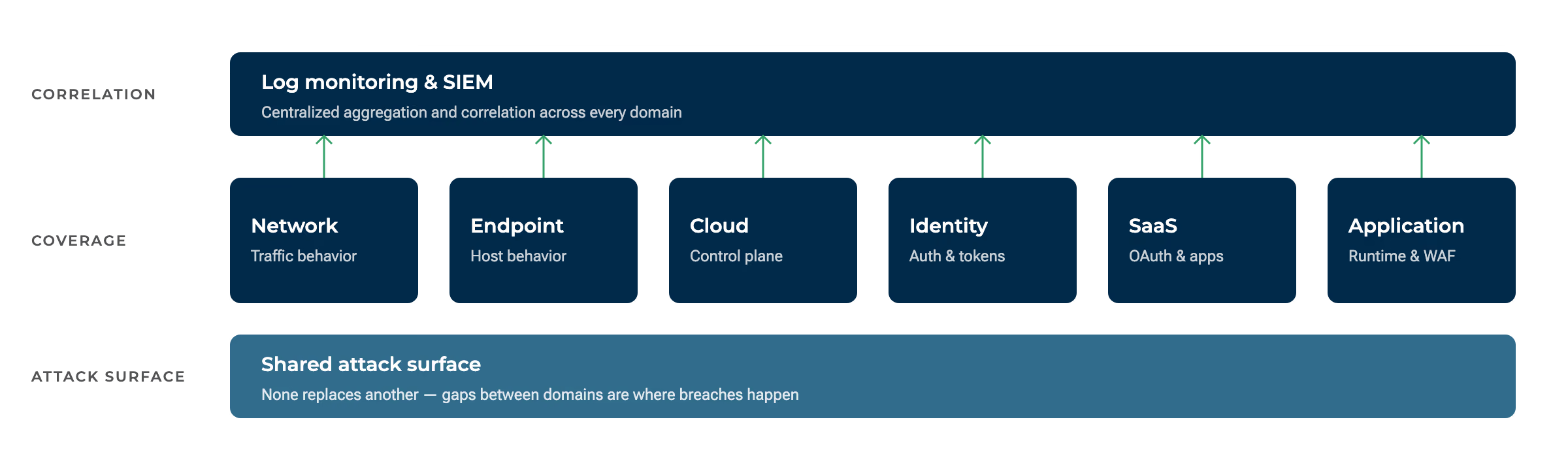
Modern cybersecurity monitoring spans seven domains, each with distinct telemetry, tooling, and visibility gaps. Treating any one domain in isolation creates the multi-domain breach pattern noted above. The diagram below visualizes the seven domains as overlapping coverage layers on a shared attack surface — none replaces another, and the gaps between them are where breaches happen.
Network — traffic analyzed for adversary behavior, east-west and north-south.
Endpoint — process, file, registry, and memory behavior on hosts.
Cloud — control-plane activity, configuration drift, and workload runtime telemetry.
Identity — authentication flows, privilege changes, and token use across providers.
SaaS — connected apps, OAuth grants, and administrative actions in SaaS platforms.
Application — runtime behavior, WAF telemetry, and application logs.
Log — centralized aggregation and correlation across every other domain.
Network security monitoring
Network security monitoring (NSM) is the continuous analysis of east-west and north-south traffic for behavioral anomalies — a discipline that complements signature-based intrusion detection systems with behavioral analytics. Network monitoring in the performance sense remains a different job from network security monitoring, which watches the same traffic for adversary behavior. See our network security coverage and the modern category framing in network detection and response (NDR) for tooling depth. Control-plane and east-west visibility matter most precisely because that is where lateral movement hides and where perimeter tools are blind.
Endpoint security monitoring
Endpoint security monitoring observes process behavior, file integrity, registry and system changes, and memory artifacts on workstations and servers. It is the foundation that most security programs start with, and the limitation that most security programs hit. Roughly 50% of major data breaches involve attackers circumventing endpoint controls — through living-off-the-land techniques, fileless execution, or simply pivoting to identity-based attacks where endpoint visibility ends. This is why endpoint detection and response (EDR) — which adds behavioral analytics to traditional endpoint protection — is necessary but not sufficient.
Cloud security monitoring
Cloud security monitoring provides visibility into cloud control planes, workload telemetry, configuration drift, and ephemeral workloads such as containers and serverless functions. The CSPM, CWPP, and CNAPP (cloud-native application protection platform) categories converge on a single mission — continuous configuration and runtime visibility across cloud estates — and native cloud logs are a primary, often-underused source. See cloud security for the dedicated breakdown and cloud detection and response (CDR) for the runtime detection category.
Identity threat detection and response (ITDR)
Identity threat detection and response (ITDR) monitors identity providers, directory services, and authentication flows for credential theft, anomalous logins (impossible travel, atypical geographies), privilege escalation, dormant-account abuse, OAuth-token misuse, and lateral movement via identities. Distinct from identity and access management (IAM) logging — which is auditing and compliance focused — ITDR is behavioral and adversary focused. Identity is widely recognized as the primary modern attack surface: roughly 22% of breaches start with stolen credentials, and the abuse of valid accounts and cloud accounts (MITRE ATT&CK T1078.004) is a recurring theme in the worst recent intrusions. The compromise chains that defeat single sign-on and MFA are exactly the behavioral patterns ITDR is built to surface — and exactly the kind that endpoint and log monitoring miss.
SaaS security monitoring (SSPM)
SaaS security posture management (SSPM) monitors SaaS platforms — CRM, productivity suites, identity providers, and code repositories — for misconfigurations, anomalous administrative actions, OAuth abuse, and connected-app risk. This domain has become a primary battleground. The 2025–2026 wave of OAuth-token breaches showed that connected third-party integrations, not endpoint compromise, were the attack vector: attackers abused standing tokens to read data directly from SaaS platforms with no malware and no perimeter breach (SecurityWeek). Some analysts have called 2026 "the year of SaaS breaches" for this reason (Cyber Defense Magazine). The SSPM controls that matter most are connected-app inventory, OAuth-token monitoring, app-to-app permission auditing, and admin-action behavioral baselines. Shadow-AI integrations — employees connecting AI tools to corporate SaaS via OAuth — are an emerging extension of the same monitored surface.
Application security monitoring
Application security monitoring (a discipline overlapping with application monitoring in the observability sense) covers runtime application behavior — including static and dynamic testing results in the build pipeline, runtime application self-protection, web application firewall (WAF) telemetry, and application logs. It is where remote monitoring of customer-facing services lives, and where the line between security monitoring and engineering observability blurs most. With vulnerability exploitation now the leading initial-access vector, application-tier monitoring should flag process crashes, anomalous child-process spawning, and request-error spikes — signals that are invisible to log-only or endpoint-only stacks.
Log monitoring and SIEM
Log monitoring is the centralized aggregation, normalization, correlation, and retention of logs from across the stack — the historical foundation of cybersecurity monitoring and the architecture most often described as SIEM and log monitoring. SIEM has evolved into a backend analytics and retention layer for broader SecOps platforms rather than the sole detection engine. That evolution matters because, as the next section shows, SIEM alone catches far less of the adversary playbook than most teams assume.
How cybersecurity monitoring works
Cybersecurity monitoring follows a continuous loop. The same eight steps run for every monitored domain, with the inputs and the analytics changing by sensor type. The lifecycle is what makes monitoring a discipline rather than a tool, and it is the difference between continuous monitoring and periodic scanning.
Collect telemetry from network, endpoint, cloud, identity, SaaS, and application sources.
Normalize and enrich raw data with asset, identity, geo, and threat-intel context.
Detect through correlation rules, behavioral analytics, machine learning, and signatures.
Triage alerts — deduplicate, score severity, and suppress known false positives.
Investigate confirmed events — stitch related signals into attack narratives.
Respond — contain assets, revoke credentials, and block malicious connections.
Report — feed SOC dashboards, executive reports, and compliance evidence.
Continuously improve — tune detection rules and close coverage gaps.
A useful mental model is to think of the loop in two phases: acquire and analyze (steps 1–3), then decide and act (steps 4–8). The first phase is data engineering and detection science. The second phase is human and machine decision-making — where most of the operational cost lives. Strong programs invest evenly in both. Weak programs over-invest in collection and under-invest in triage, which is why so much SIEM data is ingested but never used for detection.
Continuous monitoring — the operating mode that NIST calls "continuous security monitoring" and that frameworks reference as continuous cybersecurity monitoring — is what distinguishes the discipline from periodic scanning. Threats are not on a schedule, and continuous threat detection cannot be either. Threat hunting is a complementary practice that runs proactive hypotheses against the same telemetry, asking "where would an attacker be hiding right now?" rather than waiting for an alert. When detection fires, incident response is the operational shift that completes the loop. The UK's CREST Cyber Security Monitoring Guide is a practical reference for building this lifecycle into a repeatable program.
To implement a continuous cybersecurity monitoring plan, most teams sequence it the same way: inventory assets and identities, prioritize the log sources that matter (identity providers, perimeter and remote access, cloud control planes, and critical business applications), instrument each of the seven domains, then iterate on detection content. A note on encrypted traffic: HTTPS, encrypted DNS, and modern transport protocols have made deep packet inspection less practical, so most network detection has moved to metadata-based and behavioral approaches — analyzing flow characteristics, beacon patterns, and session-level anomalies rather than payloads.
The honest coverage gap: how much do you actually see?
Most cybersecurity monitoring content tells readers what to buy and how to deploy. This section tells the harder truth: how much of the MITRE ATT&CK adversary playbook the typical enterprise monitoring stack actually detects, and where the gaps live.
The 79% problem. Independent research in the CardinalOps 2025 State of SIEM report found that enterprise SIEMs detect only 21% of MITRE ATT&CK techniques on average — meaning 79% of techniques pass undetected by the SIEM alone. As of mid-2026 this remains the current edition, so the figures are still citable. Neutral coverage from Help Net Security and Dark Reading confirms the headline and adds the supporting detail: more than half of SIEM data is never used for detection, fewer than 20% of detection rules ever trigger, fewer than 5% of rules generate most of the alert noise, and more than 70% of detection gaps could be closed with data the SIEM is already ingesting. The implication is that the coverage gap is not primarily a budget problem — it is a detection-engineering problem.
What each tool category actually covers. No single sensor or platform covers all of ATT&CK. The matrix below shows where each tool category contributes — with cells marked Strong (well-covered), Partial (mixed coverage), Weak (limited visibility), or None (out of scope by design). This is a coverage heatmap, not a vendor ranking, and actual results vary by deployment maturity.
Table 2. MITRE ATT&CK detection coverage by monitoring tool category
Tool category
Initial Access
Execution
Persistence
Credential Access
Discovery
Lateral Movement
Collection
C2
Exfiltration
Impact
SIEM
Partial
Partial
Partial
Partial
Partial
Weak
Weak
Partial
Weak
Partial
EDR
Partial
Strong
Strong
Partial
Strong
Partial
Partial
Partial
Weak
Strong
NDR
Strong
Weak
Weak
Partial
Strong
Strong
Partial
Strong
Strong
Partial
ITDR
Strong
None
Partial
Strong
Partial
Strong
None
None
Weak
None
CSPM
Partial
None
Partial
Partial
Weak
None
None
None
Partial
Partial
UEBA
Partial
Partial
Partial
Strong
Strong
Strong
Partial
Partial
Strong
Partial
Table 2 shows indicative MITRE ATT&CK coverage strength by monitoring tool category under typical deployment patterns. Combining EDR, NDR, ITDR, and a user and entity behavior analytics (UEBA) layer typically lifts coverage well above the 21% SIEM-only baseline.
Alert fatigue is a coverage problem in disguise. Coverage is not only about what a tool can see — it is about what analysts can actually act on. Across the industry, analysts investigate well under half of the alerts they receive, and a 24/7 SOC can cut detection time by roughly 70% versus business-hours-only coverage. This is why alert fatigue is not a staffing problem to solve with more analysts. It is a coverage and content problem. The fix is not louder alerts; it is fewer, higher-fidelity alerts that stitch related behaviors into attack narratives. Closing the gap requires three disciplines: detection engineering as a named practice (writing and continuously tuning detection content), AI-augmented triage that suppresses noise without dropping signal, and broader sensor coverage (network, identity, cloud, and SaaS — not just endpoint and logs).
Why CVE-centric monitoring misses the defining recent breaches. The most consequential 2025–2026 intrusions used identity and OAuth-token abuse against correctly-functioning software — no exploit, no CVE, no malware. A monitoring program tuned to known signatures and patch status will not see an attacker who logs in with a valid token. That gap is exactly what the next section illustrates with worked cases.
Cybersecurity monitoring in practice: 2024–2026 credential and OAuth cases
Recent credential and OAuth-token breaches bypassed malware, CVEs, and MFA — proving identity and SaaS-token monitoring are now baseline, not optional. Three cases from 2024 through 2025 illustrate the failure modes, and a 2026 continuation shows the pattern did not stop. These are described at the level of what defenders should monitor and what would have caught the activity — not as attacker playbooks.
Change Healthcare — roughly nine days of pre-detection dwell (2024). The intrusion began on February 12, 2024, and was detected on February 21, 2024 — about nine days during which attackers operated inside the environment before anyone noticed. The lesson is not about the initial entry point; it is that dwell time, not just the moment of compromise, defines breach severity. Continuous behavioral monitoring that flags anomalous internal activity — not just perimeter events — is what compresses a nine-day window into hours.
Salesforce / Salesloft Drift OAuth token theft (2025). Attackers abused standing OAuth tokens from a connected third-party integration to exfiltrate data from Salesforce with no malware, no CVE, and no perimeter breach. The grant already existed, so single sign-on and MFA were never challenged — there was nothing to phish, because the token was already trusted. The monitoring lesson is concrete: inventory and prune connected OAuth apps, revoke over-scoped tokens, and alert on anomalous token use and bulk CRM exports. This is an SSPM and ITDR signal, invisible to endpoint and log-only stacks.
SK Telecom — a 27-million-subscriber breach (disclosed 2025). A breach affecting roughly 27 million subscribers illustrates why telemetry breadth and timely detection matter at scale. At that blast radius, the difference between detecting in days versus weeks is measured in regulatory exposure and customer harm.
The pattern continued into 2026. The same OAuth and identity-token campaign class repeated across unrelated sectors in 2026, including further breaches tied to connected-integration and AI-tool OAuth access (The Hacker News; Dark Reading). A related chain — vishing a help desk, authenticating into an enterprise identity provider such as Microsoft Entra, then pivoting into a CRM — drove a large telecom breach as well (BleepingComputer). There is a defensive bright spot worth noting: in at least one case the affected SaaS provider detected the malicious activity via API calls from non-whitelisted IP addresses within about one to two weeks — exactly the kind of behavioral signal SSPM and cloud detection and response are designed to surface.
Table 3. 2024–2026 credential and OAuth cases and what monitoring would have caught
Case
Failure mode
What monitoring would have caught it
Change Healthcare (~9-day dwell, 2024)
Slow detection of internal attacker activity
Behavioral monitoring of anomalous lateral movement and credential use, compressing dwell time
Salesforce / Salesloft Drift OAuth (2025)
Standing OAuth token abused; SSO and MFA never challenged
Broad telemetry plus timely anomaly detection across identity and data-access surfaces
Table 3 maps three 2024–2026 credential and OAuth breach cases to the specific monitoring signal that would have detected each.
Cybersecurity monitoring and compliance
Continuous monitoring is the evidence layer for nearly every modern compliance regime. The frameworks differ in phrasing but converge on the same expectation: ongoing collection, review, and retention of security-relevant data, with documented procedures and tamper-evident storage. The security frameworks topic page covers the regulatory landscape in depth; this section is the one-page crosswalk that consolidates monitoring obligations across the major regimes.
Table 4. Compliance crosswalk — monitoring controls across major regulatory frameworks
Table 4 crosswalks continuous monitoring obligations across ten major regulatory frameworks, mapping each to its control reference, monitoring scope, cadence, and expected evidence artifact. See the GDPR compliance treatment of Article 32 for depth.
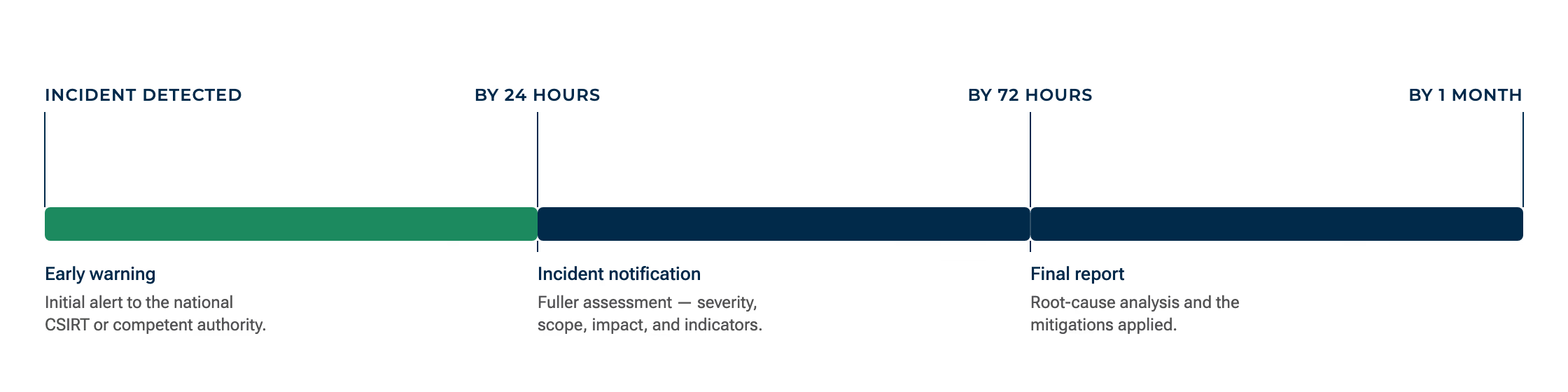
NIS2 enforcement is sharpening in 2026.NIS2 Article 23 imposes a three-stage cascade: a 24-hour early warning, a 72-hour incident notification, and a 1-month final report. Enforcement across EU member states is moving from paper compliance to active, risk-based supervision, with fines up to EUR 10 million or 2% of worldwide turnover for essential entities. That 24-hour window has a direct monitoring implication — detection-to-CSIRT-notification capability has to be on call around the clock. A monitoring program designed for next-business-day triage cannot meet a 24-hour rule.
NIS2 Article 23 reporting cascade: 24-hour early warning → 72-hour incident notification → 1-month final report. (Callout alt text: timeline of the NIS2 Article 23 reporting cascade — 24-hour early warning, 72-hour notification, 1-month final report.)
The umbrella references remain consistent across sectors: NIST CSF 2.0 DE.CM for the Detect function, NIST SP 800-137 for the information security continuous monitoring (ISCM) program structure, GDPR Article 32 for technical and organizational measures, and CIS Controls v8 for prescriptive log and network-monitoring controls. The MITRE ATT&CK framework is the de facto detection-coverage benchmark referenced inside most modern audit programs.
Choosing a delivery model and modern approaches
Five delivery models cover most of what mid-market and enterprise buyers consider for cybersecurity monitoring services. The decision rarely comes down to budget alone — the real question is who owns response action when a confirmed attack is in flight. The matrix below summarizes the trade-offs.
Table 5. Cybersecurity monitoring delivery model decision matrix
Table 5 compares five cybersecurity monitoring delivery models by scope, response ownership, price band, staffing, time-to-value, and best-fit organization size. Price bands are typical 2026 industry estimates and vary with environment size, telemetry volume, and SLAs.
MDR vs MSSP. This is the single most-asked question in the space, and the distinction is about response ownership. A managed security service provider (MSSP) manages security tools and forwards alerts; the customer retains response authority and action. A managed detection and response (MDR) provider takes response action on the customer's behalf — quarantining a host, disabling an account, blocking a connection — within an agreed scope. MSSP fits organizations with response capability that want tool operations outsourced. MDR fits organizations that need response action they cannot staff in-house, especially overnight and weekend coverage. Fully outsourced SOC-as-a-service (SOCaaS) or virtual SOC (vSOC) options extend this further for teams with fewer than five security FTEs who need 24/7 cybersecurity monitoring without standing up a dedicated SOC.
2026 market context. Managed security services remain the fastest-growing segment of the monitoring market. Independent market estimates project growth from roughly $39.47 billion in 2025 to about $66.83 billion by 2030 — figures presented here as market-level estimates rather than audited fact.
The AI-SOC nuance. AI-augmented monitoring is reshaping operations, but adoption is racing ahead of measurable results. Industry analysts name "AI SOC agents" as an emerging category, projecting that roughly 70% of large SOCs will pilot them for tier-1 and tier-2 work by 2028 — yet only about 15% are expected to see measurable improvement without structured evaluation (BleepingComputer). The lesson for buyers: machine learning genuinely improves monitoring when it narrows the speed gap with AI-powered attackers and converts alert volume into attack narratives, but it has to be evaluated on detection outcomes, not vendor claims.
Measuring effectiveness. Effective cybersecurity monitoring is judged by outcomes, not activity. The metrics that matter are mean time to detect (MTTD), mean time to respond (MTTR), dwell time (against the 241-day 2025 baseline), MITRE ATT&CK coverage (against the 21% SIEM-only baseline, with a combined-stack target above 70%), and detection precision and recall. The modern approaches that improve them — detection engineering as a named discipline, AI-augmented triage, behavioral analytics over signature matching, and cross-domain correlation — all share one goal: converting monitoring from a noise-generation problem into a measurable cyber resilience capability. The security posture view and the broader catalog of cybersecurity monitoring solutions round out the decision set.
How Vectra AI thinks about cybersecurity monitoring
Vectra AI approaches cybersecurity monitoring as a signal problem, not a logging problem. The assume-compromise philosophy starts from the premise that smart attackers will get in — so the most valuable monitoring focuses on what they do once inside: lateral movement, privilege escalation, anomalous identity behavior, OAuth-token abuse, command-and-control activity, and exfiltration. Attack Signal Intelligence applies AI-driven behavioral analytics across the modern attack surface — network, identity, cloud, and SaaS — to surface the attacks that endpoint and log-centric monitoring miss. The goal is fewer, higher-fidelity detections that trace through the kill chain, not more alerts to triage. For organizations with constrained security teams, that converts monitoring from a noise-generation problem into an attack-resilience capability — measured by how many real attacks are caught earlier, not how many logs are ingested.
Future trends and emerging considerations
The cybersecurity landscape is evolving faster than most monitoring programs can refactor. Over the next 12–24 months, five trends will materially change how enterprises monitor — and the budget conversation that funds it.
Identity and SaaS-token monitoring become the highest-leverage investment. The defining breaches of 2024–2026 abused valid identities and OAuth grants, not malware or CVEs. The buyer with one more dollar to spend is most likely to recover the most coverage by investing in ITDR and SSPM — connected-app inventory, token-anomaly detection, and identity behavioral analytics — rather than by deepening endpoint coverage that the attackers are already routing around.
Exposure monitoring rises with the vector reordering. With vulnerability exploitation now the leading initial-access vector and the median time-to-patch worsening to 43 days, continuous exposure and vulnerability monitoring moves from a hygiene task to a front-line detection priority. Programs that treat patch status as a quarterly report will keep losing the race against an entry vector that is now number one.
AI-augmented triage matures, unevenly. AI SOC agents will be piloted broadly by 2028, but the gap between pilots and measurable improvement is wide. Expect contracts, job descriptions, and tooling to shift toward AI handling routine tier-1 triage while human analysts concentrate on tier-2 and tier-3 investigation, detection engineering, and threat hunting. AI security itself becomes a new monitored surface — model anomalies, data poisoning, and shadow-AI OAuth sprawl all generate signals the program must absorb.
Regulatory cadence tightens. The NIS2 Article 23 24-hour early-warning rule is being enforced in earnest across EU member states in 2026, with fines up to EUR 10 million or 2% of turnover. Continuous monitoring SLAs are moving from "reasonable" to "auditable," and slow detection now translates directly into compliance exposure.
Cross-domain consolidation, not single-tool centralization. Buyers are not consolidating onto a single tool category — they are consolidating onto platforms that correlate across categories. The platform conversations of 2026 are about evidence integration and analyst experience, not about reducing the sensor count.
The preparation playbook is not exotic. Catalog the seven domains against your current sensor footprint. Run an ATT&CK coverage assessment honestly, not aspirationally. Inventory every connected OAuth grant and prune what you cannot justify. Decide what your delivery model needs to look like in 18 months, not in three. And invest in detection content as a continuously maintained asset, the way engineering teams invest in test suites.
Conclusion
Cybersecurity monitoring — whether you call it cyber security monitoring or security monitoring — is the umbrella discipline that makes every other security investment legible. Without continuous visibility across the seven domains (network, endpoint, cloud, identity, SaaS, application, and log), investments in detection, response, and compliance are flying partially blind. The recent baselines are clear: breach costs are softening only because the best programs detect faster, the leading entry vector has shifted to unpatched exposure, and the defining intrusions now defeat MFA by abusing identities and OAuth tokens rather than dropping malware.
The honest coverage data — SIEM alone catching 21% of MITRE ATT&CK techniques, analysts investigating under half of their alerts, 241-day dwell time as the industry baseline — is not cause for despair. It is a roadmap. Closing the gap requires three commitments: instrumenting all seven domains rather than relying on one or two, treating detection content as a continuously maintained asset rather than a one-time deployment, and choosing the delivery model honestly against your team's response capacity.
For security leaders deciding where to spend the next dollar, the highest-leverage investments are typically identity and SaaS-token monitoring (ITDR and SSPM), behavioral coverage of network and cloud, and AI-augmented triage that converts alert volume into attack narratives. Explore the linked topic pages above to go deeper on any single domain, and use the compliance crosswalk and delivery-model matrix as starting points for the internal conversations these decisions require.
FAQs
What is the difference between cybersecurity monitoring and security monitoring?
Cybersecurity monitoring and security monitoring are near-synonyms for the same umbrella discipline: continuous, threat-focused visibility across the enterprise attack surface — network, endpoint, cloud, identity, SaaS, application, and log telemetry. In everyday practice, security teams use the two terms interchangeably, and most sources treat them as equivalent. A minority of practitioners draw a fine distinction, framing "cybersecurity monitoring" as the broader umbrella and "security monitoring" as its day-to-day operational subset, but that distinction is not standardized and rarely affects how programs are built or run.
The more useful distinctions are with adjacent concepts that are genuinely different. Network monitoring, in its common sense, tracks performance and availability (uptime, latency, bandwidth) rather than adversary behavior — its threat-focused cousin is network security monitoring. Threat detection is the detection step that lives inside monitoring, not a synonym for the whole discipline. The comparison table earlier in this guide lays out scope and primary output for each. The practical takeaway: do not over-index on the cybersecurity-versus-security wording, and do focus on instrumenting the full attack surface rather than a single domain or tool.
Which is the best tool for cybersecurity monitoring?
There is no single best tool for cybersecurity monitoring, because no tool category covers the full adversary playbook. Independent testing shows enterprise SIEMs alone detect only 21% of MITRE ATT&CK techniques on average, and every category in the coverage matrix earlier in this guide has tactics it covers well and tactics it cannot see. Effective programs layer complementary categories — SIEM for log correlation and compliance evidence, EDR for endpoint behavior, NDR for network and lateral-movement visibility, ITDR for identity attacks, and CSPM for cloud configuration — so that one sensor's blind spot is another's strength.
The better question is which combination closes your largest gaps. Start from an honest MITRE ATT&CK coverage assessment of the tools you already run, identify the tactics where coverage is weak or absent — most often lateral movement, credential access, and exfiltration — and add the category that addresses them. For most enterprises the highest-leverage additions are identity and network behavioral coverage, because they detect the valid-account and OAuth-token attacks that endpoint and log-centric stacks miss.
How do SIEM, EDR, and NDR differ in purpose?
SIEM is a log-aggregation and correlation platform — centralized analytics across many telemetry sources, optimized for compliance evidence and rule-based detection. EDR is an endpoint-focused sensor that collects process, file, registry, and memory telemetry from workstations and servers and applies behavioral detection at the host level. NDR analyzes network traffic — particularly east-west lateral movement — for behavioral anomalies, often using AI-driven analytics on metadata rather than payloads.
The three are complementary, not substitutes. Most modern SOCs run all three (sometimes called the SOC visibility triad), with SIEM as the analytics and retention backend and EDR and NDR as primary sensors. Adding ITDR for identity coverage closes the largest remaining gap in most stacks, because identity-based attacks route around endpoint and network controls. The CardinalOps finding that SIEM alone detects only 21% of MITRE ATT&CK techniques is the single best argument for the multi-sensor approach — no one category covers the full adversary playbook.
How does continuous monitoring support compliance goals?
Continuous monitoring produces the evidence artifacts that almost every modern compliance regime requires. NIST CSF 2.0 treats it as the core of the Detect function, and NIST SP 800-137 defines the program structure (the ISCM strategy and process). PCI DSS v4.0.1 Requirement 10 mandates daily log review and centralized log management. HIPAA 45 CFR 164.312(b) requires audit controls. SOC 2 CC7 requires documented detection and incident-response capability. NIS2 Article 23 imposes the 24-hour/72-hour/1-month reporting cascade, which is impossible to meet without round-the-clock detection. GDPR Article 32 calls for ongoing technical and organizational measures, with audit logs and tamper-evident storage as standard evidence.
The practical implication is that monitoring outputs — log retention records, alert reviews, incident tickets, and notification logs — are the evidence trail auditors expect. Programs that treat compliance as a separate documentation exercise end up duplicating work; programs that design monitoring with compliance evidence baked in (consistent log retention, tamper-evident storage, documented review cadence) consolidate the operational and audit functions. The compliance crosswalk earlier in this guide maps each framework to its monitoring obligations and evidence artifacts.
What is the difference between MDR and MSSP?
An MSSP — managed security service provider — manages security tools and monitors them on the customer's behalf, typically forwarding alerts for the customer's own analysts to investigate and act on. The MSSP owns operations of the tooling; the customer owns response. An MDR provider — managed detection and response — takes response action on the customer's behalf within an agreed scope. The MDR provider can quarantine a host, disable an account, block a connection, or escalate a confirmed incident according to a pre-agreed playbook.
The choice usually comes down to whether the customer has internal capacity for round-the-clock response. Organizations that do prefer MSSPs because they keep control over containment decisions. Organizations that do not prefer MDR, because waiting for an in-house analyst to act on a 2 a.m. alert is no faster than waiting for the next business day. Hybrid arrangements are increasingly common: the customer keeps strategic control, while the provider handles tier-1 and tier-2 triage and a defined response scope.
How much does cybersecurity monitoring cost?
Cost depends primarily on the delivery model, and the figures below are industry estimates that vary with environment size, telemetry volume, and service levels. A fully staffed in-house 24/7 SOC carries the highest fixed cost — often $1 million to $2 million or more per year fully loaded, plus five to eight or more analysts to cover round-the-clock shifts. Outsourced models shift to recurring pricing: an MSSP typically runs $10,000 to $50,000 per month, MDR roughly $40,000 to $150,000 or more per year for mid-market environments, and SOCaaS or virtual SOC services in a similar band depending on scope.
The more important question than headline price is what you get for it — specifically, who owns response action when an attack is confirmed. An MSSP that only forwards alerts leaves containment to your team; an MDR that takes response action within an agreed scope is doing more work and prices accordingly. Buyers increasingly evaluate providers on response time and detection outcomes rather than tool count or alert volume, which is the more meaningful basis for comparing cost against value.
Can effective monitoring reduce the risk of ransomware?
Yes, materially. Most ransomware deployments are preceded by days or weeks of reconnaissance, credential theft, lateral movement, and staging — and ransomware now appears in roughly 48% of breaches per the 2026 DBIR. Behavioral monitoring across network and identity surfaces, not just endpoint signatures, gives defenders the early-warning signals needed to contain attackers before encryption fires. The MITRE techniques most relevant to pre-encryption activity — valid-account abuse, brute force, and the staging that precedes data-encrypted-for-impact — are detectable far earlier in the kill chain than the encryption event itself.
The 2024–2026 surge in identity-first attacks makes ITDR a particularly high-leverage investment for ransomware resilience. An attacker who has a valid single sign-on session or a standing OAuth token does not need malware, so endpoint signatures and data-loss-prevention triggers alone will not catch them. Behavioral monitoring of identity flows — impossible-travel logins, anomalous admin actions, OAuth-token misuse, and unusual data-access patterns — is what closes that gap and turns monitoring into genuine ransomware risk reduction.