How to reduce false positives across your detection stack
Key insights
A false positive is benign activity flagged as malicious, and rare-event math makes it the hardest number in detection to move.
In the 2026 SANS/Anvilogic State of Detection Engineering survey, 66% of false positives originated in vendor-provided rules, steady from 64% in 2025.
The same 2026 survey found 59% of teams track false positive rates but only 14% prioritize reducing them: a 45-point gap between measurement and action.
Measure precision first, the share of alerts that turn out to be real. It predicts analyst trust better than raw alert volume does.
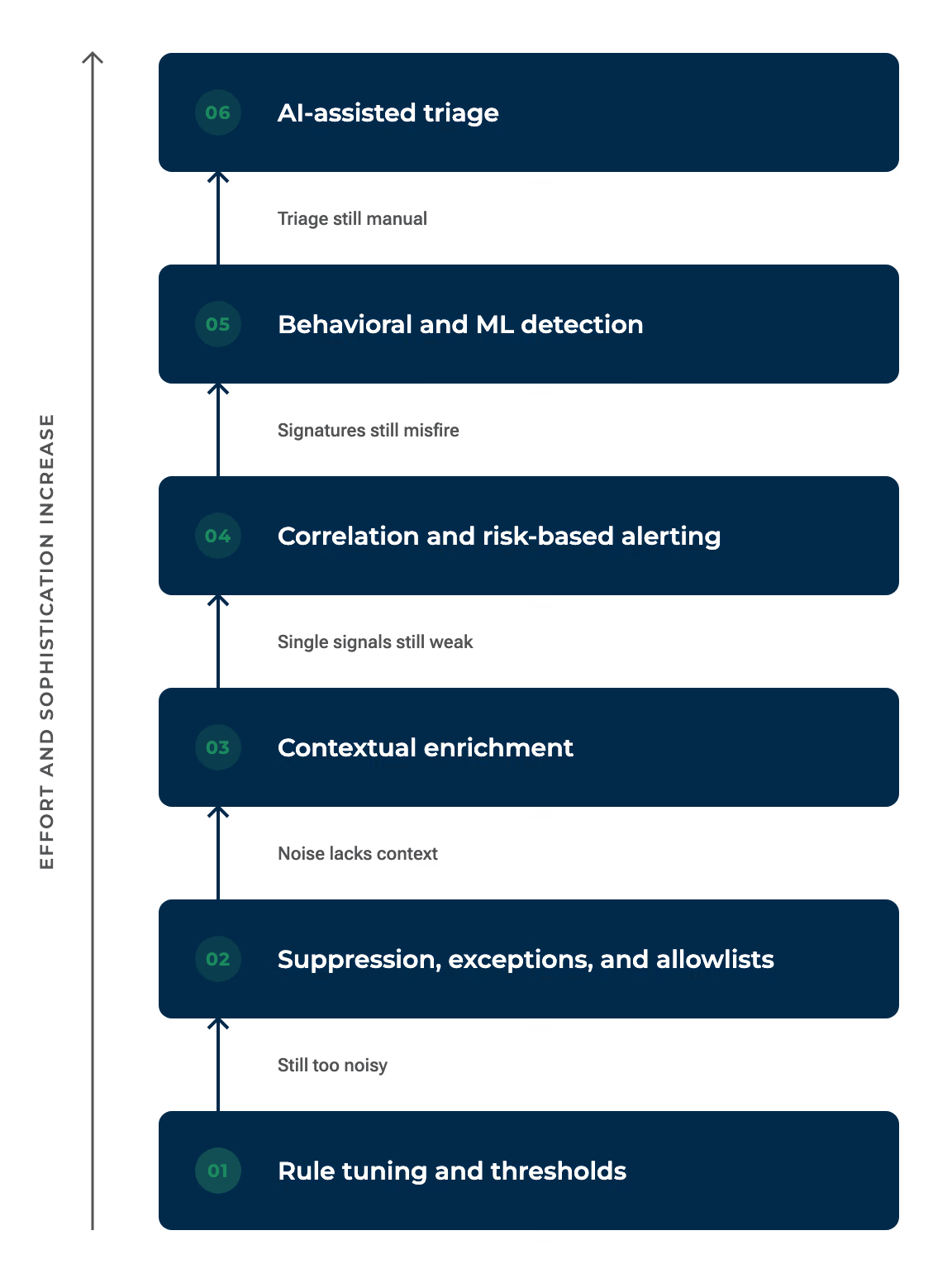
Work the six-rung reduction ladder in order: tuning and suppression are cheap and fast, while behavioral and AI methods change the base-rate math itself.
A false positive is an alert that flags benign activity as malicious. NIST defines it as an instance in which a security tool incorrectly classifies benign content as malicious. In statistical terms it is a type 1 error: accepting the hypothesis that a significant event occurred when none did.
Reducing false positives is therefore two jobs, not one: measuring how often your threat detection pipeline cries wolf, then changing what fires. This guide covers the math, a six-rung reduction ladder, control-by-control tuning, and the governance that keeps the gains.
What is a false positive in cybersecurity?
The definition above is the operational one, from NIST SP 800-83 Rev. 1. NIST maintains five definitions across its publications, and the differences matter. To an analyst, a false positive is a wasted investigation. To a statistician, it is one misclassified event inside an enormous benign population. Both views count, because the second explains why the first never goes away.
False positives, false negatives, true positives, and true negatives
Every alert lands in one of four cells, set by whether the activity was actually malicious and whether the tool alerted. A true positive (TP) is an alert on real attacker behavior, such as an EDR flagging credential theft from memory. A false positive (FP) is an alert on benign activity, such as a SIEM rule flagging an administrator's scheduled backup script. A false negative (FN) is malicious activity that produces no alert, such as an attacker using valid stolen credentials. A true negative (TN) is benign activity that correctly produces nothing, which is nearly everything your environment does. Comparisons of the two error types treat the false negative as the costlier one, and it usually is. The four-outcome quadrant frames the trade-off this whole page manages: every suppression that removes false positives can manufacture false negatives.
The four classification outcomes every alert falls into, each with a cybersecurity example.
Why false positives are mathematically unavoidable
False positives dominate because of the base-rate fallacy: judging alert quality by detector accuracy while ignoring how rare intrusions are. Stefan Axelsson's foundational 1999 base-rate analysis showed that when benign events outnumber intrusions by millions to one, even a highly accurate detector produces an alert stream that is mostly false alarms. A 2022 re-examination, an arXiv preprint, revisited Axelsson's result for non-signature detection and argued that false positives deserve the same depth of analysis true positives already get. The practical consequence: analyst effort cannot fix a noisy detector, because the noise is a property of the math. Every method on this page works by lowering the false alarm rate itself or shrinking the benign base a detector must score.
When intrusions are rare, even an accurate detector fills the queue with false alarms.
What causes false positives
Most false positives trace to six mechanical causes: overly broad rules, missing context at detection time, environment changes that invalidate a baseline, static signatures colliding with legitimate but unusual behavior, over-reliance on a single detection method, and vendor default rules never adapted to the environment. SOC analyst guidance catalogs the same pattern across tools. The striking finding is where noise originates. The 2026 SANS/Anvilogic State of Detection Engineering survey covers 307 practitioners across more than 10 industries, and its published findings report that 66% of false positives originated from vendor-provided rules, steady from 64% in 2025. The problem is not receding either. The 2025 SANS Detection & Response Survey found more than 60% of respondents encounter false positives frequently or very frequently, with "very frequent" rising from 13% to 20% year over year, feeding alert fatigue downstream.
Analyst perception matches. In a 2022 USENIX Security study of SOC analysts, one participant said, "We know 99% of the alarms we generate are false positives, but we still have to look at them." The paper attaches its own caveat: that 99% "is found to be mostly benign triggers and not necessarily a measurement of the performance of the technology itself." It is a perception, not a measured rate.
Cause
Why it fires
Typical control affected
First fix
Overly broad rules
Logic written for a generic environment
SIEM, network sensors
Tune or retire the noisiest rules first
Missing context
No asset, identity, or role data at detection time
SIEM, EDR
Enrich alerts before they fire
Environment drift
Migrations and new applications invalidate baselines
Anomaly-based tools
Re-baseline after every major change
Static signatures
Legitimate but unusual behavior matches a known-bad pattern
Antivirus, EDR
Stage updates, keep known-good allowlists
Single-method detection
One engine's blind spots go uncorrected
Any standalone control
Correlate across sources before alerting
Vendor default rules
Shipped logic never adapted to the environment
SIEM, EDR
Review and adapt defaults before enabling
Six root causes of false positives, the mechanism behind each, and the first corrective step.
False positives can be induced on purpose
Every cause above is accidental. There is now evidence of false positives as a deliberate attacker objective. A 2026 arXiv preprint, not yet peer-reviewed, evaluated passive prompt injection against large language models used for SOC log analysis and named false positive generation as one of four attack objectives. It reported attack success rates up to 88.2% under baseline conditions, with layered defenses achieving a 90.4% attack reduction and 8.4% residual vulnerability. The lesson stays on mechanics: if AI assists your triage, its verdicts can be adversarially steered, so AI-assisted pipelines need the same validation discipline as any other detection layer.
First, the operational SOC false positive rate: FP alerts divided by total alerts, times 100. This is what most teams mean by "our FP rate", and it is computable from triage verdicts recorded during incident investigation.
Second, the statistical false positive rate (FPR): FP divided by (FP + TN). This is the formal rate, and honesty requires saying it is rarely computable in a SOC. A true negative is every benign event that correctly produced no alert, and that denominator is effectively unbounded. Nobody counts the connections that were fine.
Third, precision, also called alert fidelity: TP divided by (TP + FP), the share of fired alerts that were real. Standard references on precision and recall pair it with recall, TP divided by (TP + FN), the share of real activity caught. Track recall too, so the FP versus FN trade-off becomes measurable rather than rhetorical.
Metric
Formula
What it answers
Caveat
Operational false positive rate
FP alerts ÷ total alerts × 100
How much of the queue is noise?
Depends on consistent triage verdicts
Statistical false positive rate (FPR)
FP ÷ (FP + TN)
How often does the detector misfire on benign events?
Rarely computable: TN is effectively unbounded
Precision (alert fidelity)
TP ÷ (TP + FP)
When an alert fires, how often is it real?
Says nothing about missed attacks
Recall
TP ÷ (TP + FN)
How much real activity was caught?
FN is only knowable in hindsight
The four detection quality metrics, the formula for each, and the caveat that bounds it.
What is a good false positive rate?
A 2026 SOC metrics guide puts a world-class false positive rate under 10%. Research on determining an acceptable false positive rate counters that the tolerable number depends on daily event volume and analyst capacity, so no universal benchmark exists. The math sides with the second view. Axelsson's 1999 conclusion was that "the false alarm rate is the limiting factor for the performance of the intrusion detection system" (Axelsson, 1999). A rate that is workable at 200 alerts a day is unworkable at 20,000. Treat under 10% as a practitioner heuristic, set your real target from your own volumes and staffing, and track the trend line. You will not eliminate false positives entirely, and the broader KPI program belongs with your cybersecurity metrics practice, not on this page.
The false positive reduction ladder
Reduction methods stack in a deliberate order, from cheap configuration work to architectural change. Neutral guidance on how to reduce false positive alerts converges on the same progression: tune what you have, add context, then change how detections are generated. Work the rungs in order, because each removes noise the next would otherwise absorb, and the top rungs are where threat detection quality changes structurally.
Tune rules and thresholds against your own environment
Suppress with precision through documented exceptions and allowlists
Enrich alerts with asset, identity, and threat context
Correlate events and alert on risk, not single signals
Shift detection to behavioral baselines and machine learning
Add AI-assisted triage, validated operationally
The six-rung false positive reduction ladder, worked in order from cheap tuning to AI-assisted triage.
Rung 1, rule tuning and thresholds
Start where the noise concentrates: identify the handful of rules producing the most false positives and tune, refine, or retire them first, adjusting thresholds against documented baselines. Given that two thirds of false positives originate in vendor-shipped rules, treat every default rule as a draft. Rule tuning is one rung here, not the page's subject. The rule lifecycle, testing, and detection-as-code belong to detection engineering.
Rung 2, suppression, exceptions, and allowlists
Suppress with surgical precision. Exclude a specific field from a specific rule, or a specific process chain, never a whole rule and never a bare process name. An EDR noise reduction playbook documents the discipline: map every exclusion to the MITRE ATT&CK technique it affects and review quarterly, or exclusions silently become permanent blind spots.
Rung 3, contextual enrichment
Enrich before firing, not after. Asset criticality, identity, user role, network position, and threat-intelligence confidence turn an ambiguous event into a decidable one. The same signature hit means different things on a domain controller and a test server.
Rung 4, correlation and risk-based alerting
Stop alerting per event. Score sequences of related events across sources and alert only when accumulated risk crosses a threshold. This collapses many low-confidence flags into fewer high-confidence detections, reducing noise by design rather than by exception.
Rung 5, behavioral and ML detection
Baselines plus anomaly classification cut signature noise at the source, because alerts fire on deviation from your environment's learned behavior rather than on generic patterns. This is where behavioral analytics, user and entity behavior analytics (UEBA), and network anomaly detection enter as reduction methods. Each has its own page. Here they are rungs, not subjects.
Rung 6, AI-assisted triage
The top rung applies AI threat detection and SOC automation to first-line triage: investigating, deduplicating, and suppressing false positives before an analyst sees them. The honest caveat is that no independently verified reduction percentage exists. A 2026 survey of AI-driven security alert screening, an arXiv preprint synthesizing 119 records including 87 core studies, found persistent gaps in operational validation, adversarial robustness, cross-environment generalization, and evaluation practice. Treat rung 6 as a real method that remains unproven at your scale until validated in your environment.
Reducing false positives control by control
Every control has a different dominant noise source, so the lever that works for EDR will not work for a web application firewall (WAF). The general playbook above applies everywhere. What follows is the control-specific version.
SIEM
Decide what warrants action before you ingest, and ingest only log sources you will act on. Guidance on eliminating SIEM false positives converges on correlation over per-event alerting and on dropping alerts for activity another control already blocked. Review rule performance monthly. Most SIEM noise is an ingestion and rule-scope problem before it is a detection problem.
EDR
Use sensor-visibility exclusions and ML-sensitivity settings deliberately, and suppress on full process chains keyed to hash plus parent plus child, never on a process name alone. Maintain an exception register mapped to ATT&CK techniques, as the EDR playbook cited above prescribes. EDR noise concentrates where admin tooling resembles attacker tradecraft, exactly where sloppy exclusions are most dangerous.
NDR
Network detection and response (NDR) reduces false positives structurally: behavioral baselines, machine learning classification, and multi-engine correlation score activity before a detection is ever generated. Tuning NDR means validating baselines after network changes, not maintaining signature exclusion lists.
XDR
Extended detection and response (XDR) attacks single-signal noise through cross-domain correlation: an endpoint signal corroborated by identity and network evidence carries higher confidence than any signal alone, so fewer, better alerts reach the queue. Track precision per source feed to confirm your XDR correlation is actually raising fidelity.
Email security
Keep allowlists tight and specific, and never allowlist your own domains, since spoofed internal senders are a standard phishing technique. Tune thresholds separately for trusted groups, review the quarantine for miscaught mail, and retire the noisiest rules monthly. Email filtering follows the same tune-suppress-review loop as every other control, applied to sender, content, and authentication signals.
WAF, IDS, and IPS
Run every new WAF or intrusion detection and prevention (IDS/IPS) rule in detect or count mode before it blocks anything. Exclude a specific field from a specific rule, never the rule. Disable rule classes irrelevant to your stack, and inspect encrypted traffic or accept a blind spot. These tools are false positive prone for a structural reason: generic signatures scoring enormous traffic volumes, the exact base-rate setup described earlier. Note that no current NIST IDS/IPS guidance exists. The retired SP 800-94 Rev. 1 draft states "Further development of this draft has ceased (July 15, 2022)", leaving the 2007 SP 800-94 final, now nearly two decades old, as the standing publication.
Application-security scanner false positives (SAST, DAST, SCA, and vulnerability scanning findings) follow a different playbook driven by code context rather than alert context, and cloud control-plane alerts carry cloud security posture context of their own.
Control
Dominant false positive driver
Primary lever
Governance rule
SIEM
Per-event rules on noisy log sources
Correlation and ingest discipline
Review rule performance monthly
EDR
Broad rules colliding with admin tooling
Precise process-chain exclusions
Register and ATT&CK-map every exclusion
NDR
Baseline drift after network changes
Multi-engine scoring before alerting
Re-validate baselines after changes
XDR
Duplicated single-domain signals
Cross-domain correlation
Track precision per source feed
Email security
Over-broad allowlists and stale rules
Tight, specific allowlists
Retire noisy rules monthly
WAF, IDS, and IPS
Generic signatures against legitimate traffic
Detect-mode staging, field-level exclusions
Never exclude an entire rule
Per-control quick reference covering the dominant noise driver, the highest-leverage fix, and one governance rule each.
Governance: sustaining the reduction
Reduction is a loop, not a project. Analysts annotate every closed alert as true positive, false positive, or needs tuning, and that verdict stream, captured during incident investigation, feeds detection engineering to refine logic. Set the cadence and name the owner: noisy-rule review monthly, exception-register review quarterly, re-baselining after major changes. The register is core SOC operations discipline: every suppression documented, mapped to the MITRE ATT&CK technique it affects, and reviewed on schedule, because untracked suppression becomes a permanent blind spot. ATT&CK v18 replaced per-technique Detections with Detection Strategies and Analytics on 2025-10-28, a testable structure for higher-fidelity detections, and v19.1 is the current release. Our analytical reading maps this work to NIST CSF 2.0 subcategories DE.AE-02, DE.AE-03, DE.AE-07, and DE.AE-08, alongside CIS Controls v8 safeguard 13.11 and ISO/IEC 27001:2022 A.8.16.
The trade-off you cannot escape
Over-suppression manufactures false negatives, so the goal is high fidelity, not zero alerts, and where to sit on that curve is a governance decision with a named owner. Two dated cases bracket the failure directions. In April 2010, an antivirus definition update misidentified the legitimate Windows process svchost.exe as malware, pushing Windows XP machines into reboot loops: a false positive acted on at scale, and the timeless argument for staged rollouts and known-good allowlists. The mirror image is dismissing a real intrusion as a false positive. According to an internal incident readout viewed by Nextgov/FCW in July 2026, Department of Homeland Security personnel twice ruled signs of intruders inside the agency's Homeland Security Information Network harmless, and the intruders persisted for weeks. A benign verdict is a claim that needs verification discipline, which is what the annotated feedback loop provides, and skipping it is one way noise hardens into alert fatigue.
Modern approaches to false positive reduction
Industry investment now concentrates on three fronts: behavioral baselining of the kind network detection and response platforms perform, cross-domain correlation, and AI threat detection applied to first-line triage, often inside broader SOC modernization programs. The most useful evaluation question comes from the independent evidence: the 2026 preprint survey of AI-driven alert screening found persistent gaps in operational validation and evaluation practice, so ask any vendor whether reduction claims were validated in an environment like yours, or only on a benchmark. Stated neutrally, the business case holds: the Ponemon Institute's Cost of a Data Breach 2025 study found that security teams using AI and automation extensively shortened breach times by 80 days and lowered average breach costs by USD 1.9 million compared with organizations that did not use them.
How Vectra AI thinks about false positive reduction
Vectra AI reads the evidence on this page as a base-rate argument. If the false alarm rate is the limiting factor in detection performance, as Axelsson showed, the highest-leverage move is not filtering harder downstream but changing what generates an alert in the first place. Behavioral detections scored against attacker-behavior baselines produce fewer, higher-confidence signals than signatures scored across an enormous benign event base, because they shift the math at the source. That is the methodology behind Attack Signal Intelligence: correlate behaviors across network, identity, and cloud into scored, prioritized detections, and put triage ahead of the analyst rather than behind them. Noise is treated as a design flaw to engineer out, not a queue to absorb.
False positive reduction, in the end, is measurement plus method plus governance. Measure precision, climb the ladder in order, tune each control against its own dominant noise source, and register every exception. The reward is the one thing every figure on this page points toward: an alert queue your analysts can trust.
FAQs
What is the difference between a false positive and a false negative?
A false positive is benign activity wrongly flagged as malicious, wasting analyst time. A false negative is malicious activity that produces no alert, leaving an attack undetected. Tuning trades one against the other, so track precision and recall together.
What is a good / acceptable false positive rate for a SOC?
Practitioner benchmarks put world-class SOC false positive rates under 10% (2026), but no universal number exists. Acceptable rates depend on daily event volume and analyst capacity, so set targets from your own baseline and track the trend.
How can machine learning help cut false positives?
Machine learning learns environment-specific baselines so alerts fire on meaningful deviations rather than static signatures, and it scores event sequences to suppress low-confidence noise. Behavioral analytics applies this at the source. Validate any model operationally before trusting it.
What is detection engineering and how does it reduce noise?
Detection engineering treats detection rules as engineered software: versioned, tested against known behaviors, deployed gradually, and measured in production. It reduces noise by catching broad or broken logic before deployment. See detection engineering for the full lifecycle.
How often should detection rules be tuned?
Continuously, on a defined cadence: review the noisiest rules monthly, review every suppression and allowlist quarterly, and re-baseline after major environment changes. Name one owner for the loop, and treat untouched vendor-default rules as standing tuning candidates.
What is alert fidelity / precision in a SOC?
Alert fidelity, formally precision, is the share of fired alerts that turn out to be real threats: true positives divided by all alerts. It predicts analyst trust in the queue better than raw alert volume does.