Ransomware caused an estimated $57 billion in global damages in 2025, with 85 active groups representing a record-high fragmentation of the threat landscape (Check Point Research, 2025)
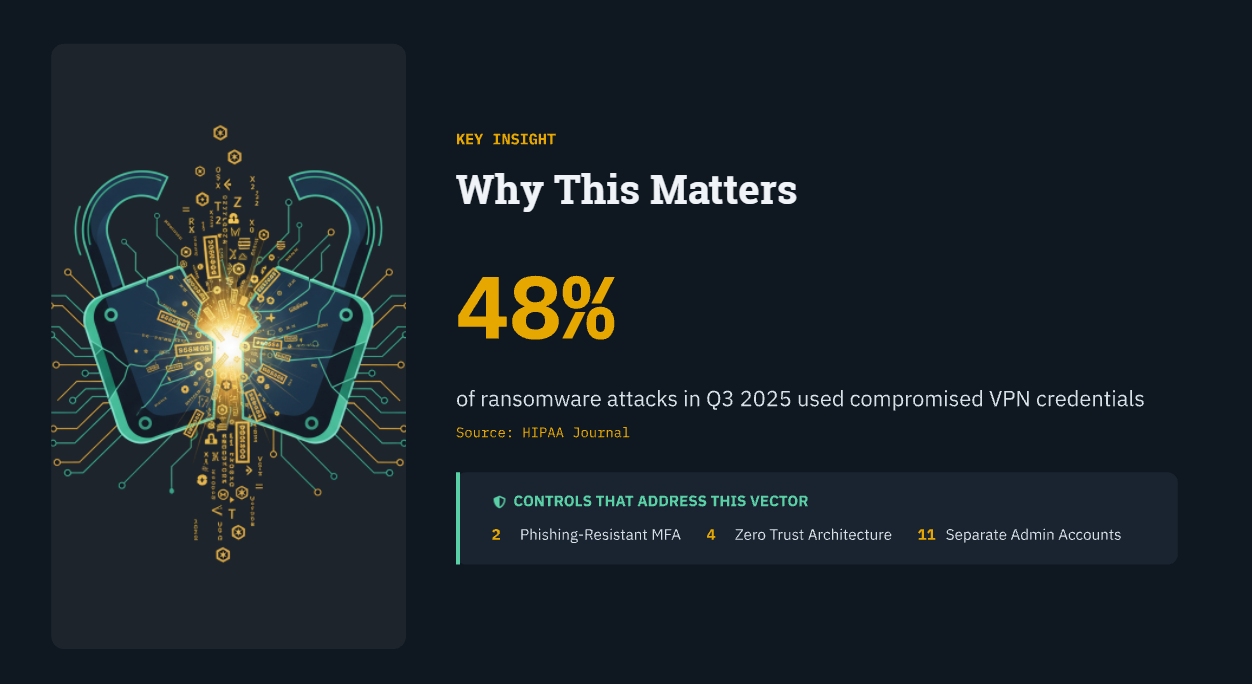
Compromised VPN credentials now account for 48% of ransomware attacks, making identity-based initial access the dominant entry vector (HIPAA Journal, Q3 2025)
Data exfiltration occurs in 76% of ransomware incidents before encryption begins, making every ransomware attack effectively a data breach (Deepstrike, 2025)
Recovery times have improved dramatically — 56% of organizations now recover within one week, compared to 33% the year prior (Sophos, 2025)
The FBI recommends against paying ransoms, as only 46% of paying victims recover their data and 80% experience subsequent attacks (CSO Online, 2025)
In Q3 2025, 85 ransomware groups operated simultaneously, the highest count ever recorded, while damages reached $57 billion globally (Check Point Research, 2025; Cybersecurity Ventures, 2025). In March 2026 alone, three groups, Qilin, Akira, and DragonForce, accounted for 40% of 672 recorded incidents in a single month (Infosecurity Magazine, 2026).
This guide provides security professionals, SOC analysts, and CISOs with current intelligence on how ransomware works, which threat actors pose the greatest risk, and what defensive measures actually reduce exposure. Whether you are building detection capabilities, refining incident response procedures, or briefing leadership on organizational risk, the information here reflects threat research and defensive best practices from the FBI, CISA, and MITRE ATT&CK.
What is ransomware?
Ransomware is a type of malicious software that encrypts files on a victim's device or network and demands a ransom payment, typically in cryptocurrency — to restore access. According to the FBI, ransomware prevents access to computer files, systems, or networks until payment is made.
CISA defines ransomware as malware that encrypts files on a device, rendering the files and the systems that depend on them unusable. The operational consequence goes beyond locked files, ransomware disrupts the business processes that depend on that data.
According to Cybersecurity Ventures, global ransomware damages reached $57 billion in 2025, approximately $156 million per day. These costs extend far beyond ransom payments to include business disruption, recovery expenses, reputational damage, and regulatory penalties.
Modern ransomware operators conduct reconnaissance, establish persistence, and exfiltrate sensitive data before deploying encryption. This transforms each ransomware incident into a potential data breach with long-term consequences for affected organizations.
How ransomware differs from other malware
Ransomware differs from other malware primarily because it makes itself known to the victim. While spyware, trojans, and viruses typically operate covertly, stealing data, establishing backdoor access, or corrupting files without announcement, ransomware demands payment through explicit ransom notes. This visibility is deliberate: the cyberattack must be recognized before the victim can be pressured to pay.
Each malware type differs in purpose, visibility, and how attackers profit from it.
Malware Type
Primary Purpose
Visibility
Financial Model
Ransomware
Extortion via encryption
Explicit (ransom demand)
Direct payment demand
Spyware
Data theft
Hidden
Indirect (data sales)
Trojans
Remote access
Hidden
Varies
Worms
Self-propagation
Often visible
Varies
Viruses
File corruption
Often visible
Varies
Financial incentive drives constant adaptation, the shift from phishing-dominated entry in 2023 to compromised VPN credentials accounting for 48% of attacks by Q3 2025 shows how quickly operators change methods when defenders close one vector.
How ransomware works
Modern ransomware attacks follow a five-stage sequence, and defenders can disrupt each one. Mapping detection controls to each stage is what separates organizations that catch attackers before encryption from those that discover the damage after.
The typical ransomware attack progresses through five stages:
Initial access — attackers gain entry through phishing, compromised credentials, or exploited vulnerabilities
Lateral movement — malware spreads across the network while harvesting additional credentials
Privilege escalation — attackers obtain administrative access to maximize impact
Data exfiltration — sensitive information is stolen before encryption for double extortion leverage
Encryption and ransom demand — files are encrypted and victims receive payment instructions
Each stage maps to a distinct detection opportunity, and a distinct failure point.
Ransomware attack vectors and initial access
According to HIPAA Journal, compromised VPN credentials accounted for 48% of ransomware attacks in Q3 2025, up from 38% in Q2. This represents a fundamental change from earlier years when phishing dominated initial access.
Credential-based entry has overtaken phishing, exploitation, and every other ransomware delivery method
Initial Access Vector
Q3 2025 Share
Trend
Compromised VPN credentials
48%
Increasing
Exploitation of external services
23%
Stable
Phishing and social engineering
~15%
Decreasing
Compromised RDP credentials
~6%
Stable
Supply chain attacks
~6%
Increasing
The shift reflects both the widespread availability of stolen credentials on criminal marketplaces and the effectiveness of initial access brokers, specialists who compromise systems and sell access to ransomware operators. These brokers use infostealers to harvest credentials at scale.
External service exploitation accounts for another 23% of attacks, with recent campaigns targeting vulnerabilities in VPN appliances (CVE-2024-40766 in SonicWall), Citrix NetScaler devices (CVE-2025-5777), and enterprise software like Oracle E-Business Suite (CVE-2025-61882).
Lateral movement and data exfiltration
Once inside a network, ransomware operators begin moving laterally within 48 minutes on average. The fastest observed cases show full network propagation in just 18 minutes (Vectra AI research). Defenders have less than an hour, sometimes less than 20 minutes, to detect and contain the spread before the attacker controls the environment.
Attackers use legitimate administrative tools and credentials to move laterally, making their activity difficult to distinguish from normal network operations without behavioral analysis.
According to Deepstrike, 76% of 2025 ransomware attacks involved data exfiltration before encryption, making nearly every ransomware incident a data breach by the time encryption begins. This enables double extortion: even if victims restore from backups, attackers threaten to publish stolen data.
Common tools observed in the exfiltration phase include:
MITRE ATT&CK catalogs the specific techniques ransomware operators use, from credential abuse (T1078) to encryption for impact (T1486). The primary ransomware technique is T1486, Data Encrypted for Impact, categorized under the Impact tactic.
Six techniques appear in the majority of ransomware operations, spanning from initial credential abuse through defense evasion to final encryption.
Technique ID
Name
Tactic
Ransomware Relevance
T1486
Data Encrypted for Impact
Impact
Primary ransomware technique
T1078
Valid Accounts
Initial Access, Persistence
Credential abuse for entry
T1021
Remote Services
Lateral Movement
RDP, SMB for spreading
T1003
OS Credential Dumping
Credential Access
Privilege escalation
T1059
Command and Scripting Interpreter
Execution
Payload deployment
T1562
Impair Defenses
Defense Evasion
EDR killer tools
Over 70 ransomware families are mapped to specific ATT&CK techniques. Running this mapping against deployed detections reveals exactly where coverage exists and where it does not, a process that enables focused threat hunting against known gaps.
Types of ransomware
Ransomware now comes in several distinct categories, each with different encryption methods, extortion tactics, and business models.
Encrypting ransomware vs. locker ransomware
Ransomware splits into two primary categories: encrypting ransomware (crypto-ransomware) and locker ransomware.
Encrypting ransomware encrypts individual files and data on infected devices. According to Keeper Security, victims can still use their devices but cannot access encrypted files without the decryption key. Modern encrypting ransomware uses strong encryption algorithms including AES-256, ChaCha20, and RSA-2048 that are computationally infeasible to break.
Locker ransomware (screen lockers) takes a different approach, locking users out of their entire systems rather than encrypting individual files. According to Check Point, locker variants prevent any access to the device until payment is made. While locker ransomware was more common in ransomware's early history, encrypting ransomware dominates today due to its greater impact and harder recovery path.
Recovery, response, and backup strategies differ significantly between the two.
Type
What It Does
User Can Still...
Recovery Without Payment
Crypto-ransomware
Encrypts files
Use device, access unencrypted data
Restore from backups
Locker ransomware
Locks entire system
Nothing
Reimage system
Double and triple extortion ransomware
Most ransomware attacks now combine encryption with data theft, and some add DDoS attacks and third-party threats on top.
Double extortion ransomware combines data encryption with data theft. Attackers first exfiltrate sensitive information, then encrypt systems. If victims restore from backups without paying, attackers threaten to publish or sell the stolen data. According to Arctic Wolf, 96% of ransomware incident response cases in 2025 involved data exfiltration, making double extortion the norm rather than the exception.
Triple extortion ransomware adds additional pressure tactics beyond encryption and data theft:
Threatening to contact the victim's customers, partners, or patients about the breach
Launching DDoS attacks against the victim's infrastructure
Targeting third parties with extortion demands based on stolen data
The result is overlapping harm, operational disruption from encryption, breach notification obligations from exfiltration, and reputational damage from public leak threats, all applied simultaneously.
What is ransomware-as-a-service (RaaS)?
According to IBM, ransomware-as-a-service (RaaS) is a business model where ransomware developers sell or lease their malware to affiliates who conduct the actual attacks. The model has industrialized ransomware, turning it from a technical crime into a franchise operation.
RaaS operators provide affiliates with:
Ready-to-deploy ransomware payloads
Administrative panels for victim management
Payment processing infrastructure
Negotiation support and victim communication tools
Technical support and updates
In exchange, affiliates share ransom proceeds with the RaaS operators. According to Flashpoint, typical affiliate revenue shares range from 70–85% of ransom payments, with Qilin offering an industry-leading 85% share to attract affiliates.
Criminals with no technical expertise can now deploy professional-grade ransomware, which is why the number of active groups hit 85 in Q3 2025.
The ransomware threat landscape
A record 85 ransomware groups operated simultaneously in Q3 2025. Between January and September, 4,701 incidents were recorded globally, a 46% increase over the same period in 2024. The fragmentation follows law enforcement disruptions of major groups and reflects the ease with which new groups can launch using RaaS infrastructure.
In March 2026 alone, 672 ransomware incidents were reported, with just three groups (Qilin, Akira, and DragonForce) responsible for 40% of the total.
Most active ransomware groups in 2025
Group
Status
2025 Activity
Notable Characteristics
Qilin
#1 most active
75+ victims/month
85% affiliate share; supply chain focus
Akira
Top 3
$244.17M in proceeds
Targets SMBs and critical infrastructure
Medusa
Active
300+ victims (as of Feb 2025)
Critical infrastructure targeting
DragonForce
Rising
Growing rapidly
Low profit-share requirements
LockBit 5.0
Re-emerged (Sept 2025)
15+ victims post-relaunch
Recovering from law enforcement action
RansomHub
INACTIVE (April 2025)
Ceased operations
Affiliates migrated to other groups
Qilin emerged as the dominant ransomware group, processing over 75 victims monthly by Q3 2025. The group's 85% affiliate revenue share, higher than competitors, has attracted skilled affiliates from disbanded operations. Notably, North Korean threat actors deployed Qilin payloads in March 2025, indicating nation-state collaboration with criminal ransomware operations.
Akira accumulated $244.17 million in proceeds as of late September 2025, according to CISA advisories. The group targets SMBs and critical infrastructure across manufacturing, education, IT, healthcare, and financial services.
LockBit re-emerged with version 5.0 in September 2025 despite significant law enforcement pressure including Operation Cronos. While diminished from its peak, the group's persistence demonstrates the resilience of well-established RaaS operations.
High-profile case studies
Change Healthcare (2024–2025): The ALPHV/BlackCat attack on Change Healthcare represents the largest healthcare data breach in U.S. history. According to AHA, approximately 192.7 million individuals were affected, with total costs estimated at $3 billion. The root cause was compromised credentials for a Citrix server without multi-factor authentication, a basic security control failure with catastrophic consequences.
Qilin "Korean Leaks" Campaign (September 2025): According to The Hacker News, Qilin compromised a single managed service provider (GJTec) and used that access to attack 28 downstream organizations, including 24 in South Korea's financial sector. Over 1 million files and 2TB of data were exfiltrated. This supply chain attack demonstrates how a single MSP compromise can amplify ransomware impact exponentially.
Clop Oracle EBS Campaign (November 2025): According to Z2Data, the Clop ransomware group exploited CVE-2025-61882 (CVSS 9.8) in Oracle E-Business Suite to compromise over 100 companies including Broadcom, Estee Lauder, Mazda, Canon, Allianz UK, and the Washington Post. The campaign followed the same mass-exploitation playbook Clop used against MOVEit in 2023, same group, same tactic, different vulnerability.
Industry impact statistics
Healthcare was the top ransomware target in 2025, with 460 attacks and 182 data breaches reported to the FBI, a combined 642 cyber events (IC3 2025 Annual Report, published April 2026). Financial services was the second-highest sector at 447 total events.
The concentration of attacks on specific industries reflects both the value of the data they hold and the operational pressure that makes victims more likely to pay.
Sector
2025 attack share
Year-over-year change
Key statistics
Healthcare
#1 targeted (FBI IC3 2025)
Increasing
642 total cyber events; 88 distinct threat groups targeting sector
Manufacturing
26% of listed victims
+61%
23.1% of insurance claims
Education
180 attacks (Q1–Q3 2025)
+69% in Q1
4,388 attacks/week in Q2
Financial services
#2 targeted (FBI IC3 2025)
Stable
447 total cyber events; 15.4% of insurance claims
According to Verizon DBIR analysis, 88% of data breaches at SMBs involve ransomware, compared to 39% for large organizations. Without dedicated security resources and incident response capabilities, 60% of attacked small businesses close within six months.
Three distinct control layers, prevention, detection, and response, separate organizations that recover from ransomware from those that do not. Prevention is the cheapest layer. Detection and response determine the outcome once an attacker is already inside.
12 essential ransomware prevention controls
CISA's #StopRansomware Guide defines the baseline controls every organization should deploy. These 12 controls address the most common attack vectors and reduce exposure across the ransomware kill chain.
Priority controls (implement immediately):
Prioritize remediating known exploited vulnerabilities focus on CISA KEV catalog entries
Enable and enforce phishing-resistant multi-factor authentication on all external-facing services
Maintain regular offline, encrypted backups and test restoration procedures
Additional technical controls:
Implement zero trust architecture principles for network access
Segment networks to limit lateral movement opportunities
Disable SMBv1 and upgrade to SMBv3 with encryption
Centralize logging with SIEM and minimum 12-month retention
Restrict PowerShell execution via group policy
Deploy EDR, NDR, or XDR solutions with real-time detection capabilities
Enforce passwords of at least 15 characters
Separate administrative accounts from daily-use accounts
The 48% share of attacks using compromised VPN credentials makes three actions urgent: audit VPN configurations, enforce MFA on all remote access, and evaluate zero-trust network access as a VPN replacement.
Backup strategy for ransomware resilience
The 3-2-1-1-0 backup rule, as detailed by Veeam, provides ransomware-resilient data protection:
3 copies of data (primary plus two backups)
2 different storage media types
1 copy offsite
1 copy immutable or air-gapped
0 errors after verification testing
Immutable storage converts backups to write-once, read-many (WORM) format that cannot be overwritten, changed, or deleted, even by administrators with full credentials. This protects against ransomware that specifically targets backup systems.
Untested backups are not backups. Verifying restoration procedures at least quarterly — and documenting actual recovery times against stated objectives, is the difference between a backup that works and one that merely exists.
Ransomware detection indicators
Every stage of the ransomware attack chain produces network artifacts that signature-based tools miss. Network detection and response reveals the lateral movement, exfiltration, and command and control traffic that endpoint agents never see.
Precursor malware to monitor:
Bumblebee, Dridex, Emotet, QakBot, and Anchor loaders often precede ransomware deployment
Detection of these threats should trigger immediate investigation
Network indicators of ransomware activity:
Abnormal data outbound on any port (exfiltration)
Tools like Rclone, Rsync, FTP/SFTP moving large data volumes
C2 callbacks to unknown infrastructure
Lateral movement patterns (unusual authentication, service account abuse)
DNS tunneling attempts
ARP spoofing activity
When a service account authenticates at 3 AM, an admin session transfers 40 GB to an external host, or a user accesses file shares they have never touched, those deviations are the signal.
If your organization is hit by ransomware, CISA provides immediate response guidance:
Isolate immediately — disconnect affected systems from the network to prevent spread
Do NOT restart or reboot — this may trigger additional harm or destroy forensic evidence
Secure backups — disconnect backup systems to prevent encryption
Document everything — screenshot ransom notes and preserve system state
Assess scope — determine which systems are affected and the extent of encryption
Contact authorities — notify FBI, CISA, and local law enforcement
Check for free decryptors — the No More Ransom Project provides free decryption tools for 100+ ransomware families
Acting within the first hour determines whether the attack stays contained to one segment or spreads across the network.
According to Sophos, 56% of organizations recovered within one week in 2025 — up from 33% in 2024. The gap between organizations that recover in days and those that take months is narrowing.
Recovery timeframe
2025
2024
Change
Within one day
16%
7%
+9 points
Within one week
56%
33%
+23 points
One to six months
11%
31%
-20 points
Should you pay a ransomware ransom?
The FBI and CISA recommend against paying ransoms. The data supports this position:
Only 46% of organizations that pay ransoms successfully recover their data (CSO Online)
93% of paying victims still had their data stolen and potentially exposed
Approximately 80% of organizations that paid experienced subsequent attacks
Payment funds criminal enterprises and incentivizes future attacks
Victim behavior reflects this guidance. According to Sophos, 63% of ransomware victims refused to pay in 2025, up from 59% in 2024. Meanwhile, 97% of organizations successfully recovered their data through backups or other means, demonstrating that payment is not necessary for recovery.
If you are considering payment, legal counsel and law enforcement engagement should precede any decision. Some payments may violate sanctions regulations, and authorities may have intelligence about the specific threat actor that changes the calculus.
Ransomware compliance and regulatory requirements
NIS2, NIST IR 8374, and proposed UK legislation now mandate ransomware-specific controls and incident reporting timelines. Mapping existing controls to these framework requirements, and generating audit-ready evidence, is an operational necessity, not a governance exercise.
Framework mapping
NIST IR 8374 — Ransomware Risk Management Profile: This NIST publication applies the Cybersecurity Framework's five core functions (Identify, Protect, Detect, Respond, Recover) specifically to ransomware risk. Updated for CSF 2.0 in January 2025, it provides actionable guidance aligned with ISO/IEC 27001:2013 and NIST SP 800-53 Rev. 5.
MITRE ATT&CK Framework: Version 18 of ATT&CK (October 2025) documents over 70 ransomware families and their techniques. Organizations can use ATT&CK to validate detection coverage against known ransomware behaviors and identify capability gaps.
NIS2 Directive (EU): The NIS2 Directive requires essential and important entities across 18 critical sectors to implement ransomware-specific controls. Key requirements include 24-hour early warning for significant incidents and penalties up to EUR 10 million or 2% of global revenue for non-compliance
The average ransomware insurance claim reached $1.18 million in 2025, a 17% increase year-over-year (Resilience, 2025). Ransomware accounts for 76% of incurred losses despite representing 56% of claims.
Insurers denied approximately 40% of cyber insurance claims in 2024, often citing "failure to maintain security" exclusions (HIPAA Journal). They are scrutinizing vulnerability management, practices, MFA deployment, and backup procedures when evaluating claims.
An emerging concern: the Interlock ransomware group has been observed stealing cyber insurance policies from victims to benchmark ransom demands against coverage limits. When attackers know your coverage ceiling, adequate insurance without corresponding security improvements becomes a liability.
How Vectra AI detects ransomware
Vectra AI approaches ransomware defense through Attack Signal Intelligence, detecting attacker behaviors across the entire attack chain rather than relying on signatures or known indicators. By analyzing network traffic, cloud activity, and identity signals, the platform identifies lateral movement, privilege escalation, and data exfiltration patterns that precede ransomware deployment.
The "Assume Compromise" model starts from the premise that preventive controls will fail, and focuses detection on what happens after initial access. The window between initial access and encryption, often as little as 18 minutes, is where behavioral threat detection catches what signatures miss.
AI-driven detection identifies novel ransomware behaviors without requiring prior knowledge of specific variants. When attackers develop new evasion techniques, behavioral analysis continues to flag the underlying patterns, credential abuse, unusual data access, lateral connection attempts, that remain consistent across campaigns.
Without visibility across identity, cloud, and network layers, attackers reach the encryption stage undetected.
Where most ransomware defenses fall short
Ransomware groups reorganize within weeks of law enforcement disruption, shift attack vectors within quarters, and adopt new extortion tactics within months. Organizations that implement MFA, maintain tested immutable backups, segment networks, and deploy behavioral detection recover faster and avoid paying ransoms.
The path forward starts with honest assessment:
Do you have continuous visibility into lateral movement across your hybrid environment?
Can your current tools detect credential abuse and privilege escalation before encryption begins?
Are your backups truly immutable — and have you tested restoration within the last 90 days?
Do you know which MITRE ATT&CK techniques your detection stack covers and where the gaps are?
Can you demonstrate compliance readiness with evidence, not documentation alone?
Ransomware in 2025 represents a mature, sophisticated, and highly fragmented threat that no organization can afford to ignore. With 85 active groups, $57 billion in global damages, and attacks that routinely combine encryption with data theft, the stakes have never been higher.
The data shows that prevention and preparation work. Organizations that implement MFA, maintain tested immutable backups, and segment their networks recover faster and avoid paying ransoms. Those that invest in detection capabilities — particularly network-based behavioral analysis — catch attackers before encryption begins.
The path forward requires continuous evolution. As ransomware operators develop new techniques and exploit new vulnerabilities, defenders must adapt. Regular testing of detection coverage against the MITRE ATT&CK framework, ongoing security awareness training, and quarterly backup restoration tests provide the foundation for resilient operations.
For organizations seeking to strengthen their ransomware defenses, Vectra AI's approach to Attack Signal Intelligence provides detection across the entire attack chain — identifying the behaviors that precede ransomware deployment regardless of specific malware variants or evasion techniques.
Sources and methodology
Statistics and threat intelligence cited in this guide are drawn from the following sources:
FBI IC3 2025 Annual Report (published April 2026) — sector-level ransomware attack data
Check Point Research, Q3 2025 — active ransomware group counts and attack volumes
Infosecurity Magazine, April 2026 — March 2026 incident volumes and group attribution
HIPAA Journal, Q3 2025 — initial access vector distribution
Sophos State of Ransomware 2025 — recovery times, payment rates, victim behavior
Cybersecurity Ventures, 2025 — global damage projections
Flashpoint, 2025 — RaaS affiliate revenue share data
CISA #StopRansomware Guide — prevention controls and incident response guidance
MITRE ATT&CK v18 (October 2025) — technique mapping and ransomware family documentation
NIST IR 8374 (updated January 2025) — ransomware risk management profile
Named incidents (Change Healthcare, Qilin Korean Leaks, Clop Oracle EBS) are sourced from AHA, The Hacker News, and Z2Data respectively.
FAQs
What is ransomware in simple terms?
Ransomware is malicious software that locks your files by encrypting them, then demands payment — usually in cryptocurrency — to unlock them. According to the FBI, it is one of the most financially damaging forms of cyberattack, costing organizations an average of $5.5–6 million per incident. The attackers provide a ransom note with payment instructions and a deadline. If you pay, they claim they will provide a decryption key — though recovery is not guaranteed. Modern ransomware also steals your data before encrypting it, threatening to publish sensitive information if you do not pay even after restoring from backups.
How does ransomware get on your computer?
In Q3 2025, compromised VPN credentials accounted for 48% of ransomware attacks (HIPAA Journal). Phishing emails with malicious attachments or links remain a primary vector. Exploitation of unpatched vulnerabilities in internet-facing systems — particularly VPN appliances, Citrix devices, and enterprise software — provides another entry point. Supply chain attacks through managed service providers or software vendors can compromise multiple organizations simultaneously. Once attackers gain initial access, they typically spend days or weeks moving through the network and stealing data before deploying encryption.
Should you pay the ransom?
The FBI and CISA recommend against paying ransoms. The statistics support this guidance: only 46% of organizations that pay successfully recover their data, while 80% of payers experience subsequent attacks. In 2025, 63% of ransomware victims refused to pay — and 97% of organizations recovered their data through backups or other means. Paying ransoms funds criminal enterprises and incentivizes future attacks. If you are considering payment, consult legal counsel and engage law enforcement first. Some payments may violate sanctions regulations, and authorities may have intelligence that affects your decision.
What should you do if you are hit by ransomware?
Immediately isolate affected systems by disconnecting them from the network to prevent further spread. Do not restart or reboot systems — this may trigger additional damage or destroy forensic evidence. Secure and disconnect backup systems to protect them from encryption. Document everything by taking screenshots of ransom notes and preserving system state. Assess the scope of the attack to understand which systems are affected. Contact the FBI, CISA, or local law enforcement. Before considering payment, check the No More Ransom Project for free decryption tools — they have decryptors for over 100 ransomware families.
How can you protect against ransomware?
Phishing-resistant MFA on all external-facing services and remote access points is the single highest-impact control. Maintain offline and immutable backups following the 3-2-1-1-0 rule detailed by Veeam. Patch known exploited vulnerabilities promptly — prioritize entries in the CISA Known Exploited Vulnerabilities catalog. Implement network segmentation to limit lateral movement. Deploy EDR, NDR, or XDR solutions with real-time detection capabilities. Separate administrative accounts from daily-use accounts and enforce passwords of at least 15 characters. Consider zero trust network access as a VPN replacement, given that compromised VPN credentials account for 48% of attacks.
What is double extortion ransomware?
Double extortion ransomware combines traditional file encryption with data theft. Attackers first exfiltrate sensitive data from your network, then encrypt systems and demand payment. If victims restore from backups without paying, attackers threaten to publish or sell the stolen data on leak sites. According to Arctic Wolf, 96% of ransomware incident response cases in 2025 involved data exfiltration — making double extortion the standard operating model. Even organizations with excellent backup practices face significant pressure to pay, because data exposure triggers regulatory penalties, reputational damage, and competitive harm.
Who is behind ransomware attacks?
Organized cybercriminal groups running ransomware-as-a-service (RaaS) platforms carry out most ransomware attacks today. According to Check Point Research, 85 distinct ransomware groups were active in Q3 2025. The most active include Qilin (75+ victims monthly, 85% affiliate revenue share), Akira ($244 million in proceeds), Medusa (300+ victims across critical infrastructure), and DragonForce (rising due to low profit-share requirements). Some groups have ties to nation-states — North Korean hackers deployed Qilin ransomware in March 2025, indicating collaboration between state actors and criminal organizations. Initial access brokers specialize in breaching systems and selling access to ransomware operators, further industrializing the ecosystem.
How do I know if I have ransomware?
The most obvious indicator is a ransom note displayed on screen — a text file, HTML page, or desktop wallpaper with payment instructions and a deadline. Other signs include files that suddenly cannot be opened or have unfamiliar extensions appended to their names, unusually slow system performance, and antivirus software that has been disabled without explanation. In enterprise environments, security teams may observe mass file modification events, unexpected encryption processes consuming CPU and disk resources, or C2 traffic to unknown external addresses. If you suspect ransomware, isolate the affected system immediately and do not restart it — rebooting may trigger additional encryption or destroy forensic evidence needed for investigation.
Can you remove ransomware?
Ransomware removal involves isolating infected devices, identifying the specific ransomware strain, and eliminating malicious files. While antivirus tools or professional incident response teams can assist with removal, removing the malware alone does not decrypt locked data. Recovery depends on the ransomware type, the availability of backups or decryption keys, and whether the encryption can be reversed. The No More Ransom Project provides free decryption tools for over 100 ransomware families — always check this resource before considering payment. For enterprise environments, engaging a professional incident response team is recommended to ensure complete removal, prevent re-infection, and preserve forensic evidence for law enforcement and insurance purposes.